

Managing Member @OvisCapital
San Francisco Bay Area
Joined August 2012
- Tweets867
- Following47
- Followers698
- Likes342







If banks sell data centers debt 80c on the dollar then this funding source is shut. If neocloud debt is yielding high teens, that’s shut too.
How will the 2027 $1.4 trillion of data center investments be funded?
teapaw.org/deitaone/status/212561…

$CRWV - COREWEAVE BONDS PLUNGE AS 2031 YIELD SURGES TO 17.91%
CoreWeave's debt is coming under renewed selling pressure, with bond prices falling sharply amid growing concerns over AI infrastructure financing.
According to Tradeweb data:
🔸 October 2031 bonds: Down 1.92 cents to 74.23 cents on the dollar, yielding 17.91%.
🔸 June 2030 bonds: Down 3.79 cents to a record low of 76.55 cents on the dollar.
The sharp decline in bond prices highlights mounting credit concerns as investors reassess the risks of debt-funded AI expansion.
1
4
697
Watching big tech spend ~$1T (3% of GDP) on capex this year, with estimates growing to $1.35T (4% of GDP) next year, I keep checking what the guys on the other side think. So I follow the a16z podcast.
For months, the argument has been that AI isn't in a bubble because demand for compute is insatiable.
In this episode, the argument took an interesting turn: even if some of the companies building the infrastructure go bankrupt, the equipment will still be there, and someone else will own it.
That's quite a concession.
music.amazon.com/podcasts/77…

1
2
335
This is a big change, because it essentially closes the debt market.
Since hyperscalers now have negative cash flows, growth can be funded with either debt or equity.
Debt seems to be closing (or very expensive) and equity is also semi-closed at this time with NASDAQ negative year to date.
Yes, it can all change in a minute, but it's the first time folks on the other side are using the B word.
1
73
My AI tells me that 40 years later this still holds true: a 10% decline every other year and a 20% decline every 6 years.
Historically, times like this turn out to be great for bargain hunting


“About once every two years the market falls 10%. Every six years the market’s going to have a 25% decline. That’s all you need to know. You need to know that the market’s going to go down sometimes. If you’re not ready for that, you shouldn’t own stocks.” – Peter Lynch
3
156
1/4
$ANT went public today. One of the most important factors determining its long-term success will be pricing power.
Selling an amazing / world changing technology doesn't necessarily mean the economic benefits stay with its inventor. It rarely does.
One of the most revealing episodes came from the OpenAI $200 subscription September 2026 debacle:
3/4
OpenAI tried to give subscribers half as much for the same $200. Instead, subscribers ended up keeping their previous allowance, plus additional benefits.
Think about what that says about pricing power.
There are at least five heavily funded frontier labs, each of which believes it cannot afford to fall behind. And then there are the increasingly capable Chinese open-weight models.
1
103
4/4
AI may turn out to be the most transformative technology of our lifetimes. That doesn't mean its creators will capture most of the economic value.
For $ANT shareholders, understanding who captures the economic value may be the key question
1
1
103
How good is this book? I read it twice.
It’s been released 2 weeks ago
a.co/d/045L9Uru

4
247
Ok, good, this turned out to have been just a PR stunt to help AI doomers relax while still working full steam ahead.
We might just be lucky enough to be living in a once-in-a-millennia renaissance
teapaw.org/openai/status/21075967…

Apparently even in the age of AI, science advances one funeral at a time.
That’s a shame, we could have had a scientific renaissance but now advances will have to wait for a committee approval.
If we get 4-5 frontier labs instead of 2, I wonder if there wouldn’t be more urgency.
Would Musk let Grok sit on proofs to 100 year old math questions, waiting for a committee?
2
167
The old convention in banking is that the moat is in cheap deposits. We saw one risk of that with the 2023 banking crisis (borrow short / lend long).
A second risk is coming with AI agents.
A higher yielding loan business is becoming more valuable than a lower yielding deposit franchise

We are going to learn how many systems only work today because they are built around friction that will no longer exist soon.
2
5
471
Apparently even in the age of AI, science advances one funeral at a time.
That’s a shame, we could have had a scientific renaissance but now advances will have to wait for a committee approval.
If we get 4-5 frontier labs instead of 2, I wonder if there wouldn’t be more urgency.
Would Musk let Grok sit on proofs to 100 year old math questions, waiting for a committee?

We’re working with an independent advisory group of mathematicians to help OpenAI responsibly share advances in AI and mathematics.
The group will advise on how we assess and communicate new mathematical results, uphold academic and professional standards, and build tools that support mathematical research and learning.
Through this work, we want mathematicians to be at the center of shaping how AI supports mathematical understanding and how its benefits reach the wider community.
openai.com/index/advisory-gr…

theverge.com/tech/998078/ama…
Why did Amazon block Meta's AI agent Muse from shopping on Amazon.com?
Because AI agents do not use ads to decide what to buy and without ads, Amazon.com loses money:
teapaw.org/LironManor/status/2096…

You go on Amazon and search for a product. Why do half of the results are “sponsored”?
After all:
1. It is a bad user experience (user sees first whoever bought the keywords instead of what would best fit the keywords).
2. It makes products more expensive, because fewer sales go through “organic” channels.
The users will clearly benefit from their agents shopping for them, so Amazon is knowingly creating a poor user experience out of economic necessity. As agents will be shopping more and more for us, I wonder if it doesn't impact Amazon's moat (what do I care about "shopping convenience" if an agent is doing it all for me?)
1
72
You go on Amazon and search for a product. Why do half of the results are “sponsored”?
After all:
1. It is a bad user experience (user sees first whoever bought the keywords instead of what would best fit the keywords).
2. It makes products more expensive, because fewer sales go through “organic” channels.
So why did the company built around “your margin is my opportunity” start taking more margin while making its core product worse?
Because 30 years in, online retail is likely still losing money, so they have to offset it with high margin ads.
In 2025 Amazon earned ~$34B on retail, which included a very high margin ad revenue of $69B. No ads? They lose money on retail (yes, including prime memberships and 3rd party seller fees).
1
3
127
Correlation isn’t causation.
There are two main reasons for the below:
1. S&P500 companies recognize OpenAI/Anthropic/SpaceX unrealized gains (@idomeroz1 point)
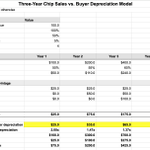
2. Mismatch of revenue / expense recognition on chips (see here teapaw.org/LironManor/status/2076… ). This again artificially/temporarily benefits S&P500 companies

Since the launch of ChatGPT, the S&P 500’s inflation-adjusted revenue per worker (a proxy for efficiency) has inflected higher. The small-cap universe is seeing the opposite trend.

3
434
I get survivorship bias, but I see the below too often. We’re in a once in a century (or three) event and there will be winners and losers.
Spoiler alert: the winners will not be the ones slow to adapt.
To the extent that AI use boosts firm performance, some early signs here that early AI adopting firms that were already doing well may start to outpace others.
Data from OpenAI shows some firms are using AI much more, and they tend to be firms with the most productive employees.


1
4
431
Btw, do yourself a favour and follow @emollick
Super clear voice in a sea of AI cacophony. Imagine writing a book about AI in 2023 that’s still relevant!
1
65