
We should all be able to safely and comfortably bicycle a mile or two to a local school, grocery, or café.
Joined October 2014
- Tweets3K
- Following320
- Followers176
- Likes2.7K





Yes. Though over 50% of incidents are resolved at the scene. They're really a paramedic, not an ambulance.
Unfortunately behind a paywall and for the few PP articles I'm interested in (your's and a few others) not worth the cost and primarily the PITA of signing up.
In speed, comfort and amenities @GoBrightline is about 40 years behind other developed countries.
Sad when something like this is held up as a success by Americans.
A related bit is how it affects decision making.
When costs of roads are subsidized as they are now then a mfr can choose to locate as far from their customers as they desire.
If they have to pay for what they actually use via a wheelage fee then they'll be incented to make better decisions.
Similarly choosing where to live. If we feel the cost of each mile we drive then we might choose to live closer to where we need to go and maybe even choose to walk or ride a bicycle rather than drive a car.
Bicycle should indeed pay their fair share. As should people driving cars and trucks.
streets.mn/2016/10/24/yes-bi…
Wrong question.
It's not speed that kills but inattentive driving.
Right Question: If an engineer can't be trusted to design roads that insure safety for ALL users (e.g., CROW), which of these would be the best penalty: Fired, or ...Fired.
We need a law mandating that dumpsters be made of plastic from recycled plastic bollards so that drivers vehicles won't be hurt when they hit them.
Ams includes a lot of infra that's dated and now known to be not-so-safe like some painted bikeways, DZBL's, etc. Many bikeways need to be expanded as well. Slowly improving however!
These are much less likely in Utrecht, etc. Groningen does have one of the more dangerous roundabouts in NL though and did have a street shared by bikes & buses that was quite uncomfortable.
That's car infra. If it went under and was well designed for social and physical safety then in would be bike/ped infra.
I don't disagree with what you've written but Amsterdam is actually rather not-so-great compared to places like Utrecht, Groningen and a few others.
I think the vast majority of disabled in The Netherlands ride bicycles, trikes or use mobility scooters. These work much better for them than cars or other motor xport.
streets.mn/2015/05/06/enabli…
startribune.com/mn-state-fai…’s%20the%20fastest%20way%20to%20the%20Minnesota%20State%20Fair%3F%20We%20tried%20four%20methods.&utm_campaign=Essential%20Minnesota

Those would not be 'accidents'. They would crashes, injuries and deaths caused by intentionally poor design engineering.
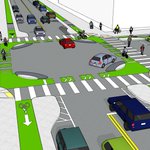
Get rid of the mixing zones. There is no way to make them safe.
Install proper protected bikeways built to CROW specs.
(Why do U.S. traffic engineers want to make targets out of people on bicycles?)
This is a step forward, but a very small one.
It's like getting excited because the school bully says that they'll now only beat us up 4 times per day instead of 5.