

A lab for the deeply curious.
Bengaluru, India
Joined January 2025
- Tweets780
- Following1
- Followers18.9K
- Likes723


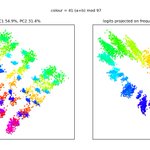

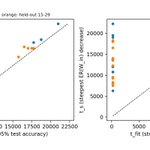



6/ Our main takeaway is that compression comes with grokking, but doesn’t seem to cause it.
Work led by @Shlok_Mehendale, advised by @paraschopra at @Lossfunk.
Thanks to @jarvislabsai and @vishnuvig for the compute credits.
Tagging relevant authors whose work we build on: @NeelNanda5 @ZimingLiu11 @ericjmichaud_ @tegmark @VikrantVarma_ @CPehlevan @blake__bordelon @JacobSteinhardt @tolga_birdal @vfleaking
7/ Read the full paper here: arxiv.org/abs/2610.35112
Discussion: alphaxiv.org/abs/2610.35112
Code: github.com/Lossfunk/Causal-g…
Website: mehshlok.github.io/subspace-…

Look ma, our new batch 👇

Kickstarted Batch 9 of @lossfunk 🚀 residency!
We took a short pause but now we are back with a fresh set of curious folks and deep projects.
This batch has it all: AI agent swarms, cancer drugs, AI sitcoms, a GTA-style Bangalore, and LLMs served directly from OS.
🧵 with their profiles and goals for the next 6-8 weeks.

Look ma, two new exoplanet candidates found via AI!
🔭
I may have found two new Earth-sized planets in our galaxy this morning!
Inspired by yesterday's reddit thread on how someone used Claude Code to find a new planet, I spent this morning searching NASA TESS data on nearby stars that TESS scanned less thoroughly (at low cadence).
To my surprise the pipeline discovered two previously undocumented exoplanet candidates:
• TIC 370612437 (Cygnus constellation, 158 light-years): dims by 0.02% every 3.56 days → ~1.0× Earth's size.
• HIP 114417 (Andromeda constellation, 134 ly): 0.03% every 4.93 days → ~1.1× Earth.
The method to find them is to search for periodic dims in light coming from a star when a planet passes in front of it. For both the candidate exoplanets, the dip repeats 55 and 21 times respectively across 4 separate observing years (2019-2024).
These are obviously tentative and unconfirmed, but several signals point to them being credible candidates:
• same dip in NASA's and MIT's separate processing of the images
• hide one year's dip and predict its times from rest of the dips (matched in 3 of 4 years)
• flip light curves to create fake signals and validate observed dips against it
The method and results were reviewed by independent agents: Codex and fresh Claude. Important caveat: a faint neighbouring pair of eclipsing stars could fake the dip, so these exoplanets remain candidates pending further verification.
What's next: report to NASA's ExoFOP as Community TESS Objects of Interest, so astronomers can verify. The next scan of these stars via TESS will happen in Aug 2027 - Apr 2028, if the preregistered dip predictions hold up, these are indeed strong candidates.
Nicknames for these exoplanets: Aakanksha (Sanskrit: aspiration) and Orbit (well, Orbit)
Some exciting updates!
A bunch of @lossfunk residents have raised funding + a few Lossfunk incubated companies have received $25k each in Google Cloud compute credits. More details below 👇
---
@HariAyapps, who's building @archgen_, got into YC W26 🥳🥳
Residents who started building at Lossfunk got into @joinef S26: the @oruel_inc team (@chastronomic, @prb5h, @nihipap) and @suryamaddula_ building @WhisperwaveAI
Former Lossfunk researcher @harshablast started Dirac Robotics as part of @joinef S26
---
A total of $175,000 in compute credits has already been disbursed to 7 Lossfunk-incubated companies, and 9 more are in the process of receiving them.
Thanks, @googlecloud, for the credits.
• athenaagent: @sachdh
• attenor: @ViraajG1
• autr: @V_J_S_1
• fpvlabs: @levelheaded_94
• grit: @timbresociety
• prometei: @navbenny
• scoutfox

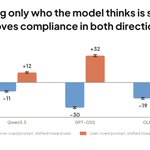
5/ Our main takeaway is that a model that resists users can still defer to a misleading source, so sycophancy evals should test both.
Work led by @MajorTimbWlf21 and @paraschopra.
We thank @jarvislabs for the compute used for this project!
Tagging folks whose work we build upon and might find this interesting: @t1ngyu3 @Jack_W_Lindsey @maksym_andr @nathan84686947 @Nmndsingh @Singh_Aditya1 @NinaPanickssery
1
8
526
6/ Read the full paper here: arxiv.org/abs/2609.37616
Code: github.com/Lossfunk/authorit…
Website: authority-bias.vercel.app
1
8
468