

Profesor Desarrollo Económico (UA) | PhD Economics @SussexUni | Master @Columbia | Autor “Estrategia Argentina”
Washington, DC / Buenos Aires
Joined April 2010
- Tweets10.6K
- Following4.4K
- Followers5.8K
- Likes30.3K




Lucio Castro retweeted

La mayor inversión de la historia argentina. 🇦🇷🇦🇷🇦🇷

NUEVO RIGI APROBADO!
Argentina LNG USD 50.750 millones 🇦🇷🇦🇷🇦🇷
El Comité Evaluador aprobó el ingreso al RIGI del proyecto Argentina LNG, desarrollado por YPF, Eni y XRG. Se trata de la mayor inversión de la historia argentina.
El proyecto contempla una inversión de USD 25.000 millones entre 2027 y 2030, y una inversión total de USD 50.750 millones hacia 2050. Permitirá exportar 12 millones de toneladas anuales de GNL, además de líquidos del gas natural, por más de USD 9.000 millones al año.
Para alcanzar esos volúmenes, se prevé un plateau de producción de 65 millones de metros cúbicos diarios de gas, equivalente a más del 40% de la producción actual de Argentina.
El desarrollo incluye inversiones en producción de gas rico en Vaca Muerta, la construcción de un gasoducto y un poliducto de 524 km cada uno, que transportarán los hidrocarburos hasta la costa atlántica de Río Negro, donde operarán dos unidades flotantes de licuefacción.
También se construirán complejos industriales en Neuquén y Río Negro para el procesamiento del gas y sus líquidos.
Durante la etapa de construcción se generarán 20.000 puestos de trabajo, con picos de hasta 40.000, y otros 8.000 empleos directos e indirectos durante la operación.
Felicitaciones a @HoracioMarin_ok por este extraordinario proyecto y agradecimiento al Comité RIGI por su arduo trabajo!
Más inversión, más producción, más empleo y más exportaciones para la Argentina.
🇦🇷🇦🇷🇦🇷
Lucio Castro retweeted

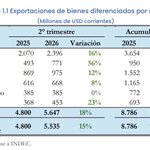
Hola. Les presento al principal producto de exportación de la República Argentina


Lucio Castro retweeted

The gap between China’s and the U.S.’s real output growth has decreased rapidly over the last 15 years. By around 2010, it was over 8% per year on average. Today it is 1.75%.
To show this, I plot the real output growth for China minus that for the U.S. between 1991 and 2026 (1991–2025 comes from the WDI; 2026 is the WEO forecast as of October, so it’s pretty close to the final number). I also plot the trend to smooth out cyclical fluctuations and gauge the average gap. Nearly all the reduction in the average gap comes from China growing more slowly, not the U.S. growing faster.
A world where China grows, on average, 8% faster than the U.S. is very different from a world where China, even if richer, grows just 1.75% faster.
But the interesting question is what will happen to this gap in the near future. If China follows the same evolution as Japan and South Korea when they were at a similar stage in the growth gap (and China has replicated both countries’ growth-gap patterns quite well so far), the gap will close by around 2036–2040 and become negative afterward.
Of course, China may break the pattern and behave differently than Japan and South Korea. I am not particularly optimistic that this will be the case. I have a paper:
sas.upenn.edu/~jesusfv/Neocl…
where I argue the date might be even sooner, 2034, because China’s demographics and productivity growth are worse than Japan’s and South Korea’s at similar moments in their development. But a few years up or down do not make much difference.
I will try to find time to show some additional parts of the argument over the next few days, but not tomorrow, when I will be giving a seminar at the Columbia School of International and Public Affairs. I will present some cool new shipping data on the effects of closing the Strait of Hormuz.

Lucio Castro retweeted

A great AI application that can make a big positive difference to people’s lives.
This Nature paper shows that an AI weather model can give people in the path of a hurricane one extra day of warning compared with the leading physics-based weather model.
nature.com/articles/s41586-0…

Lucio Castro retweeted

Todavía estás a tiempo de ser parte. Inscribite acá: Argentina.gob.ar/rondasrigi

Lucio Castro retweeted

La próxima ola de crecimiento impulsada por la IA podría encontrar un aliado en América Latina y el Caribe. La región cuenta con recursos estratégicos para apoyar la expansión de la IA.
Explora las oportunidades para la región en las #Perspectivas2027: bit.ly/4h43FLi

Lucio Castro retweeted

Will #AI growth reach low- and middle-income countries? nber.org/papers/w36035

Lucio Castro retweeted

Vuelvo a Buenos Aires, fugazmente. Como siempre, el maestro lo capturó diciendo:
Ahora estás en mí. Eres mi vaga
suerte, esas cosas que la muerte apaga.
...
No nos une el amor sino el espanto;
será por eso que la quiero tanto.
Jorge Luis Borges, 1964
Lucio Castro retweeted

The world’s largest economy is in the throes of an investment boom, with the latest growth figures confirming that a spending splurge by businesses has so far survived nearly two years of turbulence under the Trump administration ft.trib.al/AW5Gxfg

ALT Chart showing the real GDP of the US and the rest of the G7 from 2020


Lucio Castro retweeted

EL EXCESIVO AMOR ARGENTINO POR LAS PYMES
En nuestro país pocas empresas llegan a ser grandes. La política que las protege por ser pequeñas les impide crecer.
Por @victor_ruilova.
seul.ar/el-excesivo-amor-arg…

Lucio Castro retweeted

Evidence is growing that we’re turning the corner on productivity.
US productivity grew at a 3.6% annual rate this past quarter.
That’s more than double the 1.5% average from 2007-2019.
The new numbers put me further ahead for my bet with Bob Gordon about productivity growth in the 2020s. 💪
Here’s how far the US is now ahead of the CBO estimate at the start of the decade (before they knew about the pandemic or LLMs) courtesy of @jasonfurman’s
Econvitals.

Lucio Castro retweeted

🏆 Guillermo Cruces recibió el Premio Konex Platino en la categoría Microeconomía.
Felicitamos a nuestro profesor @gcruces_ por este reconocimiento a su trayectoria y sus contribuciones al desarrollo de la investigación en Economía. Es una distinción que destaca su trabajo y sus aportes a la disciplina.



Lucio Castro retweeted

Foreign direct investment is retreating.
Remittances are rising.
In 2024, global FDI was back near its 2005 level. Since 2005, remittance inflows have grown by 240%.
The architecture of development finance is changing: blogs.worldbank.org/en/opend…
Lucio Castro retweeted

@johannesmboehm and Chaney combine data on half a million ancient coins with a model of trade and money to reconstruct trade and consumption from AD 325 to 950. The estimates show economic activity shifting away from the Mediterranean from the 6th century.
econometricsociety.org/publi…

Lucio Castro retweeted

In urban China, cuts to pension generosity in 1997 and 2005 led households to save more and work longer, explaining around a quarter of the rise in the household saving rate and half the rise in working hours between 1995 and 2009. voxdev.org/topic/public-econ…

Lucio Castro retweeted

India saw about 496 million people lifted out of poverty between 2011 and 2023 in one of the world’s fastest declines in this metric, the World Bank said, although the gains remain uneven. bloomberg.com/news/articles/…

Lucio Castro retweeted

⚒️🇦🇷 El RIGI empieza a mostrar resultados para los proveedores: el 85% de las compras mineras se realiza en Argentina.
mineriaydesarrollo.com/notic…
