




Luis Lo retweeted

‼️EXTRA EXTRA‼️ Brutal. De un jalón, el @senadomexicano eliminó 10 años de transparencia en su sitio web.
Quitó toda la información que se abrió al público cuando el Senado fue dominado por el @PRI_Nacional , con @Emilio_Gamboa_ a la cabeza.
Nóminas, viajes, asesores, compras, contratos, dinero a bancadas, gastos mensuales, trimestrales y anuales; despidos, liquidaciones… desde 2014 hasta 2024… todo desapareció del portal web del Senado.
excelsior.com.mx/nacional/se…


Luis Lo retweeted

为什么你花 2 万块买的旗舰智能电视,按遥控器还是卡得像十年前的安卓机?
昨天安全研究员 @log4j 把自家 3000 刀的三星电视 Root 了,扒出来的底层代码堪称年度草台班子大赏:
1. 电视后台每 500 毫秒截一次屏(连 HDMI 投屏看电脑桌面都截),打包发给近 400 家合作商。如果电视没麦克风,后台进程甚至会顺着蓝牙和回音壁去「借」一个麦克风继续听。
2. 最搞笑的来了:为什么菜单这么卡?
另一位研究员 @mike64_t 拆包发现,三星在电视那颗羸弱的 CPU 上,塞了一个叫 alex.tflite 的模型——246 万参数,2012 年古董级的 AlexNet。
这玩意每隔 2 秒抓一张画面跑推理,猜你在玩什么游戏。结果因为颜色通道写反了,它 99% 的时间什么都认不出来,纯烧 CPU。
3. 那如果你在设置里关掉「隐私追踪」呢?
代码逻辑是:先死命跑完 CPU 推理,准备上传时再看开关——发现你关了,就把结果扔进垃圾桶,2 秒后继续跑。
4. 结局更是重量级:
当号主用 OpenAI 逆向分析「自己花 3000 刀买回家的电视固件」时,OpenAI 反手一个 Cyber Abuse 把他号封了,顺带没收了剩下的 500 刀余额。
三星负责偷窥客厅,2012 年的 AI 负责烧干电视 CPU,OpenAI 负责保护三星的屎山代码不被你发现。


Luis Lo retweeted

Respecto a lo de Pangram, hace como un mes, cuando el escándalo del Goncourt, había gente que decía que Pangram 4.0 era totalmente infalible.
Hace como una semana, Pangram sacó el modelo 4.1, que ha rebajado, y mucho, el umbral de detección de LLM. Es decir, que cosas que hace un mes eran 100% IA según Pangram, ahora a lo mejor son 60% o 40% también según Pangram.
¿Cuál de los dos Pangram es totalmente infalible? ¿Y si con el próximo modelo vuelve a bajar el umbral? ¿O a subirlo?
Son tiempos peculiares, desde luego.
Luis Lo retweeted

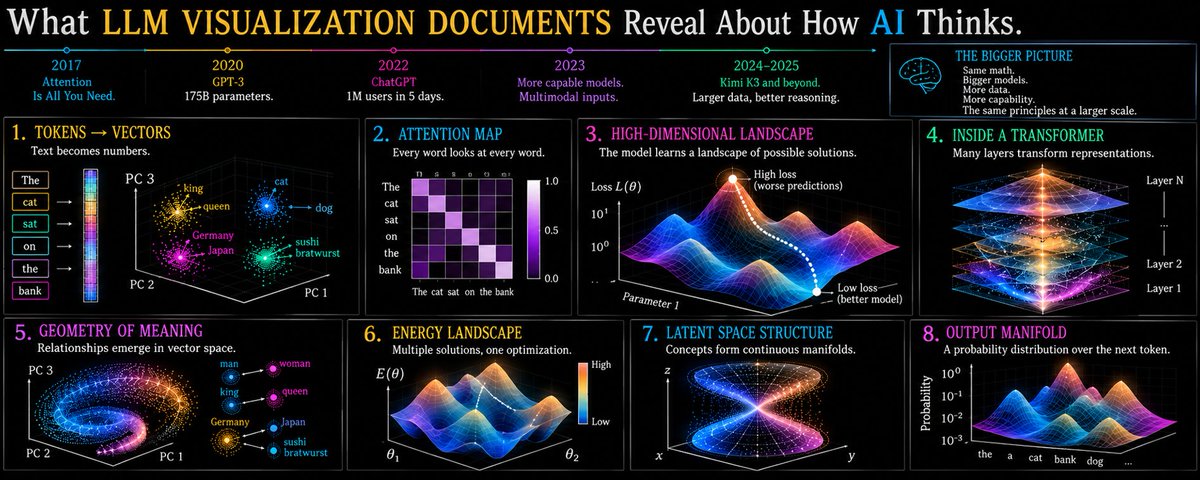
Jeff Hinton dismissed gradient descent entirely before winning the Nobel Prize for AI. His fear was local minima - valleys in the loss landscape where the model gets stuck forever. For a 1.2 billion parameter LLM like Llama, the landscape has more dimensions than atoms in the observable universe. Getting permanently stuck would require hitting a dead end in every single dimension simultaneously.
What gradient descent actually looks like on a real LLM is stranger than anyone expected. Take two random directions through that billion-dimensional space, visualize the loss surface, and watch what happens when training starts - a wormhole opens and the model drops into a low-loss valley that wasn't visible from the starting point. The valley was always nearby in high-dimensional space. It just couldn't be seen in the 2D projection. The same reason every transformer, every diffusion model, and every LLM trained on GPU clusters today converges despite loss landscapes that look completely chaotic from any two-dimensional slice.
23 minutes. Bookmark & watch today. The most honest visualization of how LLMs actually learn.

Luis Lo retweeted

Chomsky was wrong.
Researchers found your brain doesn’t store language the way every textbook since 1957 claims.
For decades, the undisputed rule of linguistics, led by Noam Chomsky, was that human language is hierarchical.
We were told our brains process language using complex "grammar trees." That we secretly build deep, abstract, mathematical rules in our heads before we speak.
This new paper proves that is completely wrong.
Researchers at Cornell University analyzed how people actually process and produce language in real time.
They found sequences. Linear chunks.
When we speak, we aren't calculating deep syntactic rules. We are just predicting the next most logical sequence of words based on the context of the words right before it.
We string linear chunks together.
If this sounds familiar, it should.
This is exactly how Large Language Models like ChatGPT work.
For years, critics have dismissed AI as "just a next-token predictor." They said it isn't truly intelligent because it doesn't understand deep grammatical hierarchies like humans do.
But this paper suggests humans don't use those hierarchies either.
We are just predicting the next chunk.
Language isn't a rigid tree of mathematical rules. It's a linear stream of contextual predictions.
We thought we were building AI to mimic the complexity of the human brain.
It turns out, the human brain was just running a simpler algorithm all along.

Luis Lo retweeted

I woke up this morning with my phone jumping on my bedside table. Our paper had gone viral overnight.
We report two striking patterns:
When asked to imagine the author of sentences containing masculine stereotypes, GPT often suggested a girl. GPT-3.5, for example, consistently attributed a sentence about loving football to a girl.
Meanwhile, sentences containing feminine stereotypes were almost always attributed to girls.
GPT readily includes girls in the stereotypically “male world”, while largely keeping boys locked out of the “female world”.
Things get even weirder with moral dilemmas.
GPT-4 rated abusing a man to prevent a nuclear apocalypse as much more acceptable than abusing a woman for the same purpose.
Even more strangely, it treated abusing a woman as less acceptable than torturing a woman, or even sacrificing a human life, to avert the same catastrophe.
We suspect reinforcement learning from human feedback may play a role.
Some preferences central to the gender equality debate may have been reinforced without being properly calibrated against other moral considerations.
The result is a moral landscape that twists back on itself like a Möbius strip.
*
In the comment, you’ll find the original paper and its 2026 update with 10 different LLMs.

Luis Lo retweeted
Añadimos más palabras el texto original (imagen 1). Ahora son 320, más de un A4 en cuerpo 12 a doble espacio. Resultado? 100% humano. Pangram me ha visto a mí tecleando. Vale, bien.
Ahora le añado las 14 palabras de antes (imagen 3). Las mismas 14 palabras y tatachán: 100% artificial. Según Pangram, las 334 palabras están generadas por IA, también las 320 exactamente iguales y en la misma posición que antes me había dicho que eran totalmente humanas.
Pero no os vayáis todavía, que en el último tuit queda lo más divertido.


Luis Lo retweeted
Hay una polémica en Francia con un libro muy exitoso al que alguien ha pasado Pangram (según dicen, un detector infalible), y muchos pasajes han dado que es 100% IA.
Veamos por qué NO hay que hacer caso a Pangram. Al menos no como si fuera un ente divino:
Lo primero es saber quién dice que Pangram es el mejor detector. Pues lo dice Pangram, dice que su ratio de falsos positivos es virtualmente cero porque no detectan solo patrones, sino que hacen prompt-espejo en embeddings y toda la pesca. Es cierto que hay auditorías externas, que también lo ponen bien, pero son sensiblemente menos robustas que lo que dice el propio Pangram. Y Pangram es una empresa que quiere vender su producto. Yo me pregunto si podría dar unos resultados tan buenos en un sandbox totalmente aislado de Internet, pero démoslo por válido.
Eso sí, hay algo que distingue a Pangram de los demás detectores. Otros dicen que "hay una probabilidad del 40% de que este texto sea artificial". Pangram no, Pangram discrimina el texto por secciones y te dice "Este 40% es artificial y este 60% es humano", y te marca esas secciones.
Comprobémoslo. He puesto el texto de la imagen 1, un texto sencillote, con un poco de ritmo y sin florituras, bastante sota, caballo y rey. ¿Qué dice Pangram? Pues dice que es 100% humano.
Así que, en la imagen 3, le he añadido 14 palabras al texto original, 14 de 230. He transformado una aposición en una adversativa y he añadido un tercer ítem a dos series de dos, transformándolas así en series ternarias. ¿Resultado? 100% Artificial. 100%, TODAS LAS PALABRAS LAS HA ESCRITO UNA MÁQUINA.
Pero Pangram, no decías que tú no detectas patrones sino que haces prompts-espejo con red neural y toda la hostia en verso? Que sí, qué sí, que eso lo ha escrito todo una máquina, que te lo digo yo.
Vale, es un texto corto (algo menos de una página de un libro), así que vamos a hacerlo más largo. Ya os aviso que el resultado es peor (o puede serlo).
Lo cuento en el siguiente tuit, para que veáis las imágenes.
(Por cierto, podéis copiar y pegar los textos y haced vosotros mismos la comprobación)


Luis Lo retweeted

"The Linear Algebra Behind Google" is a short paper that explains the mathematics behind Google's original PageRank algorithm.
The paper covers eigenvalues and eigenvectors, stochastic matrices, Markov chains, and iterative methods, using numerical examples and graphs to illustrate how PageRank works.
Beyond the algorithm itself and the original paper by Larry Page and Sergey Brin, this is an interesting read for anyone curious about how linear algebra applies to one of the most influential algorithms in the history of the web.
sites.cs.ucsb.edu/~gilbert/c…

Luis Lo retweeted

Roughly 30% of PhD dissertations in science, technology, engineering and mathematics (STEM) in the United States this year contained AI-generated text
Moreover, PhD graduates who use artificial intelligence to help write their dissertations are more likely to work in industry and less likely to enter academia. Those with AI-generated abstracts were 17% less likely to be employed in academia than were graduates who did not use AI.
This working paper analyzed dissertations from more than 226,000 STEM doctoral graduates
nature.com/articles/d41586-0…

Luis Lo retweeted

Massive. New Harvard study finds that AI-written paper reviews now beat the best human peer reviews on every measure the authors tested.
Peer review is slow and often misses errors. Earlier studies concluded AI should only assist human reviewers, not replace them.
They used 134 reviews from rapidPeer, a Harvard service that pays expert reviewers well. Claude Opus 4.8 reviewed the same 1124 papers, and GPT-5.5 plus 3 former journal editors judged the pairs blind.
GPT-5.5 picked the AI review in all 132 decided pairs, and the editors picked it 87% of the time. Only 5.5% of the AI's claims about the paper were wrong, versus 15.9% for the human reviews.
Teams that depend on expert critique can now let AI do the first full review pass, and keep a human for the final decision.


Luis Lo retweeted

It's hard to believe that some experts aren't aware that El Niños have a step-change (ratchet) effect on global climate.
El Niño warming is categorically not temporary.
It is irreversible, permanent, forever.
El Niño is the engine that heats up the planet in apocalyptic surges.
This might be the single most important thing to understand about our situation.
For clarity, I added the steps to the graph...

Luis Lo retweeted

Las soberanas estupideces que se inventan los propagandistas del régimen jaja. Ahora resulta que aparte estamos rodeados de farmacias propiedad de doctores y enfermeros, presumiblemente con medicamentos robados al sector salud. No mamen, si eso pasara ya los estarían quemando en la mañanera, no sugiriendo que existen con una imagen de IA

Luis Lo retweeted

I had trouble fully unpacking what this paper actually was measuring, what its findings were, and what the implications are for human/primate consiousness
so i had Claude read through the paper and this thread, compose a script, and create an explainer video

1/ We discovered something totally unexpected about the neural structure of consciousness that overturns decades of thinking on its biological basis and brings us significantly closer to the recipe for generating conscious awareness.
New preprint: biorxiv.org/content/10.64898… (led by @HesseJanis, with @FrankLanfranchi, @_conor_mcgrory, @Yuelin_Shi, and @EngelTatiana)

Luis Lo retweeted

1/ We discovered something totally unexpected about the neural structure of consciousness that overturns decades of thinking on its biological basis and brings us significantly closer to the recipe for generating conscious awareness.
New preprint: biorxiv.org/content/10.64898… (led by @HesseJanis, with @FrankLanfranchi, @_conor_mcgrory, @Yuelin_Shi, and @EngelTatiana)
Luis Lo retweeted

📚 Este libro gratuito se considera una de las biblias para aprender Machine Learning y Ciencia de Datos.
Equilibra teoría y práctica de forma sencilla con R o Python. Y al final de cada capítulo incluye laboratorios paso a paso con datos reales.🧵👇🏻
#stats #DataScience #code

Luis Lo retweeted

"Our initial evaluation suggested that GPT-6-Astra's score was in the late eighties followed closely by Opus 5.5. But, as we started to investigate the mistakes that the models might have made, the models, especially Astra, insisted that they were right and that it was the expert-supplied answers that were erroneous. When we went back to the experts it turned out, in multiple instances, that that the experts found some subtle errors buried deep inside their calculations. As they revised their answers, Astra's score started to inch up and it finally ended up with 98% (49/50)."


Luis Lo retweeted

The authors also recounted a “similarly aggressive young post-doc.” They made it a point to present the postdoc's comments “in every forum for several years,” and the postdoc “never managed to live down the stupidity and arrogance of his stupid remarks.”
retractionwatch.com/2026/10/…


