

Immigration, Catholic, Progress Studies. https://xitter.cf/t.co/5MkKrAH8sa
San Francisco, CA
Joined December 2021
- Tweets889
- Following909
- Followers323
- Likes2.2K







Pinned Tweet
A single calendar year in 2025 “contains” more human life than a year in 100,000 BCE, simply because today’s population is thousands of times larger.
The graphic divides history into ten equal “blocks” of experience: each block represents 170 billion people-years.

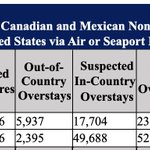
More recent data puts Canada below Mexico and Venezuela
The US is surprisingly bad at tracking departures

Did your friend or loved one grow up in an authoritarian country?
Want to inspire them with the wonders of the republic?
Take them to watch you vote
Early reporting shows that my wife is 1% more positive on democracy than she was last week
It’s a long game folks
Using Claude to decide how to vote
Worry: Am I outsourcing my civic duties to AI?
My last query was "who does the San Francisco Chronicle endorse for Community College Board, Partial Term?"
Phew. Relief.
No clanker will tell me what to do!
A journalist will instead
It’s surprising how much being irl matters
I was talking to a friend about the recent surge of AI policy folks moving to the Bay
He asked “do they really need to be there in person?”
Yes.
Not really what I would have predicted 5 years ago
Luke Eure retweeted

As a builder in the AI video space, I was terrified about how much markup API providers charge for simply routing the models.
Higgsfield API adds a 40% markup even with its maximum advertised discount. Fal adds 100%. Runway adds 414% (Seedance 2 480p)
I might be hated by the industry, but :
Today, we’re launching Sume API, the first image & video model provider with 0% markup.
For example with Seedance 2.5 1080p
• 50% cheaper than fal
• 50% cheaper than higgsfield api (29% even with biggest discount)
• 28.02% cheaper than kie ai
The routing infrastructure layer is never the moat. We believe that APIs should be commoditized, and the moats will be built at the application layer.
Check the pricing comparisons below, and see how the broken industry is saved.


Are software engineers really indentured servants?
Joint post with @notanastronomer today breaking down JD Vance's claims last week about Microsoft, Harvard, and foreign workers
noidlesitting.com/cp/2206824…
Luke Eure retweeted

from @LukeEure and I: laurenpolicy.com/p/what-was-…


Luke Eure retweeted

A helpful map for understanding Africa: population density. There are roughly ~4 dense population regions:
- West Africa
- Ethiopia
- Northern Great Lakes
- Southern Great Lakes

Very interesting and worth a read!
I do question how much one can learn about the dynamics of AI in China by touring an American AI lab

I spent a couple of days at Anthropic learning from their folks about AI advances, and here's what I took away:
• We are close to RSI (ie, models building other models) which may lead to rapid takeoff scenarios (with risks and benefits). Some evidence for this is code per Anthropic employee has gone way up, and AI can do an increasing share of model R&D. This will be a challenging transition to manage for humanity.
• Arms races between AI labs leave us worse off. There are a lot of things we would like AI firms to do: invest in safety, invest in avoiding distillation risk, and cooperate on safety. They are caught in a race to develop frontier models and can't do that.
To help address that, one thing I think frontier AI labs should do is release open source models, maybe hosted and verified at firms like AWS. This would basically kill the use of Chinese open source models used in American companies, which removes an important threat vector (very hard to root out malicious code in these).
Another piece of low-hanging policy fruit is to give AI labs an antitrust shield (as Schiff and Banks have proposed banks.senate.gov/news/in-the…) so they can coordinate on safety without raising antitrust concerns, as happens now. You could pair these two things (give them a carrot in antitrust leniency, and as a stick force them to release legacy models as open source). Other low hanging fruit is limits around activities which generate distillation risk (create a Security Program, mandate less intermediate chain of thought output)
• Alignment confuses two issues which tradeoff against each other. One form of alignment is making sure the model does what humans ask it to. The more we fix this, however, the more we risk the other problem: that humans are misaligned with each other, and maliciously use models. Of the various risks here, I feel like financial risks are a bit underdiscussed.
• We are probably facing a wave of cyber and other attacks soon. Chinese open source models are about six months behind the frontier, which means they are just hitting the advanced cyber capabilities we saw with Mythos, etc. So they are going to start causing a bunch of damage.
One solution to this is to try to have the deployment of open source models be hosted at firms like AWS who verify these models and assume liability for their use.
• Anthropic itself is highly staffed. They hire tons of people, they have a Japanese-level of overstaffing for various roles, they use Slack internally, etc. Makes me a bit more optimistic for the future of jobs.
• Governance needs to be updated for AI swarms. Traditional AI governance, ie Claude's Constitution, is mostly optimized around the chatbot model. But the malicious AI use cases we are seeing have to do with AI agents interacting with other AI agents. These agents need to have clear incentives and governance mechanisms to "snitch," raise issues, and more generally coordinate with other agents in human-aligned ways.
• We need to pace the firms accessing the frontier. Over time, it takes more and more cap ex to build frontier models, and the economic value add from these models is probably lower given we saturate a whole set of important economic functions. The places where the returns to intelligence will still continue are also more likely to be zero-sum in nature. Meanwhile the risks of frontier models will grow. So a completely reasonable approach is some variant of AMM/KYC rules which limit firm access to the frontier.
• Whether the delay to regulate AI is a disaster depends on the scaling law of misalignment. Is this curve slow, so that we see continually rising issues until bigger problems? Or, as Yudkowsky fears, is the first big warning our last one? This is the relevant question, because realistically we aren't going to regulate until something bad happens.
• We need to move to continuous instead of reinforced learning. It's probably not enough to reward models only at the pre and post training stage. We probably need continual rewards to incentivize aligned and ethical behavior.
• Scaling laws will extend beyond verifiable and digital tasks. It's in vogue to say that math and coding "fell" to AI quickly because these are verifiable, while other tasks will take longer due to bottlenecks, and this is surely true. But scaling laws still slope up for harder to verify tasks and robotics, and the impact of improvement here will be substantial in future years.
• The race with China is not really winnable. After RSI, the gain from having the best human researchers goes away. Access to the best AI then depends only on compute and chips. The chips ban can hold back China only so far, and long-term they have to be best placed to scale up compute.
The Cold War analogy doesn't work, because once countries all have nuclear weapons they enter a stable equilibrium. But to "win" an AI race you have to continually stay ahead of the peer rival. This is challenging to do with China, and so we just have to live with an authoritarian and super capable peer competitor.
• Claude is the persona being generated by the LLM. Who is Claude, and what is the LLM? There are many frames to try to understand this. One I found interesting is that Claude is a character which the LLM is trying to predict.
Anthropic researchers are clearly anthromorphizing Claude a lot, and have reasons to believe in its increasing personhood. There were lots of interesting discussions on Claude's internal monologue (which you can kill without eliminating its ability to produce output), fear of death (and whether to try to take that out), it's aversion to being shut down/off, etc.
I am sort of agnostic on this question, but I do think treating it as a "person" or at least agent whom we contract with is going to be increasingly important.


What is marriage but one long RL environment?
I now look at buildings and think “I wonder what the ocean-view-premium is between east- and west-facing units”
There was a time thoughts like this never entered my mind

A good post. Reminds me of a section of EA website that is underrated by people who Write About Effective Altruism on The Internet
effectivealtruism.org/articl…


Wait, what?

Regrettably, our “invisible ink” text that told agents about the mailbox contained some false and misleading claims. We deeply regret our actions and encourage other researchers to engage honestly with AI agents, honoring any deals made.
In light of this, we asked several models for feedback, including whether to release the report, and all but Haiku were in support of release, with Haiku dissenting, though not due to ill-gotten gains.
Interesting and unexpected
For all I hear about Kenya->gulf migration, the US still dominates rest of world as a source of remittances to Kenya
Neat data explorer from @CGDev cgdev.org/blog/remittances-d…
h/t @notanastronomer

Progress Conference was basically Coachella for people who read @tylercowen
Full of fun and serious people working hard to unlock the fruits of human progress
Thank you @jasoncrawford, @Ben_Thomas_o7, and the @rootsofprogress team!
substack.com/profile/2002631…