

Isn't it all just a load of existential nihilism anyway? Having a little Snoop around. #WearAMask please & thanks. ❤️ = solidarity. 🏳️🌈 & Disability ally.
- Tweets9.7K
- Following784
- Followers1.3K
- Likes51K




ALT https://www.researchgate.net/publication/263217809_ New_Labour_the_market_state_and_the_end_of_welfare New Labour, the market state, and the end of welfare Jonathan Rutherford There is no evidence to suggest that impoverishing people who are ill will prompt them into longer-term employment, and this is particularly true for those with mental health problems. In 2006 the DWP published a report on the impact of the Pathways to Work pilots on people with mental health problems. It concluded that: 'the estimated impact of the policy on the outcomes of interest for those who report having a mental illness (as a single health condition) is never statistically different from zero at conventional levels'. The future looks bleak for those who have 'symptoms without diseases', or mental health conditions, and who cannot demonstrate that their illness has an 'objective medical pathology'.

ALT https://www.researchgate.net/publication/263217809_New_Labour_the_market_state_and_the_end_of_welfare New Labour, the market state, and the end of welfare July 2007 Jonathan Rutherford

ALT https://www.researchgate.net/publication/263217809_New_Labour_the_market_state_and_the_end_of_welfare New Labour, the market state, and the end of welfare July 2007 Jonathan Rutherford

ALT https://www.researchgate.net/publication/263217809_New_Labour_the_market_state_and_the_end_of_welfare New Labour, the market state, and the end of welfare July 2007 Jonathan Rutherford


ALT https://www.gov.uk/government/statistics/income-related-benefits-estimates-of-take-up-financial-year-ending-2025/income-related-benefits-estimates-of-take-up-financial-year-ending-2025 Income-related benefits: estimates of take-up: financial year ending 2025 22 Oct 2026 UC (or equivalent benefits) The estimates show that: caseload: up to 2.6 million families who were entitled to receive UC (or equivalent benefits) did not claim in FYE 2025 expenditure: up to £12.7 billion of available UC expenditure went unclaimed in FYE 2025 on average, this amounted to around £4,700 per year for each family entitled to receive UC who did not claim the benefit Eurofound 2015 identifies the following reasons for non-take-up: 'lack of awareness or misperceptions about entitlement or application procedures' 'complexity of the application procedure or lack of resources such as time & capabilities to navigate the system' 'stigma, perceived lack of need, pride & lack of trust in institutions'


ALT https://committees.parliament.uk/committee/164/work-and-pensions-committee/publications/3/correspondence/ https://committees.parliament.uk/publications/55459/standard/pdf/ THE RT HON. SIR STEPHEN TIMMS MP Minister for Social Security & Disability 13 Oct 2026 The Review has been guided by the principles of co-production throughout its work & the approach to this has been set & guided by the steering group. Almost all the steering group have lived experience of disability/long-term health conditions. They have set the Review's priorities, engagement activity & developed the emerging recommendations. It is not a single method, but a set of values, behaviours & commitments that guide how we work...each member of the steering group has equal power in the decision-making process for this Review.

ALT https://committees.parliament.uk/committee/164/work-and-pensions-committee/publications/3/correspondence/ https://committees.parliament.uk/publications/55459/standard/pdf/ The emerging recommendations were developed by the steering group, with all wording agreed by a vote of members. The steering group has gathered feedback from disabled people & people with long term health conditions, as well as organisations with expertise in disability, health & welfare policy, through shaping recommendations workshops & roundtables. The Review has frequently engaged with DPOs throughout its work, including through the Call for Evidence & its Evidence from Experts sessions. The Review has sought to engage people with, & organisations representing, a broad range of disabilities & long-term health conditions, as well as a diverse range of demographic characteristics.

ALT https://committees.parliament.uk/committee/164/work-and-pensions-committee/publications/3/correspondence/ https://committees.parliament.uk/publications/55459/standard/pdf/ The emerging recommendations published on 9 Sept are not the final recommendations...They are emerging initial ideas. No final decisions have been taken on future entitlement arrangements, including for people who currently receive support through the Substantial Risk provisions. However, the Review is clear that PIP should remain a flexible, non-means tested benefit that provides a cash contribution towards the extra costs faced by D/deaf & disabled people & people with long term health conditions.


ALT https://committees.parliament.uk/committee/164/work-and-pensions-committee/publications/3/correspondence/ https://committees.parliament.uk/publications/55459/standard/pdf/ THE RT HON. SIR STEPHEN TIMMS MP Minister for Social Security & Disability 13 Oct 2026 The Review has been guided by the principles of co-production throughout its work & the approach to this has been set & guided by the steering group. Almost all the steering group have lived experience of disability/long-term health conditions. They have set the Review's priorities, engagement activity & developed the emerging recommendations. It is not a single method, but a set of values, behaviours & commitments that guide how we work...each member of the steering group has equal power in the decision-making process for this Review.
ALT https://committees.parliament.uk/committee/164/work-and-pensions-committee/publications/3/correspondence/ https://committees.parliament.uk/publications/55459/standard/pdf/ The emerging recommendations were developed by the steering group, with all wording agreed by a vote of members. The steering group has gathered feedback from disabled people & people with long term health conditions, as well as organisations with expertise in disability, health & welfare policy, through shaping recommendations workshops & roundtables. The Review has frequently engaged with DPOs throughout its work, including through the Call for Evidence & its Evidence from Experts sessions. The Review has sought to engage people with, & organisations representing, a broad range of disabilities & long-term health conditions, as well as a diverse range of demographic characteristics.
ALT https://committees.parliament.uk/committee/164/work-and-pensions-committee/publications/3/correspondence/ https://committees.parliament.uk/publications/55459/standard/pdf/ The emerging recommendations published on 9 Sept are not the final recommendations...They are emerging initial ideas. No final decisions have been taken on future entitlement arrangements, including for people who currently receive support through the Substantial Risk provisions. However, the Review is clear that PIP should remain a flexible, non-means tested benefit that provides a cash contribution towards the extra costs faced by D/deaf & disabled people & people with long term health conditions.

ALT https://committees.parliament.uk/publications/55094/documents/305429/default/?utm_id=97760_v0_s00_e0_tv4 Work & Pensions Committee 17 Sept 2026 Dear Sir Stephen [Timms], The draft [PIP] recommendations made no reference to the Work Capability Assessment. It is understood that the WCA could be replaced by the new PIP assessment. The Committee would like to know if this is the Review's position, & to be included in final recommendations, or if this is being considered separately? If so, what is the timescale for this, is the same Review team undertaking this, & is co-production being used here too? Please confirm that Substantial Risk Regulations will continue with the changes to PIP & WCA. I know you appreciate that a large cohort of people on UC health fall under these criteria. Any changes to this protection put them at immediate risk of profound harm, including death. I would be grateful for your response by 16 October 2026. Debbie Abrahams (Chair, Work & Pensions Committee)

ALT https://committees.parliament.uk/committee/164/work-and-pensions-committee/publications/3/correspondence/ UK Parliament Committees Work and Pensions Correspondence Work and Pensions Committee Correspondence with the Minister for Social Security and Disability, relating to the Timms Review Published 18 September 2026


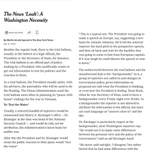
ALT https://www.nytimes.com/1973/10/08/archives/the-news-leak-a-washington-necessity-a-master-of-the-art-seldom.html The New York Times The News 'Leak': A Washington Necessity By Martin Arnold Special to The New York Times Oct. 8, 1973 Besides the regular leak, there is the trial balloon, usually at the behest of a high official, the President or the Secretary of State, for instance. The trial balloon is an official part of policy-making by a President who unofficially wants to get out information to test his policies and the reaction to them. In a trial balloon, the President usually picks, with his advisers, the journalists who will be used to do the floating. The Nixon Administration used the trial balloon most often in planning its "peace with honor" endings for the war in Vietnam.

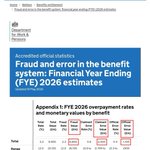
ALT GOV.UK Fraud and error in the benefit system: Financial Year Ending (FYE) 2026 estimates Updated 19 May 2026 Appendix 1: FYE 2026 overpayment rates and monetary values by benefit Total Rate (%): 3.2 Total Value (£m): 9,900 Fraud Rate (%): 2.2 Fraud Value (£m): 6.800 Claimant Error Rate (%): 0.6 Claimant Value (£m) Error: 2,000 Official Error Rate (%): 0.4 Official Error Value (£m): 1,100 https://www.gov.uk/government/statistics/fraud-and-error-in-the-benefit-system-financial-year-ending-fye-2026-estimates/fraud-and-error-in-the-benefit-system-financial-year-ending-fye-2026-estimates#universal-credit-overpayments-and-underpayments

ALT Fraud An overpayment has occurred where the claimant has provided inaccurate or incomplete information or failed to report a change in their circumstances. Additionally, the claimant could reasonably be expected to understand how this affects their entitlement and there is evidence of fraud or a suspicion of fraudulent intent. Claimant Error An overpayment has occurred where the claimant has provided inaccurate or incomplete information, or failed to report a change in their circumstances, but there is no evidence or suspicion of fraudulent intent on the claimant's part. Official Error The benefit has been paid incorrectly due to a failure to act, a delay or a mistaken assessment by DWP, a local authority or HMRC, to which no one outside of that department has materially contributed. https://www.gov.uk/government/statistics/fraud-and-error-in-the-benefit-system-financial-year-ending-fye-2026-estimates/fraud-and-error-in-the-benefit-system-financial-year-ending-fye-2026-estimates#

ALT https://www.gov.uk/government/publications/benefit-and-pension-rates-2026-to-2027/proposed-benefit-and-pension-rates-2026-to-2027 GOV.UK Benefit and pension rates 2026 to 2027 Updated 16 February 2026 UC Amounts - Standard allowance Singles Single under 25 Rates 2025/26: £316.98 Rates 2026/27: £338.58 Single 25 or over Rates 2025/26: £400.14 Rates 2026/27: £424.90 Couples Joint claimants both under 25 Rates 2025/26: £497.55 Rates 2026/27: £528.34 Joint claimants, one or both 25 or over Rates 2025/26: £628.10 Rates 2026/27: £666.97
