

Co-founder & CEO L7mp, run WebRTC in Kubernetes at scale
Budapest, Hungary
Joined June 2018
- Tweets225
- Following332
- Followers102
- Likes1.8K




Any chance we can get gpt-oss-2?
I still feel this is a huge opportunity, everyone loved gpt-oss, but it's too "old" now.

Over the next 28 days, each day we’ll either ship one thing that is a clear improvement and relevant for most codex/work users or ship a full reset. Let the improvements begin.
17
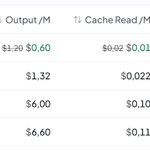
So this is basically 2.5x the price of Jev, and no input cache support.
While I think Luna is a much better base model for these decision type problems, I'm wondering if this is a competitive price at all.


Let your app choose the right model, tool, or action in near real-time with Decisions API, now available to all developers in public beta.
The Decisions API makes decisions up to 10x faster than GPT-6 Luna through the Responses API.
30


I have a feeling that these always on agents are not something people actually need. Sure, it solves a usecase, but for those you can just use OpenClaw/Hermes.
I'm expecting this to become a similar flop to what happend to the Metaverse...

Introducing dots, powered by GPT-6 Astra.
Remarkably capable, always-on agents built to handle everything.
1
21
Speaking at Cloud Native Budapest next Tuesday about Letting AI Agents Loose in Kubernetes😅
Join if you're around:
ocgroups.dev/cncf/group/fpry…

14
I saw a Jev based model router getting some attention, but I'm very sceptical with any model routing: if this could be solved, a Fable / Astra level model for sure would have adaptive thinking (they could also decide based on the prompt how hard is the task), but they can't do this, there's actually a fair performance difference between the thinking levels. So if Fable/Astra cannot tell this, how can you expect good routing from a model that is about ~1/20 of their size (based on the input token cost)??
1
26

This looks a bit now playing with the numbers after Astra did not achieved good score on the original index calculation.

Announcing Artificial Analysis Intelligence Index v4.3, upgrading Terminal-Bench to 4.0 and adding AutomationBench-AA, an agentic workflow automation benchmark with a private test set. This is a continuation of our rollout of Intelligence Index v5
Changelog (Index v4.2 → Index v4.3):
➤ Terminal-Bench: 2.1 → 4.0, completing our upgrade to the latest version of Terminal-Bench
➤ Replacing 𝜏³-Banking with AutomationBench-AA, our implementation of Zapier's business workflow automation benchmark
We are continuing to prioritize keeping Intelligence Index as useful as possible by bringing forward a subset of the changes we had planned for Index v5. Each change in v4.2 and v4.3 stands on its own merits and brings the Index closer to real-world problem solving, adds more private test sets to prevent gaming, and reduces saturation
Intelligence Index v4.3 raises the difficulty of agentic coding tasks and broadens the types of agentic workflows tested. Because we use a held-out test set for AutomationBench-AA, in collaboration with @zapier, the weight assigned to evaluations with private tasks or answers increases from 40% to 45%. Category weights are unchanged from v4.2: Agents 30%, Coding 20%, General 30%, Scientific Reasoning 20%
Detailed changes:
➤ Upgraded Terminal-Bench 2.1 to 4.0: 66 multi-step tasks testing agents on tasks run in agent sandboxes driven via the terminal, including tasks involving software engineering, machine learning, science, and operations. The 4.0 update recalibrates compute and time allowances, and improves task instructions and verification. We have changed from the Terminus 2 harness to mini-SWE-agent, a minimal, model-agnostic harness. We will also be updating our Coding Agent Index, where we test model and harness pairs, to include Terminal-Bench 4.0 soon
➤ Replaced 𝜏³-Banking with AutomationBench-AA: Our implementation of Zapier’s AutomationBench tests agents on 657 business workflows across simulated applications such as Gmail, Slack, Salesforce, and Jira. Agents must complete task objectives while following business rules. AutomationBench-AA uses Zapier’s private set of 657 tasks, and is built on v1.0.6
Key results:
➤ Claude Fable 5.1 and GPT-6 Astra lead the Intelligence Index: Both Claude Fable 5.1 (max with fallback) and GPT-6 Astra (max) score 53 on Intelligence Index v4.3, followed by Claude Opus 5 (max, 51), Claude Fable 5 (with fallback, 50), Muse Spark 1.3 (max, 48) and GPT-5.6 Sol (max, 47)
➤ GLM-5.3 and Kimi K3 continue to lead open weights models (both at 44): GLM-5.3-Flash (42) is the third strongest open weights model, followed by Qwen3.8 2.4T A95B (40) and DeepSeek V4 Pro 0813 (max, 36)
➤ 4 labs occupy the Intelligence vs. Cost per Task Pareto frontier: OpenAI occupies the majority of the cost-efficiency frontier, with all five reasoning efforts of the recently released GPT-6 Astra offering the lowest Cost per Task at their respective levels of intelligence. Claude Fable 5.1 (xhigh, max, 53), GLM-5.3-Flash (42) and MiMo-V2.5-Pro (26) round out the rest of the frontier

38

wow, claude design refuses to do work for me since my weekly limit is close to 100%, but the limit resets in 1 hour.
Luckily after I explained the model that I don't care about the limit, it started the actual task.

49
Besed on how much the new Qwen 3.8 27B was anticipated and the effort I see people put in to optimize the local work (e.g. inference) with it, I would say it would be a good strategy for OpenAI to release gpt-oss-v2 and win this local market back. Otherwise this field would be completly dominated by Qwen.
1
53
Is this peak AI hype when a 27B model have it's own countdown page?
huggingface.co/Qwen/Qwen3.8-…

1
45
Dear Mr. Altman, Mr. Amodei, Mr. Zuckerberg: pause AI development now!
Dear Mr. Pichai: this message is not for you, feel free to continue.
youtube.com/watch?v=BwKGHjo7…
2
39
wow, the new Deepseek V4 Flash model scored 53% on DeepSWE for avg task cost of $0.10
Now I understand why everyone got hooked on it.

2
75
Nice numbers, though I don't understand why the compare it to Terra and not Sol.
But the real interesting question with this: can any lab catch up to OpenAI/Anthropic, or they so far ahead now with recursive self improvement that it's impossible.

Releasing Muse Code in beta today. It's a terminal coding agent that takes on complete software engineering tasks across large repos: planning changes, writing code, validating the results. Powered by Muse Spark 1.2, a coding-focused model update.

1
1
82
I'm wondering where is the Artificial Analysis score report on Qwen 3.8 Max.
Usually they are quite quick with their benchmark results, so this feels like there's something off with the numbers.
1
71
I just had an "AI Coding in 2025" moment: had a simple textbox in a Streamlit UI, that Claude changed and it broke the ⏎ button: it no longer sent the text, rather it added a newline. But Opus 5 could not fixed it back in 5 prompts 🙃
So I switched to Codex/Sol, which wrote some crazy Playwrite tests to understand the issue and fixed it in 30 mins(!).
43
Turned out they're replacing Perplexity, which is understandable: Perplexity become unstable in the past few months, I think it has now way worse quality than it had a year ago. On the other hand, OpenAI probably found a good enough internet index and their models are frontier.

From today, @openAI’s ChatGPT Go is a Revolut benefit.
We’re delivering a subscription used by almost one billion people weekly, directly to our customers, at no extra cost.
43
This chart by @ArtificialAnlys is awesome, it shows you that intellingece is in fact getting cheaper in a rapid pace. Sure, new models might be more expesive, but the are smarter as well. But I you look at the price for a given intelligence range, they drop very fast. Having an 50+ score modell now scores ~12x less then it did just 5 months ago (gpt-5.6-luna vs. gpt-5.4).

21