Discover your MCode! Find out how you're naturally wired for work and what Motivations drive how you think, communicate, make decisions, and act.

Joined June 2026
Want to multiply your team's output? Strategic pairing based on motivational patterns is your secret weapon. Most project assignments are made based on availability or expertise. But when you understand how people are motivated to work, you can create partnerships that amplify each person's natural strengths. MCode has identified 8 distinct Motivational Dimensions. Here's what happens when you strategically pair complementary motivations: → Pair someone motivated by achievement and excellence with someone motivated by building relationships. You get high performance balanced with team harmony. → Pair someone motivated by taking action with someone motivated by deep understanding. You get forward momentum backed by thorough analysis. → Pair someone motivated by influencing others with someone motivated by improving systems. You get persuasive communication combined with practical implementation. → Pair someone motivated by envisioning possibilities with someone motivated by orchestrating complex systems. You get innovative ideas transformed into actionable plans. Instead of forcing people to work in ways that drain them, understand what energizes each person on your team, then create partnerships where both people operate in their sweet spot of flow — their zone of natural motivation — while compensating for each other's gaps. The result is exponentially better than two people working independently.  Each person's strength gets amplified.  Each person's blind spots get covered.  The work flows naturally because you're working with people's intrinsic motivations, not against them.
12
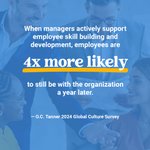
Development is one of the most reliable ways to keep good people, and one of the easiest to get wrong. Send someone to generic training that has nothing to do with what drives them, and it reads as a box being checked rather than an investment in them. The O.C. Tanner 2024 Global Culture Survey found that when managers actively support employee skill building and development, employees are four times more likely to still be with the organization a year later.  A manager backing someone's growth signals that the person has a future worth investing in, and that signal alone changes whether they stay. And when both the manager and the organization invest in an employee's development, they are nine times more likely to stay.  🤯 The number more than doubles when the support isn't coming from one person in isolation.  Development that's reinforced at both levels tells the employee the commitment is real and not dependent on having a good manager this quarter — and motivational intelligence is what helps you do it. Motivation is the natural wiring that determines what energizes someone, how they think, how they make decisions, and how they solve problems.  ✅ Growth that runs with that wiring feels like fuel, and the employee leans in.  ❌ Growth that ignores it feels like one more obligation, and the gesture that was meant to retain them does nothing.  MCode gives managers what they need to develop people in a way that fits.  Our assessment maps what drives each person, so a manager can build growth around the work that energizes someone and the direction they're wired to grow.  That way, development stops being a generic perk and becomes something the employee feels was built for them, which is exactly what turns it into a reason to stay. When development actually meant something to you, what made it worth it?
5
Most turnover gets blamed on things a raise or a new perk could fix. The deeper reason people leave is that no one ever understood what they wanted from the work itself. The Work Institute found that 75% of employee turnover could have been prevented if companies had a better understanding of what their employees wanted.  The wants that drive people out aren't about better coffee or a bigger title.  1️⃣ They want to be seen, understood, and valued. 2️⃣ They want work that engages them, development that feels meaningful, and a role that matches how they're naturally wired to think, solve problems, and contribute. Those wants trace back to what motivates a person, and motivation is specific to the individual.  It's what makes one person light up in a role that would drain someone else.  Most companies never get visibility into it, so they try to hold on to people with compensation and perks while the thing that would have kept them stays invisible.  By the time it surfaces in an exit interview, the person is already gone. Understanding what drives someone changes what you can do while they're still on your team.  You can give them work that engages them, build development that stretches them in ways they find rewarding, and shape a role around how they're wired instead of asking them to fit a mold that was never built for them. What made you want to stay in a role, or leave one?
6
There's a specific kind of professional who knows their strengths. They've taken the personality test, they've done the strengths inventory, and they can name what they're good at and how they're wired stylistically.  Yet, they're still unfulfilled in their work, and they don't know why. That gap is where personality and strengths assessments stop being useful. They describe who you are and what you're good at. They can't tell you whether the work you're doing taps into what drives you to engage.  TRUTH: You can be using all your top strengths in a role that fits your personality and still find the work draining, because nothing about the role connects to what motivates you intrinsically. The MCode assessment is built to surface that missing layer.  It identifies the underlying Motivations that pull your energy and effort, the ones that explain why you can love one project and dread another even when both use the same skills. It explains why a role you should love on paper drains you on Tuesday morning, and why a side project you have no business doing keeps lighting you up. That layer is the why behind every other assessment you've taken, and it's the part that changes how you choose your work. Discover your MCode and see what your personality and strengths results have been missing:  motivationcode.com/assessmen…
5
Generic management gives everyone the same pep talk, the same development plan, the same feedback approach. Personalized leadership understands that what energizes one person drains another. Generic management creates: → Disengaged employees → Wasted potential → High turnover of top performers → Missed growth opportunities Personalized leadership creates: → Psychological safety and belonging → Alignment between work and purpose → Genuine engagement (not just compliance) → Sustained high performance The difference isn't more effort. It's understanding what intrinsically motivates each person and leading accordingly — and the MCode assessment reveals exactly what does and doesn't energize your people, and gives you the language you need to personalize how you communicate with them! We share the complete framework for motivationally-aligned leadership — for providing high-value, resonant feedback — in this quick, 15-minute, pitch-free training: f.mtr.cool/8vn2jih6c1
5
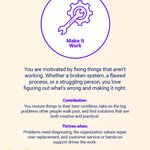
When Make It Work is one of your top Motivations, a broken thing snags your attention the way a fresh opportunity snags everyone else's. You'll volunteer for the mess nobody wants, and you'll be puzzled when people treat that as taking one for the team. Make It Work is just one of 32 Motivations that make you who you are and explain the WHY behind how you think, communicate, interpret the world around you, make decisions, solve problems, and act. Your unique ranking of these 32 Motivations reveals: 💡 Why some activities energize you while others leave you feeling drained. 💡 Why you naturally excel in some areas yet struggle in others, even when using the same skills. 💡 Why you work so well with some people, but have difficulty collaborating with others. Do you know what does and doesn't motivate you? Find out at motivationcode.com/discover-…
6
If you're motivated by Excel, your standards impress people until those standards apply to their work. Hearing that something is good enough registers as a challenge rather than a relief. Excel is one of 32 Motivations that form the WHY behind your thoughts, decisions, and actions — and that’s the game-changer, especially in your work! Motivations > Personality 👉 Personality tests describe how someone behaves.  👉 Skills assessments show what they can do.  🔥 Motivation Code reveals WHY.  Your MCode is how you’re naturally motivated, driven to win, and wired to succeed. It’s your competitive advantage. It’s your secret sauce. Your unique motivational ranking explains: → How you are wired for work. → What you need to be successful. → What causes you to struggle. → Who you are at your best. Have you discovered your MCode yet? Take the assessment at motivationcode.com/discover-…
11
Have you ever hired someone qualified who just... didn't work out under a specific manager? Here's what's happened: Managers unconsciously lead from their own motivational style. It shapes how they give feedback, set goals, define success, and communicate expectations. 👉 A Driver manager pushes for action and results. 👉 A Learner manager wants to understand root causes and explore options thoroughly.  👉 An Orchestrator manager coordinates resources and aligns cross-functional efforts systematically. None of that is wrong.  But it creates invisible expectations. When an employee's motivation doesn't align with their manager's style, both sides end up frustrated — and usually, the employee leaves. Here’s an example of what I mean: A Driver manager expects fast execution, but their new Relator employee wants context and connection before moving forward. The manager sees hesitation, and the employee feels rushed and undervalued. Same job.  Different motivations.  Total mismatch. We created a free training on how to assess manager-employee compatibility BEFORE you hire, so you can prevent the friction that leads to turnover. motivationcode.com/webinars/…
10
If you've been through DISC training, you can probably sit down with someone's report and spot patterns: → "They're a high-D, so direct communication, don't dance around the ask, and move fast." → "They're a high-S, so change needs more runway, consensus matters, and they'll disengage if decisions feel rushed." DISC does this well. It gives you a practical shorthand for the how of interacting with someone. But what DISC doesn't tell you, and what consistently trips up managers who rely on it alone, is why each person needs what they need. 1/3
1
4
Two people in the same role, with the same DISC results — two high-Ds, for example — can be motivated in completely different ways, which means how they're wired to approach work, solve problems, make decisions, and communicate is completely different. Maybe one is driven by measurable outcomes and personal achievement, and the other is driven by overcoming challenges and competition. DISC calls them both "high-D," but the management style that will engage, inspire, and fuel one will fall flat with the other. Motivation Code explains why. The MCode assessment results live underneath the behavioral layer and surface the intrinsic motivations that drive people. 2/3
1
2
This motivational intelligence reveals: ✅ What types of work energize and drain someone. ✅ What environmental conditions will cause them to struggle or succeed. ✅ What they need to engage deeply and feel fulfilled by and satisfied in their role. So use the DISC assessment for its quick behavioral reads and communication style insights, and add the MCode assessment to explain the why behind those results — why two people with the same profile respond so differently to the same leadership approach. See a side-by-side comparison of DISC and MCode and learn how the two assessments complement each other: motivationcode.com/compariso… 3/3
4
When a qualified buyer with a perfect-fit solution says, "I need to think about it," what's really happening? It's not your pricing. It's not your competitors. It's not timing. There's a communication gap you didn't even know existed. Your pitch didn't reflect what they value most. So, even though you explained everything clearly and addressed their stated needs, something felt... off. Not wrong exactly. Just not quite right. And when a decision doesn't feel right, buyers hesitate. Here’s an example: You're selling marketing automation software. You deliver a thorough presentation covering time savings, lead nurturing workflows, detailed analytics, integrations, and case studies. Your prospect nods along, asks good questions, and seems engaged.  Then you hear, "This looks great. Let me think about it and get back to you." Ugh. Seriously?! What just happened? You emphasized efficiency, data, and process optimization because that's what you've been trained to emphasize. But this particular buyer is a Visionary.  They're not motivated by optimizing current processes. They're motivated by transformation and future possibilities. They don't want to hear about saving 10 hours a week. They want to hear about pioneering a new approach to customer engagement that positions them ahead of market shifts. Same product.  Different emphasis.  Completely different level of resonance. When you lead with process optimization for someone motivated by transformation, your solution feels incremental. So they hesitate — not because the solution is wrong, but because the message didn't align with how they make decisions. Now imagine you'd identified their motivation earlier in the conversation. Instead of leading with "streamlined workflows," you lead with, "This will transform how you engage with prospects before they even know they need you. You'll pioneer an approach that positions you ahead of market evolution." Same software.  Same features.  Deep resonance. The "I need to think about it" hesitation disappears.  Want to learn the framework? Take the MCode assessment and discover the why behind how you make decisions. Then, check out our free sales personalization webinar and learn to recognize buyer Motivations early.
8
Most people assume high performers work more than everyone else. Yes, they do, and no, they don't. 😉 High performers put in longer, harder pushes against a deadline.  They also take more breaks, use all their vacation days, and protect their evenings and weekends more carefully than average performers do. Average performers are often the ones working without rest.  They grind through the day without stepping away, spill over into evenings and weekends, skip vacation days, and hit burnout regularly. Their productivity stays flat because the fuel runs out. 🧠 High performers know the math 🧠  To run fast, you also need to rest. So, between big efforts, they spend time in their sweet spot, doing work they're wired for, which restores their energy without the friction of work that doesn't fit them. The irony is that the behavior most organizations read as "less committed" (taking all the vacation days, logging off at a reasonable hour) is often a marker of the employees producing the most. There are 14 traits that separate high performers from average performers, including the ones that look counterintuitive until you understand the motivational wiring behind them. Want to learn about them all? This article gets into the dynamics of all 14 things that differentiate high performers: f.mtr.cool/9a1tvhzfj3
5
Two opposite mistakes send high performers looking for the exit, and most managers make one or the other without realizing it. 🚨 The first mistake is managing on autopilot.  When someone consistently delivers, it's tempting to leave them alone and let them do their thing. The logic: They're reliable, need less management than others, and can handle it. A manager values what they bring to the table and sees it as a way to demonstrate trust, but the employee often reads the lack of attention as neglect. High performers live on a diet of challenge and recognition, and the absence of both communicates that their contributions no longer warrant attention — and when that happens, they're less driven to go all in.  🚨 The second mistake is over-correction.  That manager realizes they've been too hands-off and swing the other way, injecting more oversight, more check-ins, more direction than the person needs. That reads as a totally different kind of insult: You don't trust them to make decisions or deliver the way they always have — and again, they pull back and disengage. 1/2
1
2
🔥 The space between those two extremes is where personalized management of high performers makes all the difference in how they show up and what they deliver. High performers need frequent recognition for what they bring, ongoing investment in what they could build, and autonomy within clear expectations. The trick is knowing, for each high performer: → The type of recognition that is meaningful → The type of work and work style that lights them up. → The type of communication they need to give it their all. And, if your team has taken the MCode assessment, this motivational intelligence is inside their reports. Oh, and these are just two mistakes of SEVEN! Read our article on the seven mistakes managers make with high performers, and the patterns to watch for in your own leadership: f.mtr.cool/yjaexazxxm 2/2
2
"Treat others how you want to be treated" is common leadership advice that's wrong for what most leaders are trying to do. People are wired differently. They're energized and drained by different things, and different contexts fuel or deplete their engagement, which is why the same management approach can produce opposite results depending on the person receiving it.  👉 The employee who wants public recognition doesn't respond to the same approach as the employee who prefers a private email.  👉 The team member who thrives on autonomy drains under the check-in cadence that energizes the one next to them.  👉 A leader who manages from their own preferences is unintentionally managing half the team well and half the team into disengagement. The leadership upgrade managers need is the ability to adapt their management approach to fit each person, and that requires knowing what drives them and what doesn't.  1/2
1
5
Once a manager has that motivational intelligence, the shifts needed become clear and specific.  ⭐️ You know who needs public recognition versus private. ⭐️ You know who needs autonomy versus close collaboration. ⭐️ You know who needs space to process versus decisions made quickly. Even better? You stop second-guessing whether the way you just delivered feedback will inspire and build momentum or shut someone down. That's the difference between a manager who's good with some people and a manager who's good with everyone on the team. MCode Team Alignment Workshops help managers build exactly this capability into their existing team, so they can become more effective leaders and build more cohesive teams. Interested? Want to know more? Here are all the details: f.mtr.cool/kvhmrjbtkw 2/2
4
When conflict at work feels personal, people pull back the effort and care they put into the job, out of frustration, resentment, or the sense that they've been disrespected, undervalued, or unseen. Harvard Business Review research by Porath and Pearson found that 48% of employees decreased their work effort after experiencing conflict, and 38% deliberately reduced the quality of their work. The cost of conflict shows up as capable people choosing to give less, and doing it on purpose. Most conflict-resolution advice treats the blowup as the problem and works to smooth it over, but the friction that drains effort day after day rarely comes from a single incident. It builds from the daily grind of working alongside someone whose approach clashes with yours, when neither of you understands why.  That underlying tension traces back to motivation, the natural wiring that determines what drives a person, how they think, how they make decisions, and how they solve problems.  When people are wired differently and have no language for it, the mismatch gets read as someone being difficult, and it starts to feel personal.  That's what turns ordinary friction into resentment, and resentment into withheld effort and lowered quality. Smoothing over the incident does nothing about the wiring underneath it, which is why the same tension keeps resurfacing with the same people.  What changes the pattern is understanding what drives each person, because the behavior that reads as difficult usually makes complete sense once you see the motivation behind it. That understanding is what lets people stop taking the differences personally and start working with them, maybe even seeing them as advantages. MCode gives teams that understanding.  Our assessment maps what motivates each person, giving everyone a shared language for how they and their colleagues are wired to work. The differences that used to build into resentment become something the team can name and navigate, so conflict stops eating the effort and quality your people would otherwise bring. When a work conflict wore you down, what made it start to feel personal?
16
Across 30 recent conversations with top performers who'd left jobs in the last six months, the reasons they walked rarely started with compensation. Five themes surfaced instead: → They were tired of internal politics. → They had ideas that never got traction. → They lost faith in the leadership. → They were bored and exhausted. Each of those themes connects to a specific type of motivational wiring: → Boredom depletes Achievers who need new challenges to shine and Learners who need new problems to master.  → Exhaustion piles up for Optimizers pulled into the same hero moment over and over.  → Lost faith hits Visionaries and Drivers first, since both are wired to chase forward movement that a stalled organization can't deliver. Retention at the top of your performance curve runs less on compensation and more on whether the work still fits how each person is wired. When it stops fitting, the best people find the exit. This is the read most retention strategies are missing. The MCode assessment shows you the motivational wiring behind every person on your team, so you can see who's running low long before they update their LinkedIn. You'll know which of your top performers needs a fresh challenge, which one is burning out in the same hero role, and which one is itching for forward movement the org isn't giving them. Pair that with the Job Fit Report, and you can match people to work that fuels them and catch a misfit while you can still fix it. Compensation keeps people from leaving for a number. Motivational fit keeps them from wanting to leave at all. If you haven't taken the MCode assessment yet, what's stopping you?! Change starts from the top down, so take it yourself first, see the difference motivational intelligence makes, and then share it with your team. Our Lite report is just $19! f.mtr.cool/t9v99rpgki
16
Strengths assessments tell you what you're good at and what you're not. The MCode assessment tells you what energizes you and what drains you. Those are different conversations, and they produce different decisions. Knowing your strengths helps you build a resume, polish a LinkedIn profile, and pitch yourself for a role. Knowing what energizes you helps you choose which roles to pitch for in the first place and avoid the ones where you'll be capable, competent, and miserable. 👉 Your most prominent MCode Motivations and Dimensions are the work and tasks that light you up, where you operate in high-performance mode and feel fulfilled.  👉 Your least prominent MCode Motivations and Dimensions are the work you can do, may even be good at, and don't get excited about.  👉 Both can use the same strengths. Only one feels like it fits you. That's why strengths-only thinking can sabotage a career. You can be promoted into a role that perfectly uses your strengths and find yourself, six months in, asking why this thing you're so qualified for doesn't feel like yours. Discover your MCode and see which work energizes you, which drains you, and why — and go Premium to get tools to enhance your professional bio, resume, and LinkedIn profile. motivationcode.com/assessmen…
5