





🔥🔥🔥

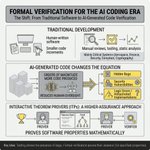
New on our Frontier Red Team blog: using Claude to formally verify software at large scale.
Formal verification can prove that code is free of certain bugs, but historically it has only been feasible for small codebases (or required a lot of expert time).
With AI models, however, this is beginning to change. In collaboration with @theoremlabs, we used Claude to prove security properties in over one hundred real-world open-source libraries over the span of a few weeks.
Read our research in full here: anthropic.com/research/forma…

We have heard so many debates about the future of #programminglanguages back at @Techweek_ and also many events were encouraging the usasge of #rust.
So here is our small contribution to your general knowledge about rust.
Disclaimer: not a coding advice😉
🤖 Made with AI

🔥🔥🔥

We’re releasing a broad range of new mathematical results produced by an internal frontier model.
We’ve been consulting with the independent Advisory Group on Mathematics and Artificial Intelligence at the Institute for Advanced Study, and we have drawn on their advice and public recommendations to inform how we release these results.
github.com/openai/math

👉👉👉

Most proofs languages are also programming languages. The reason is you need ways to define functions to reason, and from there you can define programs. Rocq can compile to OCaml for example.
I think it is still better to separate proof and program languages though, as the design spaces are a bit different, and then you can optimize the two independently.
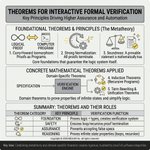
we see a big debate, all over X 🔥 on what #theorems are used for #formalverification. so here we have prepared something small 👉 for you to learn more 🍈🍈🍈
🤖 Made with AI


we are delighted to see @bcherny's update & #formalverification (we're working so hard on building) getting momentum!!!
PS: to ensure #correctness of your AI generated code / agent & its logic, you will need more than #lean SDK & skilful use of @claudeai 👌


Looking into the recent #NavierStokes debate, let us share our founder @guillaumeclaret's expert opinion 👉
Ready for the further drill down of the #interactiveprovers family? #Rocq& #Lean are the main languages, let's see how they compare 👉
#Formalverification

We are particularly bullish on the 1st family 🧑🧑🧒 of #interactiveprovers and here is a further breakdown 👉

Adding to that foundation 👉🏼this how #typescript was born youtu.be/U6s2pdxebSo
no hints, just laying down some foundations 👉👉👉 #java, a fascinating story of a language or how it all started youtu.be/ZqGSg4b_cZA
