
Cutting-edge independent research on global macro and markets. Including areas such as derivatives, commodities, equities & fixed income.
London
Joined August 2022
- Tweets1.8K
- Following1.5K
- Followers2.3K
- Likes749




***** Britain –> The government will not be able to raise living standards without significant cuts to public spending according to the think tank The Resolution Foundation. This is remarkable given it is seen as a left wing think tank. Britain’s living standards face a “catastrophic” outlook due to the surging cost of government debt. The “big choice” facing Burnham next year, “having not faced it at this Budget, is the choice between household incomes and department spending”. It said the typical working age household will see their disposable income fall by GBP1,050 between now and the next election.
The higher debt costs, which are poised to rise to GBP160bn by the start of the next decade, means “we are much, much poorer as a country”.
So far, governments have forced households to bear all of the burden rather than the state projects. Rather than allow inflation to eat away at state services, the government keeps topping them up, forcing the household to cover the cost.
The Institute of Fiscal Studies also said we face a decade of lost growth. Fundamental reforms are needed across a range of policy areas including energy policies, competition, education and tax. (Seperately, analysis by the Centre for Policy Studies shows the annual cost of hiring a minimum wage worker is poised to jump by more than GBP4,000 in just 3 years).
themacrostrategypartnership.…
5
375
***** Crack Spreads are the new "Rate Hikes"....
– Spot Brent fell USD6.08 yesterday to USD114.91bbl, dropping below the front month Brent future at USD116.19bbl. Whilst the curve remains in backwardation beyond the front month, this gradual flattening of the curve suggests an easing of spot prices as oil continues to flow, but an elevated price for an extended period as dangerously low inventories need to be rebuilt. This would change the dynamics from inflation to stagnation.Gas and coal prices continued to rise. (The US lent oil companies 40m barrels from its strategic reserves, the last batch of the US share of the global IEA deal).
Obviously, the longer the duration of the high energy price, the worse the situation is, i.e. if its 8% for one day and then comes back down, it is irrelevant. The longer it is above that level, then theoretically the economy would be consuming down the internal energy gradient of the capital stock – (ie things would be depreciating and not being reinvested in) until eventually the economy was sufficiently weak that it declined and the energy share of GDP fell back below that 7.1% level.
themacrostrategypartnership.…

1
306
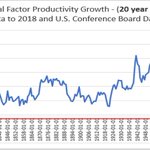
***** Britain – The Institute of Fiscal Studies warned that Britain faces the worst decade for household income on record. The think tank said a typical family’s disposable income would rise by an average of just 2% over the 2020s in the wake of the budget, the worst growth since records began in the 1950s. It described the budget as “unhelpful fiddling” that would not change the grim economic path. The chart below shows, over the preceding 20 years U.K suffered the worst decline in total factor productivity since the 1780s, clearly the consequence of the growth of government. Interestingly, that was when the French Revolution happened.
themacrostrategypartnership.…

***** The U.S.’s Exorbitant Privilege...
Reuters says the rising real yields reflect the scale of issuance, both from governments worldwide and from AI.
“There’s a competition for capital which is relatively unprecedented in recent times”
The US budget deficit is set to run at around 6% of GDP, France’s at 5% and the UK’s at 4%.
Central banks are also no longer buying bonds, which previously had suppressed bond yields, are favouring gold instead.
While the promise from AI is driving increased borrowing, lifting real yields, at some point the higher cost of capital, together with the cash burn, will be felt.
What the article doesn’t say is that the U.S. household savings rate has also been collapsing, reducing the supply of funds available for investment.
themacrostrategypartnership.…


***** Australia – Gig workers must be paid at least AUD31.30 (USD22.11) an hour, a world leading minimum pay and above Australia’s minimum wage of AUD26.44, the Fair Work Commission ordered.
The Transport Workers Union said it was now the “world leading standard”. The order followed the U.N.’s International Labour Organisation’s decision in June to adopt the first binding employment standards for gig workers, giving them rights around pay, safety and social benefits.
Great news, but you'll likely only get 1hr's work a day, maybe less.....
themacrostrategypartnership.…
1
529
**** From our latest note...
People aren't saving like they used to, and that's a red flag. It means money is being funneled into things that don't actually produce value or growth. A big part of this is the government acting like it knows best where money should go—and putting it into projects that don't create real, useful outcomes. When that happens, capital just gets burned up instead of building anything. Growth slows, the economy weakens, and the drop in savings is just one symptom of that waste.
You can see the damage in the job market too. Fewer people are working, and workers are getting a smaller slice of the economic pie than at any point since 1947. When an economy is this wasteful, it simply can't build up savings.
This is exactly why the AI boom will backfire. If AI replaces workers, those people need to land new productive jobs so they can actually afford to buy the AI products and services. If instead they end up unemployed and dependent on taxing AI companies just to get by, then those same companies get bled dry. The AI industry ends up starved of the investment it needs to survive.


***** Buying DRAM is the New Capex...
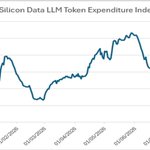
DRAM prices continued to soar, with the benchmark 4GB 512M X 8 USD11.97, up 65% over the past 3 months alone. This suggests much of the increase in capex is being absorbed by higher prices, with real capex increasing at a slower pace than the headline figures suggest, or even falling. With the token expenditure index down 28.5% over the same 3 months, the economics of AI appears to be deteriorating rapidly.
#DRAM #AI #Capex #federal


1
388
***** BoJ and monetary contraction.
Economy Minister Minoru Kiuchi said Japan has only seen moderate rises in consumer prices so far with limited pass through of higher costs from the Middle East. “The overall consumer price index rose 1.7% year on year in June, showing only moderate rises”. “We do need to be vigilant to the possibility that costs could be gradually passed onto food and other consumer goods from summer through autumn”. “We hope the BOJ continues to guide appropriate policy to stably and sustainably achieve its 2% target”.
Although the central bank is slow in raising rates, it is tightening policy rapidly through base monetary contraction, which was down 13.8% y/y in July, reducing the central bank’s balance sheet from 48.4% of broad money supply at the peak in 2024 to 39% today. This has limited broad M3 monetary growth to 1.5%.
#FedWatch

1
359
***** The crack spreads are destroying demand...
Normally crack spreads and the energy share of GDP seem to move roughly together. In the early part of the century, because of the massive underinvestment in fossil fuels, the energy share of GDP rose relative to the crack spreads, but once the shale resource started to be fracked, the two moved closer together once again. That is until now. With Middle Eastern and Russian refineries being targeted in their respective wars, crack spreads have widened to record levels. China has also limited its refining to domestic needs as it draws down on its crude inventories rather than chasing oil prices higher, although India is taking advantage of the spreads to import Russian oil and export refined product.
open.substack.com/pub/themac…
The combined primary energy share of GDP plus crack spreads is now 8.2% of World GDP, 15.5% above the post 2000 average. It is 51.5% of its August 2022 high or 55.6% of the July 2008 high.


1
452
***** Crude is not restricting the economy yet...
Primary energy is also below the 7.1% level of GDP that is supposed to be the balance between economic growth and decline. All of GDP is just the sum of energy conversions, each of which increases the transformity of work that is done. The higher the cost of extracting the fuel, relative to GDP, the less energy available for those downstream conversions, reducing GDP, and reducing the transformity of the capital stock. Putting aside the fact that renewable electricity is about 5 times the price of conventional electricity due to its low transformity and the need for capital stock to compensate, the energy share of GDP is not restrictive yet.
With Brent just below USD100bbl, energy’s share of World GDP is around 6.25%. This grosses up the fossil fuels share – (Brent oil, a 50:50 mix of U.S. natural gas and Asian LNG, and Australia Newcastle coal, all multiplied by the Energy Institute’s volume figures) – to 100% of the primary energy mix. The 6.25% figure is slightly below the average since the start of 2001 of 6.33%, and just 42.5% of the 14.69% record share of GDP on the 26th August 2022 or 44.3% of the 4th July 2008 high of 14.09% of GDP

***** US 10-year yield..
Whilst real U.S. index linked yields are climbing, breakeven yields are falling – (the US 10-year b/e yield has fallen to 2.2% and the 5-year to 2.19%) - suggesting the higher real yield is the result of excessive supply competing for limited funds given where short rates are. The 10-year real yield minus the 10-year breakeven yield is the highest since the GFC.
open.substack.com/pub/themac…


3
348
***** Yen/US Dollar....
Whilst the OECD estimates that the yen’s purchasing power parity (PPP) against the US Dollar is ¥94, having risen relentlessly over the last half a century, (see blue line in Chart 1 below), the spot exchange rate has been very volatile either side of PPP, briefly touching double PPP in 1995, alternatively trading, for the last couple of years, at a new 40-year low of ¥163, which is -42% below PPP (see green ellipse); almost as far below as it once traded above it. PPP is an anchor, but with a long and variable chain, which measures the build-up of mean reversionary pressure. The yen last traded at PPP as recently as end-2020, and never in its history has it been so far below this anchor. So, what has driven the yen down to such an unprecedented level
over the last five years? Whilst further weakness could still be on the cards (charts suggest a low of ¥/$177), from here on, the elastic will be stretched ever tighter, and ready for a huge reversal.


353
***** UK has lowest number of millionaires in 20yrs....
The number of British millionaires has dropped to its lowest level in nearly 2 decades as inflation eats into wealth and higher taxes and regulations drive the wealthy and entrepreneurs abroad. The Adam Smith Institute estimated there were now only 442,000 people in Britain worth more than GBP1m, down a massive 7% y/y, and the lowest since the 2008 GFC. “Every millionaire that leaves means less capital for British businesses, fewer international connections and weaker entrepreneurial spirit in the economy”. Prime Minister Andy Burnham has said that Britain has “overtaxed labour and undertaxed wealth”, and in a recent interview refused to rule out a wealth tax.
open.substack.com/pub/themac…

***** US Money Supply....
U.S. Money supply - (bank deposits + retail money market funds + currency in circulation) - rose a 3-month annualized 7.1% - (1 month annualized 3.9%). It was up USD422.9bn, made up of base money up USD38.7bn and commercial money up USD384.2bn, made up of a USD287.7bn increase in bank deposits and a USD97.1bn drawdown in the TGA account, slightly offset by a USD0.6bn build in the reverse repo.


1
273
***** where's the productivity??
Barclays said AI does not appear to be boosting productivity. Evidence that adopting the technology makes workers more productive is “unconvincing”. It found little to suggest that US industries that had embraced AI had seen larger improvements to productivity growth relative to where they were before the release of the technology. “Industry level evidence linking AI adoption to stronger productivity remains weak”.
So far, the hope has not materialised. “Our bottom line is that AI adoption appears gradual and steady rather than rapid and transformative, with most households and businesses still reporting limited exposure to the technology”. “At the same time, evidence of a structural pickup in productivity growth remains surprisingly fragile”.
I would add that labour productivity is one thing – (add a machine and a person is more productive) – but what about total factor productivity; does the machine pay for itself? In reality, because everything is just an energy conversion, there is no such thing as total factor productivity, so the real question is whether the AI is boosting energy consumption on a sustainable basis?
open.substack.com/pub/themac…
4
431
***** Warsh will be "one and done"
Fed Chair Warsh has set himself three, inherently
complementary, policy options. Potentially, all three can, could and should co-exist.
First, he needs to ensure bank liquidity remains ample,
implying Fed T-Bill purchases but which, all things being equal, increases the Fed balance sheet.
Second, he aims to, net, shrink the Fed balance sheet,
which implies he will want to revivify 2022-24 levels of QT.
Third, he will want to keep Trump happy with a program of headline-grabbing rate cuts.
A combination of all three in the right proportions would be net disinflationary, steepen the yield curve, encourage bank loan growth and promote real GDP growth.
What’s not to like?
themacrostrategypartnership.…
1
474
***** AI data centre build out..
The WSJ says the inflation problem is not from energy but from AI’s build out, which is pushing up the prices of everything from smartphones to electricity. The money pouring into AI is unprecedented. While much of the conversation is focussed on what AI can do, the buildout is strikingly physical. The data centers used for AI require sophisticated computing equipment, cooling systems to keep that equipment from overheating, electric and fiber-optic cables and backup generators to prevent power disruptions
open.substack.com/pub/themac…
2
1
550
***** Snippets from our Daily News..
-> U.S. Truflation measure, a real time measure, dropped below 2%.
-> Anthropic said frontier AI developers should establish a coordinated, verifiable way to slow down or temporarily pause development.
-> UK S&P Construction PMI dropped to 38.2 ..“Concerns about a prolonged decline in construction order books, alongside unfavourable near term UK economic prospects.
-> German carmakers lost ground to competitors at the start of the year.
themacrostrategypartnership.…
442
***** new highs in DRAM prices...again
ASML raised its 2026 revenue outlook as demand for AI chipmaking tools continues to increase. It forecast full year sales between EUR36bn and EUR40bn, up from its previous guidance of EUR34bn – EUR39bn. “Demand for chips is outpacing supply. In response, our customers are accelerating their capacity expansion plans for 2026 and beyond. Our customers have increased their expected short- and medium-term demand for our products"

286
****** The OECD said that Britain faces the biggest hit of all the world’s major economies from the Iranian war due to its reliance on energy imports. Inflation will increase more than in other countries, back up to 4%, knocking 50bpts off growth to 0.7%. The shadow chancellor Mel Stride said “Rachel Reeves has ramped up borrowing, spending and taxes. As a result, we have stagnant growth, while inflation, unemployment, the deficit and debt interest costs have all shot up”. “At the same time, Ed Miliband’s net zero obsession has left us reliant on imported energy instead of using our own supplies in the North Sea”.

241