

Volcanologist 🌋 Honorary Fellow at @GeosciencesEd and co-chair of @IAVCEI_thm. Views are my own.
- Tweets380
- Following747
- Followers1.1K
- Likes2K
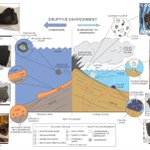




ALT Social Media brainstorming Social Media brainstorming 100% 10 P21 Figure showing a classification of volcanic deposits from the Chalco core, paired with schematic diagrams, core photos, and stratigraphic logs. The left side illustrates four volcanic processes—effusive, volcaniclastic mass flows, transient column, and steady column—each with a labeled diagram of eruptive behavior. The right side presents corresponding core photos and annotated sediment logs that highlight changes in texture, composition, and depositional features. Key features include vesicles, pumice clasts, graded bedding, and pyroclastic density current (PDC) deposits. Figure showing a classification of volcanic deposits from the Chalco core, paired with schematic diagrams, core photos, and stratigraphic logs. The left side illustrates four volcanic processes—effusive, volcaniclastic mass flows, transient column, and steady column—each with a labeled diagram of eruptive behavior. The right side presents cor





ALT Shift Leader, Folkmar Hauff, and co-chief scientist, Aaron Micallef, discussing dredge-rope tension and dredge locations.

ALT Shift Leader, Folkmar Hauff, and co-chief scientist, Aaron Micallef, discussing the ongoing dredge operation, whilst dredge team member, Silke Hauff (in green), communicates with the winch operators.

ALT Shift leader, Folkmar Hauff, and dredge team member, Silke Hauff on the RVMeteor's bridge directing dredge operations with nautical crew.

ALT Crew member, Willi Dorn, and scientist, Jakob Lang, pulling in a dredge full of interesting rocks!

ALT Some of the M191 scientists onboard the R/V Meteor after a successful dredging operation.

ALT Chief scientist, Jörg Geldmacher, presenting our work on the M191 expedition to the crew of R/V Meteor.

ALT Blog post about our first week at sea.

ALT Volcanologist and M191 science communication manager, Jacqueline Grech Licari, preparing the next blog post of our expedition.

ALT Post-doc volcanologist and M191 dredge team member, Alastair Hodgetts, holding the prized rock soon after its discovery.

ALT Detailed sketch by Alastair Hodgetts, with observations and potential interpretations for the rock's unusual texture.

ALT PhD student and M191 dredge team member, Kerys Meredew, at work sawing the new rocks to expose a fresh surface and facilitate texture descriptions.

ALT BSc student and M191 dredge team member, Jakob Lang, showing the rock to volcanologist Sebastian Watt soon after he spotted it in the dredge.

ALT 3D bathymetric model from multibeam echosounder (MBES) data for one of the confirmed volcanic edifices in the Western Sicilian Channel, for which we also captured a clear, distinct magnetic anomaly.

ALT Magnetic anomaly (top) and water column profile (bottom) from the magnetometer and multibeam echosounder (MBES) data for one of the confirmed volcanic edifices in the Western Sicilian Channel.


ALT One of the collected fumarole vents. A first for many of us!

ALT Water column profile from multibeam echosounder (MBES) data capturing gas escape through an active hydrothermal vent field in the Graham Bank region, which was first discovered in 2012. This confirms that the vent field has been active for at least 15 years. Link to paper by Coltelli et al. (2016) here: http://hdl.handle.net/2122/10536

ALT Detailed sketch by one of our geologists, Alastair Hodgetts. It picks apart the main features observed in the collected vents from exterior, cross-section and top/bottom views.

ALT Cross-section of one of the fumarole vents. Cool, isn't it?

ALT Dredge returning to the R/V Meteor for the geologists to check out the catch of the day (rocks).

ALT Morning shift (Jacqueline Grech Licari, Maxim Portnyagin and Meret Felgendreher) measuring (left) and describing rock textures (right) before packing them for their next destination.

ALT Amongst the samples collected were volcaniclastic rocks consisting of agglomerated clasts of different sizes (left), pyroclasts with bread-crusted surfaces (right) and bulk tephra samples consisting of lapilli-sized clasts and coarse ash (bottom). All these samples were collected above the Ferdinandea submarine volcano (also known as Graham Bank) that erupted in 1831.

ALT Radial jointing observed in some of the samples - potential surface flow feature or pillow?


