
Post-doc and BRIDGE Fellow in Cancer and Computational Biology at @dbc_unil @CirielloLab. Machine Learning for spatial omics.
Joined October 2014
- Tweets259
- Following647
- Followers283
- Likes399






Pinned Tweet
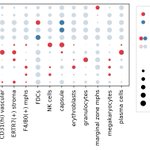
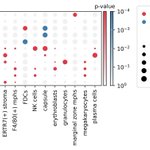
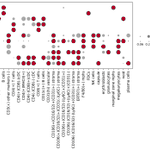
Excited that our paper "CellCharter reveals spatial cell niches associated with tissue remodeling and cell plasticity" is finally out! 🎉
A spatial clustering method for any type of spatial proteomics, transcriptomics, or even epigenomics data!
nature.com/articles/s41588-0…
I’ve been reading about neutrophils, and they are much weirder cells than people realize.
They’re the most abundant leukocyte in human blood, produced at 1 billion cells/kg/day, yet they’re poorly represented in many single-cell atlases.
A few things I found interesting🧵
Some of these tethers detach and swing around to the front, forming structures called “slings”.
The sling can then create new adhesive contacts with the vessel wall as the neutrophil continues rolling.
A surprisingly mechanical solution to the problem of moving under flow.
Neutrophils are extremely fragile, which helps explain why they are often underrepresented in scRNA-seq datasets.
This is part 1 of a series on neutrophils, focusing on their production, lifespan and migration:
batcheffect.com/p/neutrophil…
I collected all of what I could find about the upcoming @illumina Spatial Transcriptomics technology, with some predictions about costs and sensitivity compared to @10xGenomics Visium HD.
batcheffect.com/p/the-giant-…

🎉 We released CellCharter v0.3.2!
- Now part of the @scverse_team ecosystem
- More efficient differential neighborhood enrichment
- Peak finding for cluster stability
- Compatible with the latest PyTorch
A few lessons learned along the way 🧵 1/5
github.com/CSOgroup/cellchar…

Key takeaway for choosing a dependency to add to your library.
Choose either:
1️⃣ Well-maintained packages (e.g., PyTorch, Scanpy, Seurat).
2️⃣ Simple packages that don't require updates (e.g., tqdm).
3️⃣ Packages you are ready to take over if the original maintenance stops 4/5
Lastly, big thanks to @LukasHats for spotting a memory leak in the differential neighborhood enrichment function!
This pushed me to refactor it completely.
Now it's much faster and more memory-efficient. 🚀 5/5
New Batch Effect blog post! 🧬
Finding domains from spatial omics data has exploded in popularity, with over 87 methods!
However, two mistakes in their evaluation might be leading us in the wrong direction.
batcheffect.com/p/the-pitfal…

Marco Varrone retweeted

Call for PhD in quantitative Biology!!
Applications open ...
unil.ch/quantitative-biology…
#PhD #computationbiology #quantititivebiology

New Batch Effect blog post!
We often think complex algorithms are the key to analyzing spatial omics data. But sometimes, simplicity can be as effective. 🧵
batcheffect.com/p/when-simpl…

Neighborhood aggregation proved remarkably effective in capturing crucial spatial relationships while being scalable to millions of cells.
It is also the base of CellCharter, the framework we developed during my PhD to study domains from spatial omics data.
New blog post!
We are used to thinking that, when an organism has cancer, all other cells will fight it.
We are now realizing that this is not true, and some of these cells may even help it.
In this latest Batch Effect post I talk about 4 aspects 🧵
batcheffect.com/p/the-hidden…

3. How spatial omics can identify cell communities and true cell interactions to understand what is really happening.
4. How discoveries driven by spatial omics will lead to new effective therapies.