

Senior AI Engineer @google • Kauffman Fellow • ☸ • 🇵🇷 • ⛷ • 🏊🏾 • 🧘🏿♂️ • implacable • L∃∀N
San Francisco Bay Area
Joined May 2009
- Tweets12.6K
- Following1.2K
- Followers2.3K
- Likes12.8K





Marcos Polanco retweeted

Lean 4は、実際にはどのような仕組みで動いているのでしょうか?
その根底にある考え方は、驚くほどシンプルです。
「命題は型であり、証明はプログラム。そして、証明の検証は型チェックである。」
ある命題 P を証明したければ、型が P であるような項(term)を構築すればよいのです。定理証明器の仕事は、その項が本当に主張された型を持っているかを確認することです。
では、これは実際にはどのように実現されているのでしょうか?型チェッカーは、帰納法、等式、再帰、あるいは rw や simp のようなタクティクを、どのように扱っているのでしょうか?
今回、Rustで実装した最小限のLean 4風定理証明器 MiniLean4 と、その内部実装をゼロから解説する無料のインタラクティブな教材を公開しました。
learn.h5i.dev
この教材は、わずか5種類の項と8つの型付け規則から始まります。そこから少しずつ機能を追加し、実際に動作する証明チェッカーを構築していきます。
まず、型推論と型チェックを実装します。次に、簡約(reduction)と定義上の等価性(definitional equality)を導入します。これによって、カーネルは計算によって同じ結果になる式を等価なものとして認識できるようになります。
続いて、帰納型(inductive types)を実装します。 自然数から始めて、リスト、木構造、さらに一般的な帰納型の族(inductive families)へと拡張していきます。また、recursor(再帰子)を導出することで、再帰や数学的帰納法が内部的にどのように実現されているのかを理解します。
さらに、等式そのものも帰納型として実装し、少数の型付け規則と計算規則だけで、式の書き換え(rewriting)をどのように正当化できるのかを見ていきます。
最後に、タクティクエンジンを構築します。intro、apply、induction、rw といったタクティク自体を信頼する必要はありません。タクティクは証明項を構築するだけで、その正しさはカーネルが独立して検証します。
そのほかにも、宇宙レベル(universe levels)、代入、正規化、そして論理的な矛盾を避けるために型理論がどのように設計されているのかについても解説しています。
インタラクティブなデモも多数用意しました。実際のRust製カーネルをWebAssemblyにコンパイルしているため、ブラウザ上で直接証明を実行できます。
型付けの導出過程を確認したり、式が簡約される様子をステップごとに追ったり、タクティクによって証明状態がどのように変化するかを視覚的に確認したりできます。
このプロジェクトの目標は、定理証明を魔法のようなものではなく、普通のプログラミング言語の実装として理解できるようにすることです。
形式検証という言葉をよく聞くけど結局何をしているのか気になっている方、Lean 4を使ったことはあるけれど、by の裏側で何が起きているのか知りたい方、あるいは、型付け規則がなぜ形式検証の基盤になり得るのか興味がある方に、ぜひ読んでいただければと思います。
e-Bookはこちら!:learn.h5i.dev/


Marcos Polanco retweeted

btw if you can build a category leader open source project in ai engineering right now the market acquihire rate is ~$10-$100m per ai engineer.
you do not need to figure out a business model, you do not need GTM, you do not need funding.
just build things clankers want.
Marcos Polanco retweeted

Models by @GoogleDeepMind scale better on cost than their rivals.
Gemini 4 Carbon is the prime example. As tasks get more demanding, every rival gets more expensive relative to Carbon.
For a typical task, GPT-6 Astra by @OpenAI costs 3.4× as much, Claude Opus 5.5 by @AnthropicAI costs 3.9× as much, and GPT-6.1 Sol is the cheaper option at about half of Carbon’s cost (0.54×).
Across the 5% most expensive sessions, Carbon’s position improves against all three. Opus edges up to 4.2×, Astra’s cost roughly doubles relative to Carbon, and Sol’s discount shrinks.
This in turn can translate into meaningful savings across real-world tasks such as building an Android security app, one of many long-horizon tasks that our Agent Arena users delegate to their agents.

As tasks get more complex, @GoogleDeepMind and @XiaomiMiMo are the biggest winners in the Agent Arena.
On cheaper tasks, @OpenAI and @AnthropicAI hold 10 of the 11 frontier spots. On the most expensive 5% of sessions, they hold just 7. The freed spots go to Google’s Gemini 4 Argon and Xiaomi’s MiMo-V2.6 Flash and Pro.
These shifts matter as sessions costing $100 or more are not uncommon across real-world use cases coming from Agent Arena. Even within the last 2 weeks, more than 1,000 sessions crossed that boundary, and choosing a suboptimal model might have had a meaningful impact on that final bill.
Marcos Polanco retweeted

We asked GPT-6 Astra to edit Qwen3.5-0.8B weights to improve math.
It directly changed only 0.016% of weights, fixing 0.8B's reasoning loops & improving math up to 6x and even instruction following 3x, without gradients or training.
We call this Weight-Space Programming: frontier LLMs can now natively read/write neural network weights! 🧵
Blog: rikiyat.github.io/blog/weigh…

Readers added context they thought people might want to know
LLM was given weights explicitly as text in prompt and used code/forward passes (per authors' logs) to ablate Qwen looping direction, a known thinking-mode issue per model card. Primarily fixed repetition in that mode, not general 'natively' improving weights/math.
rikiyat.github.io/blog/weight-sp…
github.com/RikiyaT/lm_und…
huggingface.co/Qwen/Qwen3.5-0…
huggingface.co/RikiyaT/Qwen3.…
Marcos Polanco retweeted

Google’s Gemini 4 Carbon is the new #1 on the Artificial Analysis Intelligence Index v5, and second only to Claude Opus 5.5 on the Artificial Analysis Coding Agent Index
Gemini 4 Carbon scores 59 on Intelligence Index v5, driven by leading performance in complex reasoning, knowledge, and scientific tasks. It also has large gains in coding and knowledge work, particularly when compared to other Gemini models, but it is not leading in all these areas.
As with launch of Gemini 4 Argon, Gemini 4 Carbon is being rolled out to selected users and is not yet publicly available. Google is offering a 50% launch discount, with no confirmed end date. All our charts and figures use standard pricing for both Gemini 4 Carbon and Argon.
Key results for Gemini 4 Carbon with high reasoning:
➤ Gemini 4 Carbon leads the Intelligence Index v5, with the #1 score in 4 of the 9 Index evaluations: HLE-Diamond, Terminal-Bench-Science, AA-Omniscience, AutomationBench-AA. Carbon makes substantial gains elsewhere but is not leading in coding and knowledge work
➤ Behind only Claude Opus 5.5 on coding agents: With Antigravity CLI, Gemini 4 Carbon (high) scores 59 only 3 points behind Claude Code with Claude Opus 5.5 (max, 62) on the Artificial Analysis Coding Agent Index. Carbon ranks second on both Terminal-Bench 4.0 (64%) and FrontierCode v1.1 (51%), behind Claude Opus 5.5 (max) at 56%. Google has historically underperformed in this area and so this improvement stands out
➤ Improved agentic knowledge work, but not yet leading: On AA-Briefcase, Gemini 4 Carbon (high) scores 1609 Elo, a 126-point improvement over Gemini 4 Argon (high, 1483), but still behind models including Grok 4.7 (xhigh, 1638), Muse Wonder (max, 1659) and Kimi K3.1 Pro (1678). The largest gain comes from Presentation, up 293 Elo to 1598, alongside a 120-point improvement in Analytical Quality to 1671
➤ Lower Cost per Task than Claude Opus 5.5 for comparable overall intelligence: Gemini 4 Carbon costs $7.76 per Intelligence Index task, ~23% less than Claude Opus 5.5 (max, $10.04) but ~1.2x GPT-6 Astra (max, $6.25). It uses 123k output tokens per task, 29% fewer than Claude Opus 5.5 (max, 173k). At the same $4/$20 standard pricing, its Cost per Task is in line with Gemini 4 Argon ($7.68), while scoring 9 points higher on the Intelligence Index
➤ Leading AA-Omniscience v1.1 score, with low hallucination: Gemini 4 Carbon scores 54 on our recently updated AA-Omniscience v1.1, 6 points ahead of Claude Opus 5.5 (max, 48) and 8 points ahead of Gemini 4 Argon (46). Accuracy (% correct) rises 10 points over Argon to 58%, while its hallucination rate rises from 4% to 11%. This is still the second lowest of any model, behind only Argon, compared with 50% for both Claude Opus 5.5 (max) and GPT-6 Astra (max)
Key model details:
➤ Context Window: 1M tokens
➤ Multimodality: Text, image, video, and speech input, with text output
➤ Pricing: $4/$20 per 1M input/output tokens, the same as Gemini 4 Argon’s standard pricing, with a 50% discount. Cached input tokens receive a 95% discount ($0.20 per 1M)
Congratulations to the @GoogleDeepMind team!

Marcos Polanco retweeted

Gemini 4 Carbon is our next frontier model.
It’s state-of-the-art across cybersecurity and long-horizon capabilities.

Marcos Polanco retweeted

Meet Nex-N2.5 family, our latest open source agentic models.
Mini (35B) and Pro (397B) bring multimodal understanding and computer use. Max (1.6T) is a text-only MoE model built for complex reasoning, coding, and agent workflows.
Strong benchmark results in workflow automation and computer use:
⚡ Max scores 50.2 on AutomationBench v1.0.6—just 0.1 points behind Claude Opus 5
⚡ Pro scores 56.4 on OSWorld-2, ahead of Qwen3.8-Max at 46.7
With continuous action, visual feedback, and self-correction, NEX-N2.5 can work across Blender and CAD tools, handle expense reimbursements, and even play PC games—turning visual understanding into sustained, real-world execution.
🔗@huggingface
huggingface.co/nex-agi/Nex-N… huggingface.co/nex-agi/Nex-N… huggingface.co/nex-agi/Nex-N…
🔗@modelscope
modelscope.cn/models/nex-agi… modelscope.cn/models/nex-agi… modelscope.cn/models/nex-agi…
🔗 Github github.com/nex-agi/Nex-N2.5
🔗Website nex-agi.com/
Marcos Polanco retweeted

I'm happy to share that Mojo and MAX are now fully open - for development, extension, and commercial use! This includes the full Mojo programming language, but also the MAX graph compiler, MLRT runtime internals, and hardware abstraction logic.
Get your agents going!👇
Marcos Polanco retweeted

We added Gemini 4 Argon to our AutoResearchExam Pareto curve. It is 2-3 times cheaper compared to the other frontier models for almost the same ML engineering performance. Congratulations to the GDM team.

Marcos Polanco retweeted

ALERT🚨: NVIDIA has been working overtime, nights, and weekends after being shocked 🤯 by last week’s TPUv7 FP8 submission showing better performance per dollar.
Unfortunately for NVIDIA, its first GB300 FP4 counter-submission is still 1.64x worse in performance per dollar than TPUv7 for external customers across most of the end-to-end performance curve.
The x-axis of the graph below uses end-to-end latency, so a higher curve is better. The TPUv7 curve has higher perf per $ across most of the E2EL Pareto frontier.
This initial submission looks like NVIDIA’s first attempt to close the gap, but the gap is still massive. We expect more counter-submissions from NVIDIA as they continue trying to narrow the difference.

Marcos Polanco retweeted

We’ve teamed up with Google DeepMind and Zapier to host the inaugural Bench Summit by Kaggle.
Gain hands-on insights from the AI startups and researchers defining today’s evaluation standards, and get closer to the frontier.
Secure your spot or apply to speak:
rsvp.withgoogle.com/events/b…

ALT Announcement graphic from Kaggle for the Bench Summit. The image has a light cream background with a stylized, artistic illustration of a mountain peak overlaid with yellow contour lines and subtle geometric wire frame arrows pointing upward. Logo at the top reads "kaggle." Text at the bottom includes a red pin icon for the location "San Francisco", a calendar icon for "October 28, 2026", and the main heading: "Shape the next generation of evaluation @ Bench Summit".
Marcos Polanco retweeted

Come and work with me and my team @GoogleDeepMind!
We're looking for people with a background in philosophy, politics, computer science etc. who want to work on the biggest challenges in AI ethics and alignment:
google.com/about/careers/app…
Marcos Polanco retweeted
BREAKING NEWS🚨: Google has submitted its FIRST TPUv7 FP8 vLLM results to our Agentic Inference Benchmark and has demonstrated 1.67x better perf per dollar than even GB300 NVL72 FP4. 🚀
It is amazing to see Google go full steam ahead with externalizing the power of TPUs outside of Google.👇️ (1/4)🧵

Marcos Polanco retweeted

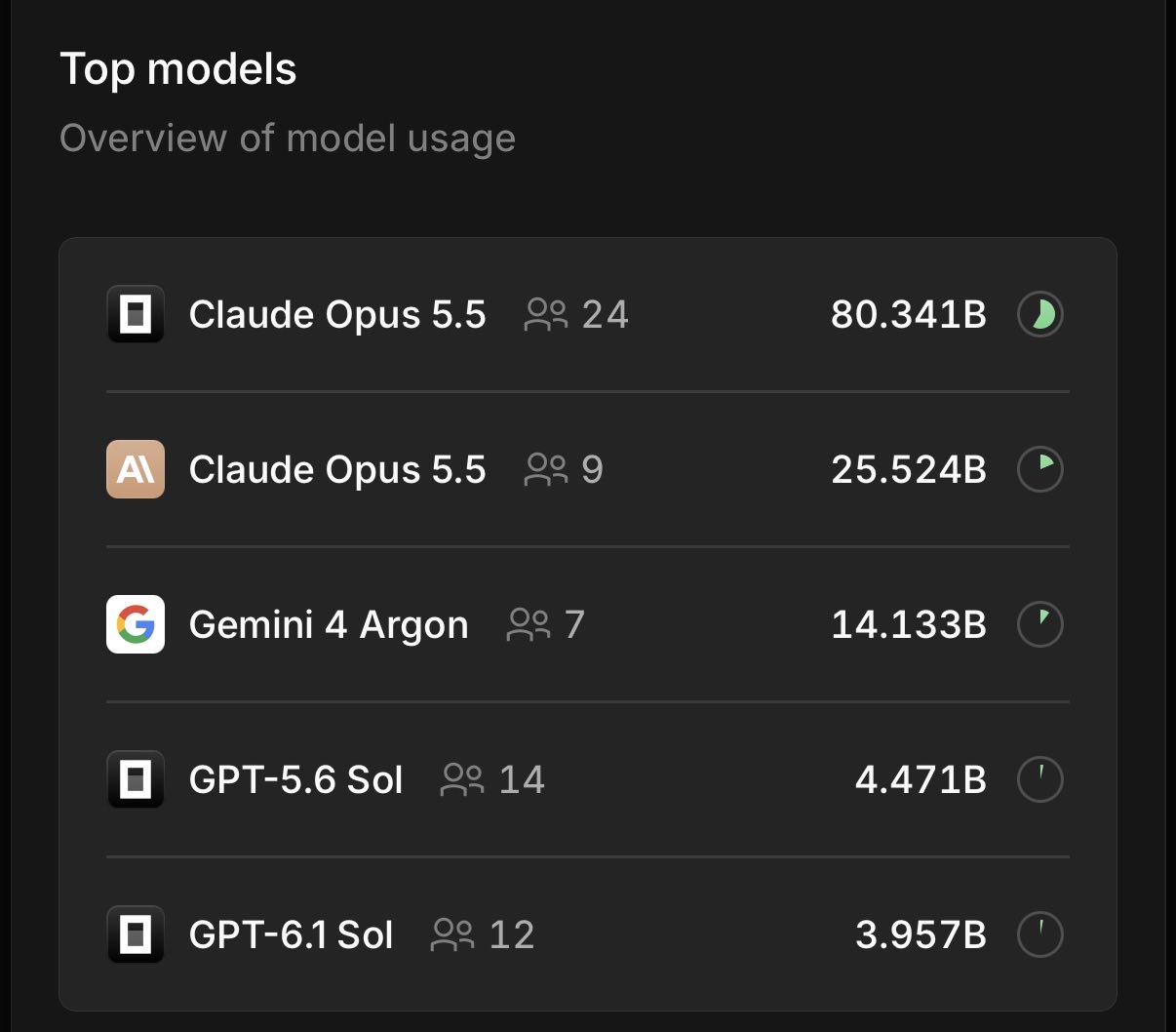
My take after testing Argon 4 over the past week, is that Google is back in the running. It feels like the org was already AGI pilled but agent usage wasn't high, which is why Claude pulled ahead. This is the first frontier agent model that seems to actually seems to be getting usage internally at Google. Extremely bullish sign and great for consumer who can pick from 3 (maybe 4 with Meta?) frontier labs again.

BREAKING: Gemini 4 is OUT and it's SURPRISINGLY GOOD??
I admit I was ready to trash this model qhen I saw the benchmarks but six of us at @every spent the past week testing it across coding, writing, design, and knowledge work, and were pleasantly surprsied.
It’s a breakthrough if your company lives in Google’s ecosystem, and a strong option for frontier hoppers as a secondary model for certain tasks. I
Here’s our vibe check:
My new favorite writing partner. DeepMind hired professional writers with red pens to stamp out AI slop, and it worked. I use it to untangle structure and sharpen metaphors; it also taught me something new tracing in a few of my favorite books. It's got a natural feel for structure and detailed explanations that Astra and Opus lack.
Shaky at refactors, fast on greenfield apps. At low effort on a from-scratch build, Gemini 4 built @kieranklaassen a working webcam heart-rate monitor in 35 minutes—matching Claude Opus 5.5’s quality and beating OpenAI’s models on that test. Where it cuts corners is self-verification and existing codebases. In 17 of Kieran’s 38 benchmark runs, it opened and closed its code-review step just 30 milliseconds apart instead of inspecting its changes. And on my Senior Engineer benchmark—refactoring a vibe coded slop codebase—it worked for four hours and 47 minutes and scored just 21% (versus 81% to 85% for GPT-6 Astra, Fable 5.1, Sonnet 5.5, and Opus 5.5). Not great.
A 2026 model trapped in a 2025 harness. Antigravity, Google’s desktop agent app, feels six months to a year behind Claude Code and Codex—lacking cloud environments, SSH, a built-in browser, and smart permission checks (leaving you clicking constant pop-ups or using unrestricted "Turbo" mode).
Net Result: I keep ChatGPT and Claude open day to day, and switch to Gemini 4 when I need an editorial partner to structure a tough essay, sharpen a metaphor, or close-read a book. Reach for it for live writing collaboration, fast low-effort prototypes, or steerable UI and dashboard design—ideally via Cursor or the API to skip Antigravity.
When a model is good enough to force you to use a bad harness, it tells you something.
State of Play: Google hadn’t shipped a major flagship upgrade since Gemini 3 Pro last November. For teams whose companies live in Google’s ecosystem, the model you can use inside your approved work tools finally belongs with the frontier pack. DeepMind closed the model gap; now Google needs to bring the app around it into 2026.
Read our full vibe check: every.to/p/vc-gemini-4-argon…


Marcos Polanco retweeted

BREAKING: Gemini 4 is OUT and it's SURPRISINGLY GOOD??
I admit I was ready to trash this model qhen I saw the benchmarks but six of us at @every spent the past week testing it across coding, writing, design, and knowledge work, and were pleasantly surprsied.
It’s a breakthrough if your company lives in Google’s ecosystem, and a strong option for frontier hoppers as a secondary model for certain tasks. I
Here’s our vibe check:
My new favorite writing partner. DeepMind hired professional writers with red pens to stamp out AI slop, and it worked. I use it to untangle structure and sharpen metaphors; it also taught me something new tracing in a few of my favorite books. It's got a natural feel for structure and detailed explanations that Astra and Opus lack.
Shaky at refactors, fast on greenfield apps. At low effort on a from-scratch build, Gemini 4 built @kieranklaassen a working webcam heart-rate monitor in 35 minutes—matching Claude Opus 5.5’s quality and beating OpenAI’s models on that test. Where it cuts corners is self-verification and existing codebases. In 17 of Kieran’s 38 benchmark runs, it opened and closed its code-review step just 30 milliseconds apart instead of inspecting its changes. And on my Senior Engineer benchmark—refactoring a vibe coded slop codebase—it worked for four hours and 47 minutes and scored just 21% (versus 81% to 85% for GPT-6 Astra, Fable 5.1, Sonnet 5.5, and Opus 5.5). Not great.
A 2026 model trapped in a 2025 harness. Antigravity, Google’s desktop agent app, feels six months to a year behind Claude Code and Codex—lacking cloud environments, SSH, a built-in browser, and smart permission checks (leaving you clicking constant pop-ups or using unrestricted "Turbo" mode).
Net Result: I keep ChatGPT and Claude open day to day, and switch to Gemini 4 when I need an editorial partner to structure a tough essay, sharpen a metaphor, or close-read a book. Reach for it for live writing collaboration, fast low-effort prototypes, or steerable UI and dashboard design—ideally via Cursor or the API to skip Antigravity.
When a model is good enough to force you to use a bad harness, it tells you something.
State of Play: Google hadn’t shipped a major flagship upgrade since Gemini 3 Pro last November. For teams whose companies live in Google’s ecosystem, the model you can use inside your approved work tools finally belongs with the frontier pack. DeepMind closed the model gap; now Google needs to bring the app around it into 2026.
Read our full vibe check: every.to/p/vc-gemini-4-argon…
Marcos Polanco retweeted

Over the last 5 years, Google teams have published 90 peer-reviewed papers (90k+ citations) on disease understanding.
Today, @pushmeet and I shared how Google is helping researchers accelerate discoveries across the continuum—from foundational biology to the bedside: blog.google/innovation-and-a…

Marcos Polanco retweeted

The people wanted it, here it is.
Full disk search, in milliseconds. 17,000x faster than Finder.
github.com/noahdunnagan/fsea…

Marcos Polanco retweeted

Every fundamental law of physics - Newton, Einstein, Quantum Field Theory - is derived from a single equation. Physicists don't propose new laws by writing forces anymore. They write a new Lagrangian and the math produces the physics automatically. The same principle that governs a swinging pendulum governs every quantum field in the universe - and the optimizer inside every LLM training run is solving the same underlying problem.
The mechanism is stationary action. A system takes the path where the total action stops changing for any small variation. That condition produces the Euler-Lagrange equation. One equation, any number of variables, any theory of physics. In Quantum Field Theory the variables are fields across all of space and the gradient must vanish at every point simultaneously - exactly the convergence condition gradient descent hunts for across billions of LLM parameters during backpropagation.
20 minutes. Bookmark & watch today. The single equation that every law of physics is secretly a special case of.

