

Functional and Evolutionary biologist studying eggshell structure, nests and life-history traits across all birds, and monitoring albatrosses from space.
Surrey, England
Joined August 2013
- Tweets96
- Following128
- Followers145
- Likes546




Behind the scenes of our latest fieldwork with Wildlife from Space team! 🌿🛰️ Using spectroscopy + satellite imagery to monitor burrowing petrel recovery on South Georgia after invasive species removal. #WildlifeFromSpace #RemoteSensing
darwinplus.org.uk/news/2025/…
20
🪶🌊 At #Biospace25, my talk reveals how citizen science delivers reliable population estimates of wandering albatrosses across South Georgia. Harnessing the power of the public for conservation! 🦅🌎 #CitizenScience #SatelliteImagery #WildlifeFromSpace

1
26
📡🐾 Excited to share insights at #Biospace25 conference! Peter Fretwell from Wildlife From Space (BAS) explores how citizen science satellite counts stacks up against ground counts for walrus. Can space-based monitoring support conservation from above? 🦭🛰️ #WildlifeFromSpace

1
34
Marie Attard retweeted

HUGE paper on carnivore skull trade-offs by @Gab_Sansalone @MarieRAttard @CarmeloFruciano Geoff Coates and Steve Wroe
Nice work on the gazillion models!
rdcu.be/dEW4C
From lions and tigers to bears, mammalian carnivore skulls vary greatly. New research reveals that there is typically more variation in carnivore skulls optimised for velocity (how quickly the jaw closes) than force (to produce a more powerful bite). doi.org/10.1038/s41467-024-4…

If you would like to help us find albatrosses from space, we currently have a live campaign:👀📷📷
zooniverse.org/projects/mari…
New findings using global dataset of 4260 (> 41%) avian species assess evolutionary adaptations of their eggshells to be relatively thicker or thinner due to diet, nesting environment and breeding strategy. #eggshells #shellthickness #birdevolution doi.org/10.1111/ibi.13136

Very excited to read the proofs for a new Thylacine book coming out soon! It will be my first book chapter.
Marie Attard retweeted

The #AlbatrossesfromSpace website is now live! Here you can find out more about using high-resolution #satellite imagery to monitor breeding #albatrosses on remote islands! bas.ac.uk/project/wildlife-f…


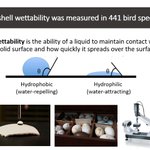
6/6 #BOU2022 #BREAK3 Our findings identify clear adaptations of eggshell wettability across a diverse range of nesting environments, driven by the need to retain heat and prevent microbial adhesion. For further details go to our paper - royalsocietypublishing.org/d….


Marie Attard retweeted

6/6 #BOU2022 #Break2 We emphasise that future studies investigating hatching failure in birds should: ensure they have considered the female factors influencing fertility, clearly differentiate between infertility and embryo mortality, and monitor failed breeders more routinely.

Marie Attard retweeted

Super work on female #fertility in #birds by @sheffielduni @EEB_Sheffield @ACCE_DTP PhD student @kassersohn - to find out more read her @RoySocPublishing paper royalsocietypublishing.org/d… #ornithology #reproduction #eggs #BOU2022


1/6 #BOU2022 #Break2 Hi BOU! I’m Kat, an @EEB_Sheffield and @ACCE_DTP #ornithology PhD student. I’m excited to present some of the key findings from our recent review on the physiological factors that influence #fertility in female #birds🥚🐣🐥

