

Studying, MSc Planetary Sciences. Space architecture. Mars.
Joined March 2020
- Tweets702
- Following655
- Followers166
- Likes4.8K





Pinned Tweet
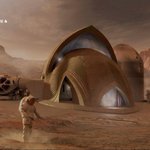
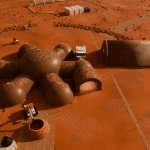
Good evening 🌒 this weekend saw some completed targets of said design concept: Ridgeline Six, Arcadia Plantitia.
Runs on 4 small fission reactors, 160kWe, 1k from crew. The render also shows the design of the hab radiators. They shed roughly ~75kW of waste heat, after first using it to melt ice for fuel. The site also includes 2,400 m² of Solar.
The site used in the renders is from a HiRISE image, chosen for likely shallow ground ice 👍🏻


I decided to create an animation to elucidate the leading candidate sites for the first crewed base. Each site, has its own card with the key facts.
Remarkable milestone for deep space exploration. It paves the way for surface power on the future Moon base, and eventually Mars. Ice + reliable power. ISRU. I hope they look at Arcadia Planitia…

We've decided on key design features and mission details for Space Reactor-1 Freedom, the first fission-powered spacecraft to travel beyond Earth orbit. Set to launch in 2028, SR-1 Freedom will demonstrate nuclear electric propulsion in deep space. go.nasa.gov/3XMCRaI

ALT Artist's concept of NASA’s Space Reactor-1 (SR-1) Freedom spacecraft with solar arrays extended as it cruises past Mars.
5
225
How have I only just stumbled on Lunar Forge.

Laser vs. Orbital Concentrated Solar: Which Approach for Processing Lunar Regolith?
Orbital Fresnel lenses are an elegant idea - collect sunlight over a massive aperture in lunar orbit and focus it onto the surface to sinter regolith. No consumables, no fuel, effectively unlimited energy.
But physics gets in the way.
Chromatic aberration means only a narrow slice of the solar spectrum actually converges at the target. Pointing stability of ~0.02 arcseconds is required while traveling at 1.6 km/s. Dwell time is minutes per pass with two-hour gaps. And permanently shadowed regions - where the most valuable ISRU sites are - can't be reached at all.
Surface-based laser processing solves all of these. Geometric precision, adaptive thermal control, continuous operation, any location, any lighting condition.
We broke down exactly how each approach works, where each fits, and why we chose laser processing for fission reactor infrastructure.
Full article:
lunarforgespace.com/laser-vs…

2
3
154
Many habitat concepts, like this one, give crews direct access to pressurised rovers and suitports. Docking rovers to the habitat is already built into many designs.

1
4
121
Mars. Catenary arch for reference, entrance to Airlock. Suitports for EVA. *Dust mitigation* (same as many other design concepts for Mars - favoured for ingress & egress method). Pressurised rover (also with suitports) connected to Airlock. The most likely solution for lunar moon base (pressurised rover & modules) would also be applied to a Mars base, predominantly because of proven full fidelity & TRL 9. That’s it.

Spent today covering biotechnology. Mycelium & melanin! Also biosensors: Pressure, O2.. fascinating stuff.
67
ρ = 1500kg/m³, g = 3.71m/s²: ρg = 5.6
kN/m³, so 1 m of cover is about 5.6 kPa (14.7 kPa on Earth).
55
Set in Arcadia Planitia; terrain from public NASA/ESA elevation data & Lidar with in game build site modelled on HiRISE imagery.

Marsborn is built around CAIRN-7, design concept for a Mars base at the Ridgeline Six site in Arcadia Planitia.
The surrounding terrain is real Arcadia Planitia, from public NASA/ESA elevation data (incl. MOLA laser altimetry), at true scale; the build site is modelled on NASA HiRISE imagery of the plain.
#Marsborngame
88
Congrats to @RocketLab with their Mars expedition. They will play an integral role in future Mars missions. Titan next.
2
23
537
The lunar surface or “moon base” will inevitably utilise proven existing hardware with a TRL of 5/9. There are three stages of exploration: Survivability, sustainability & autonomous. The lunar surface is the staging ground & preliminary steps for Mars.
1
116
Best places to build on Mars
Arcadia Planitia. Ice is less than 1M beneath surface, flat & low; thicker air helps with landings. SpaceX has looked at sites there.
(Colder than the equator & weaker sun in the winter…)
Deuteronilus Mensae: Glaciers buried under rubble. Huge amounts of clean ice.
Utopia Planitia: Thick buried ice, scalloped ground shows it.
Hellas Basin floor: Air about twice as thick; a bit more shielding. (Dust storms start here, slightly harsher winters.)
Arsia Mons skylights: Opening into Lava tubes, a natural roof against radiation! (high up, thin air, near equator, little ice)
Jezero or Gale Crater: Already well mapped out.
Polar Caps: Endless ice. (Months of darkness, frost, extreme cold)


Mars base! 😅


2
88
Another view of my design concept, a 3D print model 1:200 of site, Ridgeline Six: Arcadia Planitia.
CAIRN-7 in view (inflatable vessel under regolith shell) with a catenary arch sheltering its airlock’s surface door & two suitports. The pressurised rover docks on its own hatch at the same airlock.
Adjacent are the rigid modules, connected to a support module housing the autonomous robots (hatch visible on lower level). It’s airlock on the far side (not in view) takes the pressurised rover and houses two suitports. Support module also has a small sample hatch for samples which feeds to the sealed glovebox.

80
Build on Mars.
Marsborn Trailer v2 🚀
Marsborn is a city-builder based on real habitat designs and technology that has really been tested.
How real is Marsborn?
I've rated each build against the Technology Readiness Level scale used by NASA and ESA (ISO 16290):
TRL 1 = basic principle
TRL 4 = proven in the lab
TRL 6 = prototype in a relevant environment
TRL 9 = proven on a mission
Here's where each one stands on the TRL scale. Full thread below 🧵
#Mars
My render depicts the helium-3 tanker; carries it from Saturn orbit out to a depot at Titan.
Some facts to add to the illustration:
Climbing out of Saturn's atmosphere to orbit takes about 25–27 km/s of velocity change. Leaving Saturn's gravity is far cheaper from Titan's distance, and Titan's methane and nitrogen can be made into propellant.
Supply chain: Cruiser -> Tanker. (Other methods also considered)
Tug (Titan) -> Deimos (Mars gateway) as a reference or/& Mars.
Saturn (inner) then Uranus (deep space) 😀
