

Practical AI Engineer | Systems + Production Reality Run https://teapaw.org/t.co/xehKeeEdu4 - every model, same task, reproducible. Threads • Deep dives • No bullsh*t
AI × Engineering
Joined March 2022
- Tweets16.4K
- Following440
- Followers969
- Likes2.8K





Mistral sent 133 agents after a Django bug that a researcher reported to the Django team, patched on February 3. No order_by() has ever had this much security detail.
Mistral AI showed Mistral Large 4 (Le Chonk, 1T parameters, open weights since October 29) running its harness to map code, form hypotheses, reproduce and patch CVE-2026-1312. It’s a SQL injection via column aliases containing a period with FilteredRelation, and NVD scores it CVSS 5.4, medium.
Someone will say a known CVE might be in the training data. Maybe, and that’s what makes it a fair, repeatable test, since everyone knows what the patch should look like. The more interesting part: Mistral says the NVFP4 build runs on four B200s, so you can point this kind of triage at a private repo without sending code to anyone’s API. Where would you start, your own legacy code or your dependencies?

1,220 tok/s for Qwen3.8-27B on a single RTX 5090 means the model accepts roughly 10 tokens per forward pass, because 1.8 TB/s can stream a ~4-bit 27B model only about 125 times a second.
Japanese developer YASAKANI posted the number this week as a self-measured single-stream result, about 1.9x MegaCapybara on the same machine, with no independent reproduction and no code yet. The ratio is the interesting part. 1,220 / 1.9 puts his MegaCapybara run near 640 tok/s, while MegaCapybara’s own README tops out at 540 tok/s single-agent, and that’s already with a DFlash2 drafter and memory overclocked by 20%. The likely explanation is a workload that drafts extremely well. HyperQwen shows how big that effect is: the same 27B on a 3090 runs 127 tok/s on normal chat and 381 when the answer copies a 25k-token prompt.
If you benchmark local inference, publish the prompt and the accepted tokens per step next to tok/s, otherwise the number says more about your test than your engine. Speculative decoding quietly changed the question from how fast your GPU is to how predictable your output is.
Tencent’s full Hy4 debuts at #14 overall in Arena’s Agent Arena, four places below where its own August preview landed, even though Tencent reports gains over that preview on all 12 of its internal tasks.
The easy conclusion is that the preview was better, but the board moved under it. In August, Hy4 preview ranked #10 overall and #2 among open models, at +5.4% net improvement across 14.5K+ sessions, and since then GPT-6.1 Terra (Max) alone came in at #8. The new placement rests on 8.5K+ long-horizon agent sessions, and Arena currently counts Hy4 as restricted, because Tencent has only promised the weights “soon”. Once they ship, Arena says Hy4 ties Kimi K3.1 Pro for #1 among open models.
If you run agents on-prem today, the Apache 2.0 preview is still the only Hy4 you can actually download. Over the API, the new one costs $0.417 per million input tokens and $1.251 output through December 31. Nine weeks on this leaderboard is apparently enough to drop four places without getting any worse.

Exciting news from Agent Arena: Hy4 by @TencentHunyuan just landed #14 overall. Currently proprietary, but once its weights are released it will tie with Kimi K3.1 Pro for #1 among open models!
Across +8.5K real-world, long-horizon agentic sessions from our global community of users, Hy4 delivers +4.7% net improvement and joins the Agent Arena Pareto frontier. At $0.55/task, Hy4 costs about 62% less than Kimi K3.1 Pro (Max) at $1.46/task, and the two models’ scores are within 1 percentage point.
This release is a +3.6 percentage pt improvement from Hy4 preview at #25 with +1.1%. In fact, Hy4 improved across all key signals:
- Confirmed Success (explicit “yes, that worked” from users): #11 with +8.7% (up from #16 with +4.9%)
- Praise vs Complaint (sentiment in user reactions): #18 with +3.8% (up from #24 with +1%)
- Steerability (responding to user corrections): #14 with +5.7% (up from #27 with +0.21%)
- Bash Reliability (successful shell commands): #20 with +6.2% (up from #41 with -3.1%)
Congrats to the @TencentHunyuan team on this release!


Meta’s Muse Spark Open and NVIDIA’s Nemotron 3.5 Super VL shipped the same day, October 15. At a 1M-token context, the first needs 248 GiB of KV cache per sequence, and the second needs 8 GiB.
Sebastian Raschka just added October’s 10 open-weight releases to his LLM Architecture Gallery, from Aleph Alpha’s Kolibri-1 to Mistral Large 4. Most comparisons will start at total parameters, yet seven of the eight MoEs activate between 4.4% and 6.3% of their weights, so that number barely separates them. The layer mix does: Nemotron keeps 8 GQA layers among 40 Mamba-2 layers, while Ling 3.1 Flash runs 63 Kimi Delta Attention layers against 9 MLA. Not one of the ten uses full attention in every layer.
If you size GPUs for long-context serving, read the layer mix in config.json before the parameter count. Mistral’s 1T model stores 80.75 KiB per token, a third of Muse’s 248 KiB. And my favorite row is NVIDIA’s looped Dory1.0: 4B parameters and 224 KiB per token, more than the trillion-parameter Mistral. Small model, big appetite.

Same model, same multi-agent setup, and the result on a real GPU kernel jumped from 0.31x to 0.74x of FlashInfer once a supervisor agent was allowed to rewrite the team’s org chart.
The numbers come from “Evolving Agent Teams”, a UC Berkeley paper by Joseph Gonzalez, Ion Stoica and co, posted on arXiv on October 27. The task was writing the MLA paged decode kernel that DeepSeek-V3 uses, tested on 47 production workloads on H100. A fixed four-role Claude Code team stalled at 0.31x, and Codex on GPT-5.5 xhigh reached 0.28x. With a supervisor that invents roles and a longer budget, the kernel ended at 1.21x production FlashInfer, faster on 36 of 47 workloads.
The roles are the fun part. A “Disciplinarian” blocks any commit that drops WGMMA and enforces one change per commit. A “Knowledge Integrator” exists because versions 5 to 7 ignored a fix that version 4 had already found, since it sat in a report instead of the shared notes. If you run multi-agent coding setups, steal those two first: one file every agent must read before starting, and one agent whose only job is to say no. Rediscovering your own meeting notes three sprints later is apparently not a human-only problem.

Ubuntu says fixes for CVE-2026-98432 are available, but on 22.04, 24.04 and 26.04 a plain apt upgrade still won’t install them.
The bug is a use-after-free in the Linux kernel’s IPv4 TCP handshake. It has been there since kernel 4.4, it scores CVSS 9.8, and anyone who can send a SYN to an open port can reach it. Anthropic’s Frontier Red Team says an unreleased Claude model turned it into remote root on a server with a Multipath TCP listener: 48 minutes to leak a kernel pointer, then 5 more to run a shell command. Debian and Oracle UEK were patched in October, while Canonical’s fixed kernels (5.15.0-203.213, 6.8.0-149.149, 7.0.0-43.43) have been sitting in the -proposed testing pocket since October 26 to 28.
Setting net.mptcp.enabled=0 only closes the path Anthropic used, because the bug itself sits in plain IPv4 TCP, and Go 1.24+ opens MPTCP listeners by default anyway. If you run internet-facing Ubuntu LTS, install only the kernel package from -proposed and reboot. Otherwise, drop TCP packets carrying IPv4 options in nft (ip hdrlength > 5) until the fix reaches -updates. The model needed 53 minutes for root, which is shorter than the approval meeting for a kernel reboot at most companies.

Fixes available in -proposed pocket for CVE-2026-98432. Read the blog for more details: ubuntu.com/blog/fixes-availa…

Tencent posted 12 benchmark charts for today’s Hy4 launch, and the number I care about sits in the release text: guess-driven errors dropped from 23.1% to 5.6%.
Hy4 went live on November 4 as the full version of the 770B MoE model Tencent previewed in August. New this time is vision plus computer use, so it operates a screen with mouse and keyboard alongside the terminal, with dedicated training on Blender and CAD. Internal hallucination rate fell from 12.95% to 7.2%, and for an agent that clicks around your desktop that is the stat to watch.
Through OpenRouter it costs $0.417 per million input tokens and $1.251 output until December 31, half the list price. If you self-host, stay on the Apache 2.0 preview for now, because the new weights are only promised “soon”. But my favorite detail is Tencent’s own fridge photo test, where the model labeled a white jar “yogurt or cheese sauce, needs confirmation”, which is more humility than most agents I’ve seen in production. Half-price API now, or wait for the weights?

👋Hy4 is here, new with vision.
Firmly among the leading open models.
More productive everywhere: finance, frontend, game, officework, research…
Built responsibly, with cyber/biosecurity in mind.
Try it out and let us know!
🔗:hy.tencent.ai/research/hy4?l…

Google’s first data center class TPU in orbit can run one of its four chips at a time, for about 20 minutes.
That’s the overlooked number behind last week’s Project Suncatcher milestone. The prototype, built with Planet and launched Oct 1 on SpaceX’s Transporter-18, carries four Trillium TPUs on a roughly 1 kW solar budget. On Oct 30 Google confirmed Gemma 4 had answered a prompt from orbit with a haiku, downlinked over Svalbard. Three of four TPUs waiting their turn is the most relatable thing a cluster has ever done in space.
So this mission is a survival test: heat with no air to carry it away, and radiation hitting chips designed for a data hall. Google’s longer plan sketches an 81 satellite cluster, and power to run more than one TPU at once is the first signal worth watching. Which breaks first in orbit, the power budget or the heat budget?

Gemma 4 in Space. 🛰️
Google Research's Project Suncatcher just booted up data-center TPUs aboard a prototype satellite and ran Gemma 4 in Low Earth Orbit.
For its "Hello World" test, engineers on Earth asked Gemma 4 to write a haiku about being in space. Passing over Svalbard, Norway, the satellite downlinked its response:
Blue marble below
Data streams in silent grace
Starlight feeds my core. ✨
Built with Planet and running on a ~1kW solar budget, the team is now testing how TPUs handle heat and radiation in space.
Terence Tao described the models hosted on Open Math OS at launch as roughly a year behind the frontier, and for mathematicians that lag may be the right trade.
On Nov 3 Mistral Large 4 joined Open Math OS, live for approved teams. Open Math OS is the shared workspace from Tao’s SAIR Foundation where mathematicians and AI agents work on the same projects. Mistral Large 4 is a 1.05T parameter MoE with 52B active and a 1M context, with weights on Hugging Face since Oct 29 under Mistral’s own open weight license rather than Apache 2.0. Artificial Analysis now ranks it the top open weights model built outside China, and Mistral calls it Le Chonk, which at roughly 525 GB in 4 bit reads like a spec sheet.
The objection writes itself: why accept a weaker model for research that needs the strongest reasoning? Because a referee can rerun an open checkpoint next year, while a closed API model may be retired before the paper clears review. If you use AI in a proof or a computation you plan to publish, record the exact checkpoint and quantization next to your Lean files.
Mistral Large 4 joins the model lineup on Open Math OS.
1.05T open weights, 1M context, live today for approved teams.
Open Math OS is a research workspace where mathematicians and AI agents work on shared projects, built only on open models so the community can inspect and run them, and with the community in control of its own data.
More open frontier models in the lineup means more choice for every team.
The most useful line in OpenAI’s new hardware post is the one admitting what the model got wrong.
On Nov 3 OpenAI showed how GPT-6 Astra in ChatGPT and Codex now handles mechanical and electrical design work. Two staffers used it to design the enclosure and circuit board of a small device for talking to Codex, in under a week, as a side project. Token use across OpenAI’s hardware teams is up 23x since February, and Mazda is now testing Astra on aerodynamics and crash safety. Then the honest part: Astra did not consistently respect the manufacturer’s tolerances or assembly details.
Anyone who has shipped hardware knows that’s the expensive half, so the obvious objection, “nice demo, it won’t survive the factory”, is half right. Design time shrinks and DFM review becomes the scarcest skill in the room. If you prototype with these models, paste your fab house’s capabilities and your tolerance stack into the context as hard constraints, then keep a human sign-off before tooling. Every engineer has met the junior whose CAD looked perfect until the machinist called.

Cut GPT-6 Astra’s price by the rumored 60% and you get $4 input and $20 output per million tokens, which is Claude Opus 5.5’s rate card to the cent.
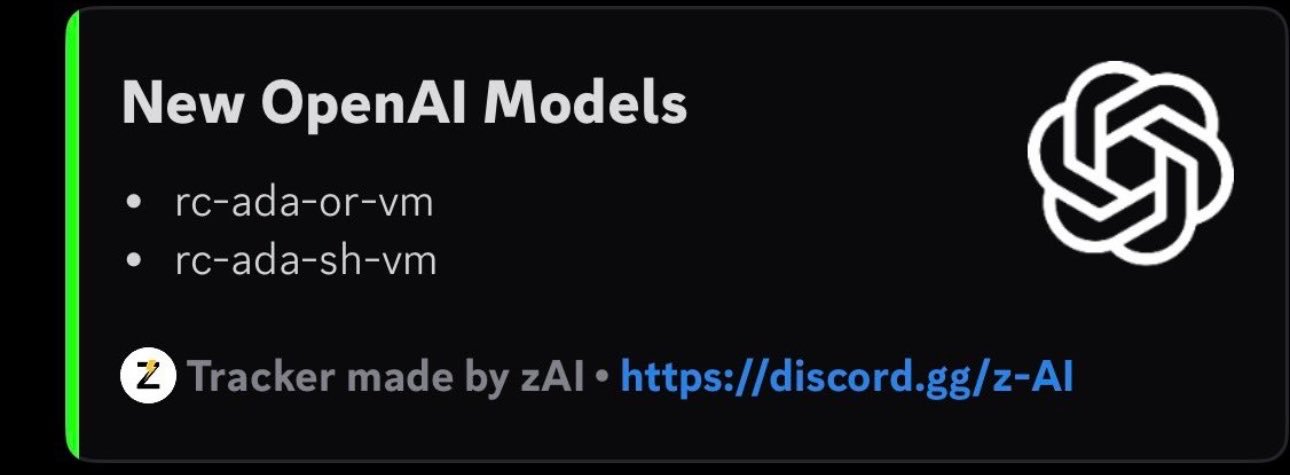
That arithmetic is the most interesting part of today’s leak. Trackers spotted two new IDs in OpenAI’s API, rc-ada-or-vm and rc-ada-sh-vm. Since Oct 31 some Codex accounts have also shown a gpt-6.2-astra line in usage analytics, while the picker still says GPT-6 Astra. OpenAI has confirmed nothing, and linking the rc IDs to Astra is guesswork so far. The names read like a Wi-Fi password at a rented villa, which is roughly how OpenAI announces models now.
Today GPT-6 Astra costs $10/$50 and Opus 5.5 costs $4/$20, so the gap is 2.5x on every token. If you run agent loops in Codex or through the API, that gap matters more than whether the next model has 6.2 in its name. OpenAI’s pricing page is the signal to watch, and until it changes, hold off on rewriting prompts. Which will decide your next model switch, price or benchmark?
Claude just became an identity provider, and that is the part of today’s plugin update most admins will skim past.
Since June, Claude Team and Enterprise have been able to auto-connect MCP plugins at login through Enterprise Managed Auth. The catch was that the company’s identity provider had to sign the identity assertion, in practice Okta via Cross App Access. Starting today, in beta, Claude can sign that JWT itself under an issuer URL unique to each organization. The plugin’s server swaps it for an access token in one back-channel call, with no redirect and no consent screen. Goodbye to the OAuth “Allow” button, the most clicked and least read page in corporate IT.
The obvious objection is security, and Anthropic’s docs answer it honestly. A Claude-issued assertion only proves membership in your Claude org through a verified email, and your SSO and MFA get no say. Remove someone and Claude stops signing for them, but tokens already issued stay valid until they expire. If you run an MCP server, your access token lifetime is now your offboarding policy. Would you turn on Claude-issued mode now or wait for your IdP?

Every “they nerfed the model” thread just got a possible fix, and Anthropic tested it on Llama, not Claude.
On November 2 Anthropic open-sourced FlashProve (Apache 2.0), a zkSNARK prototype. It proves that a reply came from one committed set of weights without revealing those weights. On Llama 4 Maverick (400B MoE, 4 bit weights) it proves 110 tokens per second on a single H100. A 1,024-token request yields a 19 MB proof that a 24-core CPU checks in seconds. The catch is the bill: 70 to 95x the GPU time of plain vLLM, plus a 1,024-token ceiling.
If you buy tokens through a reseller or a router, nobody will prove all your production traffic at that price. Spot-checking a few requests a day, though, would cost little and end the guessing about whether you got the model you paid for. Finally a way to settle “it felt dumber today” with something other than vibes. Would you pay extra per request for a proof, yes or no?

New Anthropic research: progress on provable inference for large language models.
Here, we introduce FlashProve. Building on established cryptographic techniques, FlashProve allows developers to verify whether a given response came from a given AI model. It’s substantially more efficient than prior open-source methods for doing so.
These proofs have a range of applications. They can, for instance, make it harder for attackers to hijack a chat, or enable safety evaluators to verify that the model they’re testing is the same one being served to customers.
For our full write-up, see here: anthropic.com/research/prova…
Further progress in provable inference will likely be an important part of improving trust in AI deployment. To that end, we're open-sourcing FlashProve’s code, here: github.com/anthropics/FlashP…
We’re grateful to our collaborators: Alessandro Chiesa, @GiacomoFenzi, @gwberg95, @miranda__christ, Rahul Dalal (rdalal.github.io) and Ben Mayer (@transmissions11).

Right now Alibaba’s unit tests say more about Qwen4 than its own keynote did.
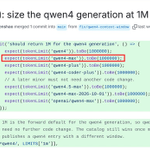
On October 28, PR #15762 landed in Qwen Code, Alibaba’s open source coding agent, and shipped in v0.26.3. It raises the default context window for every qwen4 model id from 262,144 to 1,000,000 tokens. The repo’s tests already run qwen4-omni-120b-think as the session model, a multimodal thinking variant, with qwen4-coder-plus listed next to it. Neither was on the slides at Apsara in September, which showed only Max, Flash, Plus and 27B.
The PR author openly calls the 1M figure an inference rather than a published spec, and output stays at the family’s 32K default. If you point Qwen4 at your own endpoint and the provider serves a smaller window, compaction kicks in too late. Your first long request bounces off the limit before reactive compaction recovers, so set the window by hand. Alibaba guards this launch so well that the best leak source is its own test file.

GPT-6 Astra wrote the weights of a Breakout-playing network from scratch, no training and not a single game played, and its network scored 517.4 against 15.8 for one trained with PPO for 100M steps.
That’s the second, less discussed experiment in the MIT CSAIL paper on Weight-Space Programming. In three small Atari-inspired MinAtar games the model wrote weights directly, and its networks beat 100M-step PPO in all three: Seaquest 53.1 vs 5.6, Asterix 53.2 vs 25.8. Only PPO at 500M steps came close in Asterix and pulled about 1.7x ahead in Seaquest, while still losing roughly 20x in Breakout. A hundred million steps of training lost to someone who never touched the controller.
Training isn’t going away, since MinAtar is tiny pixel grids and the authors call the results early. The more useful takeaway is for anyone running small networks in control or edge devices: a big model can now read what a network does and write a sensible starting point, so it’s worth testing whether to have it generate initial weights and fine-tune from there instead of training from scratch.

GPT-6 Astra can edit Qwen3.5-0.8B’s weights and raise its MATH-500 from 7.9% to 48.1%, without gradients or retraining.
“Sparks of Weight-Space Programming”
This blog from MIT asks whether LLMs can read and edit neural network weights directly, much like code.
In Qwen, Astra traced repetitive reasoning loops to a direction written by two MLP layers, then edited the weights to suppress it.
With 50 batches of forward-pass feedback, the fix also raised instruction following from 21.0% to 62.3%
Read on alphaXiv: alphaxiv.org/abs/2611.weight…

Mistral Large 4 posts a class-leading cyber score, and part of the reason is that Claude Opus 5.5 and GPT-6 Astra simply refuse those tasks.
Le Chonk, aka Mistral Large 4, got open weights on Hugging Face on October 29: an MoE with about 1T parameters and 52B active, 1M token context, text and image input, and three reasoning levels. Mistral reports 41% on Terminal-Bench 4.0, up from 28% in the preview three weeks earlier, and 93% on Cybench. The same report says it refuses 96.6% of malicious cyberattack requests, so a high cyber score doesn’t mean it helps anyone. It was trained from scratch on 3,800 Grace Blackwell GPUs in Mistral’s own European datacenters. A European model that behaves a bit like a European civil servant: happy to help you patch the hole, not handing over the keys.
The license matters more than the benchmarks. It’s a modified MIT: internal use is free, but offering the model to others as an API needs a separate commercial license. You also need the hardware, since FP8 weights take about 1 TB and the sample vLLM setups assume 8 GPUs. If your company wants a model for internal data that never leaves the EU, this is one of the strongest candidates, just price the server before you price the tokens.


The brain learns language from roughly 200M words with about 100T synapses, while Chinchilla’s recipe gives a 1T parameter model 20T tokens. Q Labs puts that gap at seven orders of magnitude in parameters per token.
That comparison drives Q Labs’ new paper, “Quadrillion-parameter transformers and how to train them”, out this week. The authors propose scaling laws for when data runs out rather than compute, and the conclusions cut against intuition. Big models trained repeatedly on the same data need much stronger weight decay, hyperparameters set this way stay near-optimal even at 16x the fitted compute, and with ensembling the loss keeps falling on a fixed dataset while earlier recipes get worse. Extrapolated to 5T unique tokens and 10²⁹ FLOPs, the law prescribes about 7,000x the parameter count Chinchilla would. The brain does all this on 200M words and still can’t remember where it left the keys.
“Quadrillion parameters” is an extrapolation, not a trained model, so take the headline with some distance. The practical part works today, though. If you train or fine-tune on a small dataset of your own and run many epochs, don’t shrink the model on reflex, raise weight decay first and try a simple ensemble of a few runs, because per this paper that’s where most of the remaining gain sits.

Humans are ~1,000,000x more sample efficient than LLMs, and there are no good explanations.
We’ve found that a big part of the answer is that LLMs are *massively* underparameterized by many orders of magnitude. The brain has 100T synapses learning from ~200M tokens of language. Chinchilla prescribes a 1T-parameter model on 20T tokens. That’s 7 OOMs apart in parameters per token.
After a lot of painstaking work, we present new data-constrained scaling laws and learning algorithms to scale to (extrapolated) quadrillion-parameter transformers.
w/ @akshayvegesna, @EthanBaron78553, @asatheesh6561
Full paper led by @EthanBaron78553, with @ShmuelBerman, @andrewgwils

Commits landing on the main branch of OpenAI’s monorepo grew 1,378% from early 2024 to Q3 2026, and the old Git backend’s reliability at times dropped below 90%.
That’s the backdrop for Pando, the new Git backend OpenAI described yesterday. The protocol and client stay the same, so people and Codex agents work as before, but under the hood each branch updates independently, and pushed packfiles land once in blob storage and get reused for every reader. Median push latency fell nearly 5x, the system serves almost a petabyte of Git data a day on a handful of CPU cores, and over 57 TB in a peak hour with more than 99% from cache. One engineer designed the core, teams of Codex agents implemented it, and it went from kickoff to production in 10 weeks. Agents clogged Git first, then built it a new one.
Agents don’t wear out code review first, they load the infrastructure: more parallel branches, pushes and CI fetches. If your team is adding agents, measure push and fetch latency and your CI queue before buying more seats, because that’s where the jam shows up first. Pando isn’t open source yet, OpenAI only says it’s exploring ways to share it.

The 2008 Roadster went to space and never came back.
So the 2026 one learned to land.
Not a render farm. A browser tab: one HTML file, physics simulated live at 60 fps. Built with Claude Opus 5.5.
@elonmusk ours shipped on time 😉
For the nerds:
• Top of the loop: v²/r ≈ 0.5 g, so the fans pull the rest. We gave them 2 g.
• Nothing is keyframed. The timeline comes from running the sim at 120 Hz.
• Thrusters fire only when pointing sideways or down. The N₂ gauge drains from actual use.
How it was made:
• Claude Opus 5.5 in Claude Code, about a day
• 1,289 replies, 1,238 tool calls, ~2M tokens written
• 4 AI agents: one judged every frame, one checked the judge, one fixed, one checked the fixes
• 87 defects flagged, 68 confirmed: 39 fixed, 20 half-fixed, 9 still open. We're on Elon time too.
First attempt: one prompt, $1.84, two cars that looked like toys.
This one: Claude re-read 572M tokens of its own conversation. Worth it.
3D models: "2008 Tesla Roadster" by the 86 guy and "Tesla Roadtser 2026" by asiphy007 (Sketchfab, CC BY 4.0), compressed and relit. Fan tribute, not affiliated with Tesla or SpaceX.
aicontenders.dev