

matorr.eth retweeted

This is f*cking insane. SpaceXAI lead engineer (ex-Cursor):
"99% of people still use GrokBot like Google. I run 20+ Grok cloud agents with a Chief of Staff, a PM and 15+ workers, and they never clock out"
In just 20 minutes, this engineer shows how to turn one GrokBot into a team that works for you 24/7
GrokBot → Chief of Staff → PM → Workers → Autonomous Fleet
A Chief of Staff agent plans the day and hands out every task
A PM agent splits the work and checks everything the workers ship
Anyone can chat with one GrokBot, almost nobody builds the team that keeps working while they sleep
Worth more than most $1,000 agentic engineering courses
Watch it today, then read the full harness engineering guide below before everyone catches up ↓


matorr.eth retweeted

HOLY SH*T, ELON MUSK PUT SPACEXAI'S BEST ENGINEERS ON A LIVE STREAM TO SHOW EXACTLY HOW TO BUILD A COMPANY WITH GROK BOTS
they start from an empty github org and zero bots. 72 hours, live.
how to use grok bot, from their demo:
step 1: make one bot per job, not one chat per task
step 2: tell it the result you want, voice works too
step 3: set approval rules, e.g. ask me before sending any email
step 4: show it a task once on screen, it saves it as a skill
step 5: add a routine, e.g. every morning at 9 it sends you a summary
step 6: if it refuses or asks questions, teach it, it keeps that in memory
the parts worth watching:
11:29 - the first hires: which bots they pick
20:23 - building a bot from scratch with one voice prompt
22:54 - teaching a bot a task by doing it once
25:21 - setting up a 9 am routine
save this and study the article below, it has ready-made grok bot configs you can copy ↓


matorr.eth retweeted

I just watched an amazingly good lecture by Adam Brown about the future impact of AI on physics
youtube.com/watch?v=Mw60FH5i…

matorr.eth retweeted

With AI Engineering skills, you actively shape the build: You influence what gets built, and drive the build loop. Here're key skills to do this.

matorr.eth retweeted

Try this prompt in Claude chat to give it more context about yourself:
Interview me in depth using free text, or askuserquestion tool when multiple choice works, about relevant parts of my life you don’t know about yet and save it all to memory.


matorr.eth retweeted

Claude Academy is now live.
Whether you're figuring out what AI is or already using Claude every day, there's a path that meets you where you are. The courses and tutorials are free and open to anyone at academy.claude.com
matorr.eth retweeted

Google Brain founder, Andrew Ng:
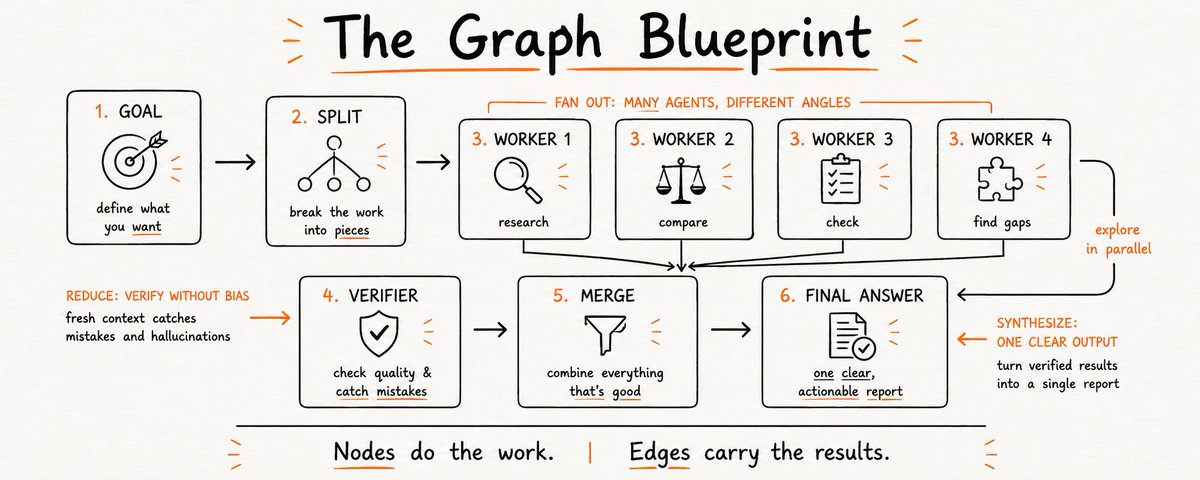
"Prompting will be dead in 6 months, graphs are what's replacing it."
In 2 hours at Stanford he shows how to build agents that work and improve entirely on their own.
The first 10 minutes cover what most $500 courses never do.
Watch the lecture first, then read the guide below on how to build a system that improves itself.



matorr.eth retweeted
Anthropic Claude Code engineer:
“At Anthropic, we don’t babysit agents anymore.
We do Graph Engineering: building verification loops that let agents test their own work, run in parallel, and keep going in the background.”
In 36 minutes, Sid Bidasaria shows how Claude Code engineers make agents catch failures and keep working without constant supervision.
Worth more than most $500 agent courses.
Watch it, then read the Graph Engineering guide below.

matorr.eth retweeted
Head of Claude Code:
"I'm not prompting my agents anymore, I'm building graphs and loops so they can build the agents for me."
In 10 minutes he shows exactly where agentic engineering is going and how not to get left behind.
Definitely something you cannot afford to skip.
Watch it, then read the step-by-step guide below on how to build a system that improves itself.

matorr.eth retweeted
How we prompt AI is very different in 2026 than 2022 when ChatGPT came out.
I'm teaching a new course, AI Prompting for Everyone, to help you become an AI power user — whatever your current skill level.
It covers skills that apply across ChatGPT, Gemini, Claude, and other AI tools. How to use deep research mode for well-researched reports on complex questions. How to give AI the right context, including more documents and images than most people realize you can provide. When to ask AI to think hard for several minutes on important decisions like what car to buy, what to study, or what job to take. And how to use AI to generate images, analyze data, and build simple games and websites.
I also cover intuitions about how these models work under the hood, so you know when to trust an answer and when not to.
Along the way, you'll see flying squirrels, a creativity test, some of my old family photos, and fireworks.
Join me at deeplearning.ai/courses/ai-p…
matorr.eth retweeted
“Loop engineering” is a hot buzzphrase after mentions of it by Boris Cherny (Claude Code’s creator) and Peter Steinberger (OpenClaw's creator) went viral on social media. Loops are now a key part of how we get AI agents to iterate at length to build software. In this letter, I’d like to share my 3 key loops, shown in the image below, for building 0-to-1 products. These loops guide not just how I build software, but also how I decide what software to build.
Agentic coding loop: Given a product specification and optionally a set of evals (that is, a dataset against which to measure performance), we can have an AI agent write code, test its work, and keep iterating until the code is bug-free and meets its specification. This idea of closing the loop took off around the end of last year, and it has been a game changer in enabling coding agents to work longer productively without human intervention. For example, over the weekend, I was building an app for my daughter to practice typing, and my coding agent could easily work for around an hour, using a web browser to check what it had built multiple times before getting back to me, without needing my intervention.
The engineering loop executes quickly. Every few minutes, the coding agent might build and test a new version of the software. I hear frequently from developers who are finding new ways to engineer more effective engineering loops. This is an active area of invention!
Developer feedback loop: In this loop, a developer examines the current product and steers the coding agent to improve it. Last year, a lot of developers (including me) were acting as the QA (quality assurance) function for our coding agents, manually finding bugs and then asking the agent to fix them. But with coding agents much more able to test their own code, the amount of time we need to spend on this function has decreased significantly. This allows us to make higher-level product decisions, such as what key features to offer, where the UI needs improvement, and so on.
The developer-feedback loop operates over time intervals between tens of minutes and hours — that's how frequently a developer might review a product and give feedback. In the case of the typing app, I changed my mind a few times about the visual design, what cat costumes she can unlock as she learns (she loves cats), and the user flow for a grown-up to log in and steer the child's learning experience.
When a developer has a clear vision for what to build, it is still a lot of work to translate that vision into a specification for a coding agent to implement. Further, after the developer has seen an implementation, they might update (or perhaps clarify) the spec to steer it toward what they want. If you find that the system repeatedly runs into certain problems, building a set of evals for the agent becomes useful.
AI-native teams are increasingly using AI to help shape product direction, for example, automating the gathering and analysis of usage data, summarizing written and verbal customer feedback, or carrying out competitive analysis. However, for pretty much all the products I’m involved in, I see humans as having a significant context advantage over current AI systems — we know a lot more than the AI system about the users and the context the product has to operate in — and thus humans play a critical role. Many people describe this human contribution as “taste,” but I prefer to think of it as humans having a context advantage, since that gives us a clearer path to helping AI systems get better. This also speaks to why this step can’t be automated: So long as the human knows something the AI does not, human-in-the-loop is needed to to inject that knowledge into the system.
External feedback loop: This includes a wide range of tactics like asking a few friends for feedback, launching to alpha testers, or putting the code into production with A/B testing. These tactics are usually slow, rarely taking less than hours and sometimes taking days or even weeks. This data informs the developer vision, which in turn continues to drive the detailed product spec, which in turn drives the coding agent.
With coding agents speeding up software development, more engineers are starting to play a partial product management role. For many engineers who are growing into this role, the hardest part is shaping the product vision and striking a balance between building (bridging the gap between vision and spec) and getting user feedback to evolve the vision. It is important to do both!
I will write more about how to do this in future posts, but for now, I find it encouraging that engineers are playing an expanded role (just as product managers and designers now do more engineering).
[Original text: The Batch]

matorr.eth retweeted
This is part of working with the EU AI Act, other labs are adding similar watermarking.
It’s hard to identify AI-generated text, and this gives people better tools to do that. We’ll also be a shipping text detection API that you can use yourself.

Anthropic says new Claude models will embed invisible watermarks in all generated text, everywhere Claude is offered.
The watermark is part of the text, it isn't metadata: "it will travel with the text when it's copied and pasted elsewhere, and may persist through some editing."
This starts with models launched on or after August 2, 2026, under an EU AI Act code Anthropic signed. Anthropic is still working on adding it to current models. The rollout is worldwide.

matorr.eth retweeted

Today I'm publishing a new essay, Policy on the AI Exponential. AI is progressing extremely fast—much faster than the policy process was built to handle. The essay lays out where I think the technology is now, and the action needed to close the gap: darioamodei.com/post/policy-…

matorr.eth retweeted
a prompt I've been using a lot recently:
implement <SPEC> and while you do, keep a running implementation-notes.html file (or markdown) with decisions you had to make weren't in the spec, things you had to change, tradeoffs you had to make or anything else I should know



matorr.eth retweeted
Interactive charts and diagrams are now in Claude Cowork.
Available in beta on all paid plans.
Claude can now build interactive charts and diagrams, directly in the chat.
Available today in beta on all plans, including free.
Try it out: claude.ai