

Life is nonlinear. So handle it using Math.
Joined June 2020
- Tweets20.2K
- Following31
- Followers226K
- Likes72.1K








A Fields Medalist has joined the growing discussion about the future of mathematics in the age of AI.
In a new episode of The Economist's Babbage, released on 21 October, James Maynard of Oxford and Yang-Hui He of the London Institute for Mathematical Sciences discuss how AI is transforming mathematical research.
The conversation follows the recent release of hundreds of AI-generated mathematical manuscripts, which has raised questions about the future of mathematical discovery.
Can AI open entirely new directions in mathematics, or will the growing volume of machine-generated results make mathematical understanding increasingly difficult?
The episode examines both possibilities.
Source: The Economist, AI Eats Science 1: The Mathpocalypse, 21 October 2026.


A fraction of a degree can change an entire pattern. At approximately 137.507764°, the golden angle, given by 360°/φ², helps explain the remarkable spiral arrangements seen in sunflower heads.

In classical physics, a particle cannot cross an energy barrier higher than its total energy.
Quantum mechanics tells a different story.
In 1926, Erwin Schrödinger introduced an equation describing how quantum states evolve.
One of its consequences is quantum tunneling: a particle can have a nonzero probability of appearing beyond a barrier it cannot classically overcome.
This phenomenon helps explain radioactive decay and underlies important modern electronic devices.

A referee found Einstein's mistake:
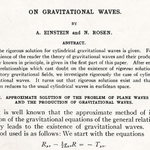
In June 1936, Albert Einstein and his collaborator Nathan Rosen submitted a manuscript to Physical Review.
Its title was provocative: Do Gravitational Waves Exist?
Twenty years earlier, Einstein had predicted gravitational waves as a consequence of general relativity. Now, however, his new calculations seemed to suggest that such waves could not exist.
Einstein was challenging a prediction of his own theory.
The journal's editor sent the manuscript to an anonymous referee, physicist Howard Percy Robertson. Robertson identified a serious problem in the mathematical argument.
Einstein was furious. On July 27, 1936, he withdrew the manuscript, objecting to its having been shown to another specialist before publication.
He sent the work to the Journal of the Franklin Institute instead. But the story took an extraordinary turn.
Robertson, who was also Einstein's colleague at Princeton, subsequently helped him recognize how the apparent mathematical difficulty could be resolved.
Einstein revised the paper, and its conclusion changed.
When the corrected paper appeared in January 1937, Einstein included a note acknowledging that the original mathematical results had been interpreted incorrectly. He explicitly thanked Robertson for helping clarify the mistake.
Nearly eight decades later, on September 14, 2015, LIGO made the first direct detection of gravitational waves, produced by the merger of two black holes.
The prediction Einstein had once doubted had become an observed feature of the universe.

During the 1860s, James Clerk Maxwell unified electricity and magnetism mathematically. His equations implied that disturbances in electric and magnetic fields could travel through empty space as waves.
His equations predicted waves travelling through empty space at a speed given by
c = 1/√(μ₀ε₀)
The calculated speed matched the known speed of light.
Maxwell concluded that light itself was an electromagnetic wave.
A mathematical theory had revealed the nature of light before electromagnetic waves were produced and detected in the laboratory.

Two MIT mathematicians have proposed a significant change to the future of mathematical research.
In an essay published on 21 October, Pavel Etingof and Slava Gerovitch argue that mathematicians should increasingly be evaluated for their understanding, judgment, and creativity rather than simply for being the first to prove a theorem.
They suggest that future PhD theses need not necessarily contain the first proof of a result.
Originality could instead come from new ideas, connections, explanations, or methods.
They also propose greater emphasis on oral examinations, collaborative research, and AI-assisted mathematical exploration.
Their central argument challenges a longstanding academic tradition: mathematical achievement should not be measured primarily by who proves something first.


We learn four fundamental arithmetic operations in school: Addition, subtraction, multiplication and division.
But mathematician Martin Eichler once suggested a fifth: modular forms.
In a recent interview, Fields Medalist Richard Borcherds revisits this remarkable idea.
Modular forms appear in unexpected places across mathematics, from number theory to the symmetries of the enormous Monster group.
Borcherds, who won the Fields Medal for proving the monstrous moonshine conjecture, calls them among the most magical objects in mathematics.
Full Interview: youtu.be/lhE4DZWFQ1U?si=qcaz…

The Secret Letters of John Nash: A Mathematical Idea Decades Ahead of Its Time
In January 1955, John Nash, then an assistant professor at MIT, sent the United States National Security Agency a series of handwritten letters proposing a new encryption machine.
Nash was already known for his work in game theory, but his letters concerned a different mathematical question: could a message be easy to encrypt yet extraordinarily difficult to decipher without the secret key?
He suggested that the security of an encryption system could depend on how rapidly the computation required to break it grows as the key becomes longer. In particular, he conjectured that for sufficiently complex encryption systems, the effort needed to discover the key would typically grow exponentially with its length.
This was a remarkably early formulation of an idea that would become central to computational cryptography.
Nash was concerned that the agency might dismiss his handwritten work. In one letter, he explained that he was an MIT mathematics professor, mentioned his game-theory research, and asked the cryptographers to examine his proposal carefully.
The NSA did examine his machine. In its reply dated 3 March 1955, the agency acknowledged the ingenuity of his ideas but concluded that the proposed system did not meet its security requirements.
The correspondence remained in government archives for decades. It was declassified in 2011 and made public in 2012, when the National Cryptologic Museum opened an exhibition devoted to Nash's letters.
The intresting distinction is that Nash's particular cipher was rejected, but his broader mathematical insight anticipated a central principle of modern cryptography: security based on computational difficulty.
His conjecture was not a proof of the P versus NP problem, nor did his proposed cipher establish modern cryptographic security. Nevertheless, mathematicians have recognised the correspondence as an important early expression of ideas later developed in computational complexity theory.

Two leading French mathematicians have offered a different perspective on the future of mathematics in the age of AI.
In interviews published by AFP on 20 October, Stéphane Mallat, recipient of the 2025 CNRS Gold Medal, argues that mathematics remains essential even as AI systems become capable of solving difficult research problems.
“Mathematics goes far beyond calculation: it's a way of thinking clearly.”
François Charles, a mathematician at the École Normale Supérieure in Paris, acknowledges concerns about the future of doctoral education but sees opportunities for more ambitious research.
Their arguments point toward an important distinction.
Solving a mathematical problem produces an answer. Learning mathematics develops the ability to understand why that answer matters.

Here is the report link:
digitaljournal.com/article/a…

1 ÷ 998001 = 0.000 001 002 003 004 005 006 007 …
… 994 995 996 997 999 000 001 …
The decimal contains every three-digit number from 000 to 999 in order, except 998.
The final calculus problem of the 2002 Harvard–MIT Mathematics Tournament had a surprisingly short solution. You never need to find the function itself.

The unit circle is where geometry meets algebra.
Every angle becomes a point, every rotation becomes a pair of coordinates, and the infinite patterns of sine and cosine emerge from a single circle.
Teacher: “What is 45 + 45?”
Student: “135.”
Teacher: “You failed mathematics.”
Student: “And you clearly don't go to the gym.” 😂

73 is the 21st prime number.
Multiply its digits: 7 × 3 = 21.
Reverse its digits to get 37, the 12th prime number (21 reversed).
In binary, 73 = 1001001₂, a palindrome with 7 digits and exactly 3 ones.
Even its binary representation reflects the digits 7 and 3.
AI Finds a Counterexample to a Conjecture of Frankl, Ota, and Tokushige.
In a paper listed on arXiv on 21 October, mathematician Balázs Patkós explicitly credits ChatGPT 6.1Sol with finding a construction that disproves a conjecture of Frankl, Ota, and Tokushige.
The conjecture predicted that a certain extremal quantity grows quadratically with t.
The new construction establishes a substantially smaller upper bound of order t³ᐟ²√(log t).
Patkós also proves an improved lower bound, narrowing the possible growth rate.
The complete argument is publicly available, with independent peer review still pending.
