

Mossman Postdoctoral Fellow at Yale Physics + QBio Institute. PhD in theoretical biophysics from Simon Fraser University. Originally from Vancouver, Canada.
New Haven, Connecticut, USA
Joined March 2020
- Tweets174
- Following168
- Followers245
- Likes168





Pinned Tweet
How well can you control a stochastic system with limited information?
Excited to share a new preprint answering this question!
“On the Information Required for Feedback Control”, with @jbetancourt015, @EmonetLab, @machtagroup, and @m_abski.

Matt Leighton retweeted

Out today on @arxiv is a Rube Goldberg machine I made in my basement. It's an analog transformer made of a few thousand transistors, and it can learn to learn things: arxiv.org/abs/2610.12571

I've been thinking a lot lately about what the future of science, especially theoretical research, will look like in the age of increasingly capable AI models.
I try and tackle this question in a new post through historical analogy to the development of chaos theory.

Ultimately I’m not too sure of what the specifics will look like. But I think we (people curious about how the world works) should spend more time playing with frontier AI, updating our intuition about what kinds of questions can now be answered far more cheaply than before.
*Thanks to @OpenAI for giving me free access to their top-end models through the ChatGPT for Academic Researchers program, which is letting me start experimenting with some of the “high-throughput theory” ideas I describe in the post.
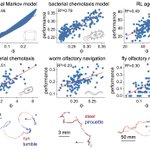
How do living organisms use information to navigate up sensory gradients?
New preprint from @kevinschen13, with Damon Clark and @EmonetLab, shows that navigation works best with a feedback loop: information flows both forward from signal to action, and back from action to signal.

Finally, we find that more feedback information from behavior to signal isn’t always better. For highly persistent environments, navigation performance is maximized at a finite information rate.

Remarkably, another team of researchers (Avishek Das at Durham University, and Pieter Rein ten Wolde at AMOLF) independently came to very similar conclusions! We were able to coordinate preprints, and their closely-related work is also out today: arxiv.org/pdf/2607.26798
Matt Leighton retweeted
To balance this giant pencil within 5° of vertical, how much information has to flow from @MattLeighton5 's eyes to his hand? His new article out today (2607.16639, with friends in @QbioYale namely @jbetancourt015, @EmonetLab, @machtagroup), has an answer...

ALT Matt is performing a feedback control task, using less than 10 bits per second. The number arXiv:2607.16639 is written on the wall behind him, because Twitter doesn't like links