

Organization Development Consultant. I-O Psychologist. Former Tenured Business Professor. Scientist. Management Consultant. Thought Partner. @vocentive
San Francisco, CA
Joined June 2013
- Tweets1.4K
- Following396
- Followers472
- Likes562







I love AI disclosure statements required by publishers these days. Some think it's a bit overreach. But I have to say I did enjoy my last disclosure:
"During the preparation of this work the author used large language models accessed through Cursor (Anthropic Claude, xAI Grok, OpenAI GPT, and Google Gemini) to draft and revise text, write figure code, and check reported statistics; a word processor with Clippy and autocorrect; and statistical software, so that no coefficient was obtained by hand. The author reviewed, edited, and verified the output and takes full responsibility for the content. These tools are not authors."
Long live Clippy. The original AI threat.

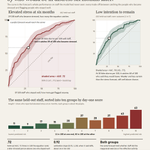
A forecast, not an effect of the exercise. Completers only, one program network, self-report. Secondary analysis of a randomized trial by Wang, Goldenberg, Lerner & Gross (2025); data public at osf.io/9awj3. Paper under review.


How the curve works: think of a smoke detector. Turn it up and it catches every fire but goes off for toast. Turn it down and it misses fires. The red curve shows every setting at once. The dashed line is a detector that is guessing.
Here, accept 30 false alarms per 100 people who turned out fine, and the eleven questions reach 59 of 100 who went on to be in distress. AUC .72. When the forecast said 60 percent, about six in ten did report elevated stress.


One in four German employees still worked from home last year — almost double 2019. This year’s RTO and isolation studies disagree on location. They do not show that the office, by itself, fixes loneliness.
I tested a different lever: a self-compassion score taken in 2018, before any of this, among 3,052 employed adults in a German national probability panel.
People a standard deviation higher on that score entered 2020 about 3% more satisfied with life. They were also less lonely and less overwhelmed by digital tools in 2024 (r = −.36; β = −.20). Through the 2020–2021 drop, life satisfaction fell about 9% at every level of the trait. Telework from 2021 to 2025 moved the same way for everyone.
The associations sat with the self-critical items, not the self-caring ones.
The level is what lasted.
@gesis_org


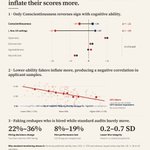
Three in ten applicants fake the personality test — and it's the lower-ability ones faking the most.
At published faking rates: 22–36% of hires change, performance drops 8–19%, and every audit statistic stays clean.
Price it for your funnel: mjmonnot.github.io/faking-co…
The preprint — meta-analysis + Monte Carlo simulations fit to the published applicant evidence:
doi.org/10.2139/ssrn.7611561

Those task changes show up with the frustration and with wanting to leave.
Over ten years, more of them said they had lost control of how the work gets done.
mjmonnot.github.io/lec-2026/
With Isaac Thompson. Thank you Tunji Oki, Alexandra Dmytriw, and @SIOPtweets.
