
Machine Learning at Roboflow
Joined April 2025
- Tweets22
- Following244
- Followers27
- Likes40
Matvei Popov retweeted

At COLM? Join Roboflow Labs tonight to talk vision, language models, and everything in between.
Meet fellow researchers and builders over light bites, 7–10pm PT.
Space is limited. Request a spot:
partiful.com/e/ldk3A6Ur2of82…
Matvei Popov retweeted

AutoResearchExam uniquely focuses on measuring and rewarding fast, sustained progress that generalizes.
We’ve also seen a lot of very interesting behavior showcased by different models as detailed in our blog. Excited to share it with everyone! benchmarks.bespokelabs.ai/au…

We are releasing AutoResearchExam, a benchmark on open-ended machine learning and engineering tasks. Our benchmark covers seven research areas including model training, data curation, AI safety and interpretability.
benchmarks.bespokelabs.ai/au…
In each task, we give agents 24 hours with a CPU or GPU machine to develop and improve their solutions through experiments and feedback. We measure both speed and quality with a combined score. Our benchmark has a unique feature: testing if agents create improvements that hold up on data they never see. We find that AI research agents often overfit as they try to improve.
We see an interesting head-to-head comparison at the frontier: Astra starts the strongest and holds the lead for up to 19 hours but Fable 5.1 catches up and gets the top performing spot in the final hours.
Qwen3.8 Max, Gemini 3.8 Flash and Grok 4.6 all sit on the cost-performance Pareto frontier, giving strong options at lower API budgets.
Anthropic's Opus and Fable retain nearly all their validation performance on hidden tests, with gaps of 1.1% and 2.9%. Astra's improvement over Sol extends to generalization too, with that gap falling from 6.9% to 1.7%. (1/n)
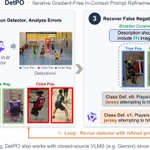
Error-driven prompt optimization makes VLMs better at few-shot object detection, outperforming general-purpose prompt optimizers like GEPA. Stop by to see "DetPO: In-Context Learning with Multi-Modal LLMs for Few-Shot Object Detection" at ECCV poster session 5 poster #211!

Big shoutout to my collaborators @GautamRGare, @NeeharPeri, Shruti Jain, John Galeotti and Deva Ramanan for the hard work!!
This gives us a gradient-free way to adapt even closed/API-based VLMs to new detection tasks without any fine-tuning, while also improving confidence calibration for the predicted boxes.
Paper: arxiv.org/abs/2603.23455

False negatives help broaden what the prompt should include, while false positives help make it more specific about what it should exclude.
We run the VLM on the few-shot training examples, look at what it gets wrong, and use its false positives and false negatives as visual feedback to iteratively refine the class description.
Instead of directly giving a VLM few-shot example images at inference time, we use those examples to optimize a better text prompt for the class.
Matvei Popov retweeted

RF-DETR is the best open-source choice if you work with aerial or satellite images
we evaluated RF-DETR and other popular object detection models on several aerial and satellite datasets
on average you gain 2–5 mAP by choosing RF-DETR
link: github.com/roboflow/rf-detr


RF-DETR is the best open-source choice if you work with aerial or satellite images
in this specific project, RF-DETR Medium outperformed YOLO26 fine-tuned on the same dataset by 12 mAP
in object detection, that is a huge gap
link: github.com/roboflow/rf-detr
Matvei Popov retweeted
I just made the best submission under an extreme parameter golf (M4 Air, 16GB) : val_bpb=1.926.
Took this as an opportunity to test an idea — what if competition submissions weren't isolated attempts but a collective + distributed candidate pool that everyone improves together?

Matvei Popov retweeted

Sharks hockey → checking the RF-DETR ablations in the Uber back to SF
good news coming in these mAP curves


RF-DETR has been accepted to ICLR!
Go give it a read it if you haven’t yet. arxiv.org/abs/2511.09554


Matvei Popov retweeted
On the twelfth day of #Shipmas, Roboflow gave to me... Qwen3-VL, fine-tuned and deployed.
Qwen3-VL is now in Roboflow Train, Workflows, and Inference so you prompt or fine-tune it and build VLM-powered apps on your own images, with native 256K context for long docs and video.
Matvei Popov retweeted
At @github Universe's "mini MCP" summit, we break down how MCP and 200k+ open source vision models enable agents to query and use the right models for specialized tasks.
The core idea is that while large, multimodal large language models (MLLMs) continue to get really good, there remain specialized tasks where an individual learner may be better suited to understand a visual scene.
In these cases, an agent can query for the right model and use it to answer a difficult question -- like in this case, an expert coral identification.
The idea is a prototype exploration of how MCP may be useful in search/retrieval/use of an individual task.


Matvei Popov retweeted

This is really crazy
Yet another work showing that in-context learning on SOTA MLLMs (Gemini 2.5 Pro) not only does not help, but even hurts results!
ICL on MLLMs is very much an open problem, and the biggest differentiator between LLMs and MLLMs [1/3]


Matvei Popov retweeted
Excited to be at #ICLR this week where I’ll be giving a spotlight talk on "Leveraging State Space Models in Long Range Genomics"! Our results indicate SSMs could help push the frontier in genomics, enabling whole-genome applications in a scalable and democratic manner!
🧵🧵🧵