
Pharmacist | Neuroimmunology Researcher | Biotech Enthusiast - I write about companies with exciting pipelines
Germany
Joined November 2022
- Tweets55
- Following55
- Followers203
- Likes3.2K
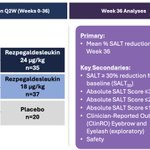
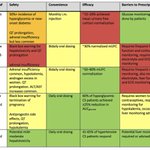


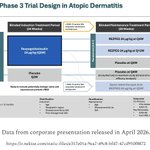

$CORT should meet these criteria if the FDA agrees that their safety edge and the efficacy in P3 are good enough. If they are, Relacorilant is best in disease.
1
5
450
Plus: there will be substantially more patients in the analyses than for AA as there were more patients enrolled even if you just take Q2W 24 ug/kg, AND way more responders. The off-treatment period is 52 w here instead of 24 for AA. Expect a clearer picture. $NKTR
434
Important caveat: data can be sliced by maintenance dosing (Q12W vs Q4W), by dose (18 vs 24 ug/kg) and by initial responders and maintainers. Look closely at denominator groups when data drops. Since P3 is already initiated with 24 ug/kg, this will be the focus (like AA!).
1
253
$NKTR In REZOLVE-AD, 167 patients enrolled into maintenance of which 71 were EASI-75 responders at 24 ug/kg. Out of those two groups (total and responders w/ P3 dose), a portion will be available for 1 year follow-up. How do they fare compared to their end of maintenance score?
This is exactly the correct take. P2 AA was POC, dose finding, induction phase length finding, withdrawal dynamics finding. All of those are ✅ (withdrawal slightly murky) and they are making sure the study is powered correctly by enrolling 850 patients in P3.
3
185
Fair, except for your point 1 as Nektar applied the same standard applied for Olumiant and the question is if responders maintain, not non-responders or partial responses. SALT20 has FDA precedent. Agree that data representation in general could be more transparent.
3
636
Yes. It’s a small dataset, with 36 vs 52 wks differing. Would have liked to see an analysis of how the drop-off looks like. Olumiant 60/80% (dose; 40 patients) of SALT20 responders lost response at 24 wks. REZPEG only 37.5%. 17/27 maintained/increased, that is encouraging $NKTR
4
706
Clear differentiation. Even without any deepening which I did not expect at all, maintenance would already be a big win. Small sample sizes but the effect seems real. $NKTR
8
1,741
$NKTR data exceeds my expectations. 17/27 patients maintained/increased hair growth. Samples sizes small but directionally encouraging. They focus on 52 week treatment as that will be induction length in P3. Week 36 data is represented in a different way and not conclusive to me.
In animal models, Treg persistence is not necessary for durability. Tregs can induce tissue homeostasis and promote Treg differentiation. Important is proper autoimmune cycle disruption. So we will know when we see the data, I’m leaning positive (see my post on the readout) 😄
1
2
84
1. Tregs aren’t elevated in blood, in the target tissue we don’t know
2. Maybe positive if unspecific expansion of Tregs reverses (safety)
3. AG-specific Tregs could still be elevated (too few to register in whole blood)
4. Tregs can shift tissue to homeostasis during treatment
1
1
85
$NKTR Watch out for this in the AA off-treatment data:
1. Responders most important. SALT ≤ 10/20/30 ~retained within 20 points?
2. Imo >50% of patients retaining is good, above 🔥
3. If relapse, when? Q4W/Q12W dosing possible?
4. Comp: BRAVE enrolled responders, REZOLVE all!

Free Corcept Therapeutics deep dive blog post including their whole pipeline and the relacorilant CRL saga: maximilianfliegauf.substack.…
107

Thanks for the shoutout! Should start posting more short summaries as tweets haha. I’m putting out one of these every 8 weeks. Trying to make them as detailed as the company’s data releases make possible.
1
2
63