

PhD student in the van Steensel lab at the Netherlands Cancer Institute
Joined March 2019
- Tweets27
- Following91
- Followers48
- Likes43
Max Trauernicht retweeted

Systematic comparison of estimates of transcription factor activity by ATAC-seq and multiplexed reporter assays biorxiv.org/content/10.64898… #biorxiv_genomic

Max Trauernicht retweeted

A throwback to last month's 'Quantitative biology to molecular mechanisms' conference – time to introduce the poster prize winners! #EMBLOmics
A round of applause for:
🏅 Max Trauernicht – The Netherlands Cancer Institute
🏅 Ingrid Pelaez Conde – Max Planck Institute for Molecular Genetics
🏅 Honorine Destain – University of Chicago
🏅 Óscar García Blay – Radboud University
Check out their posters and abstracts and find out more about the conference 👉🏻 s.embl.org/omx24-01-blog

Max Trauernicht retweeted

Have you ever wondered about how the genomic position of regulatory elements impact their functional output? Check out our latest pre-print from the @bvanssteensellab. biorxiv.org/content/10.1101/…

Finally, the preprint of my main PhD project at the @bvansteensellab is out! Check out how we identified optimized reporters for 60 transcription factors and what insights we gained in the process:

We generated a collection of new and optimised (and multiplexable) TF reporters for human and mouse cells: biorxiv.org/content/10.1101/…

Max Trauernicht retweeted

We identified a complex network of proteins that regulate MMEJ:NHEJ repair pathway balance in a chromatin context-dependent manner. With impact on cancer genomes. Paper is finally out: nature.com/articles/s41467-0…
Max Trauernicht retweeted
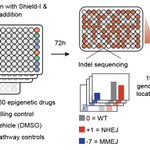
... and we used our platform of 19 chromatin-integrated pathway reporters to probe context-dependent effects of epigenetic drugs on Cas9 editing: academic.oup.com/nar/advance…

Max Trauernicht retweeted
The first preprint of our PERICODE consortium: MPRA-trained deep learning provides insight into the regulatory logic of promoters and transcription factors. biorxiv.org/cgi/content/shor…
I wrote a blog post about my PhD project at the @bvansteensellab. Give it a read! chromatingenomics.wordpress.…

Max Trauernicht retweeted
New preprint from our lab: LAD scrambling to figure out how they interact with the nuclear lamina. biorxiv.org/content/10.1101/…
Max Trauernicht retweeted

Our publication about Fpt1, an RNA polymerase III regulator in the proteome of tRNA genes in yeast, is out in Molecular Cell! A collaborative effort of @NKI_nl, @ThePughLab and @KevinVerstrepen lab, using Epi-Decoder for locus specific proteome decoding. authors.elsevier.com/c/1i825…

Max Trauernicht retweeted

Nada Jabado, @MaxTrauernicht, PhD student @bvansteensellab, @AndreaWillemin, PhD student @LabPombo & @steinaerts, appointed Science Director of VIB.AI, present compelling science during session 5 of the Berlin Summer Meeting 2023
#mdcBIMSB2023
@MDC_Berlin


I am very excited that my PhD work with @bvansteensellab and @HarmenBussemkr is now online @NAR_Open! Check out how we used massively parallel reporter assays to systematically review synthetic TP53 response elements to create highly active TP53 reporters: academic.oup.com/nar/article…

Max Trauernicht retweeted
New preprint from our lab: E-E-P massively parallel reporter assay to understand how signals from *two* enhancers are integrated by promoters: doi.org/10.1101/2023.08.11.5…
Max Trauernicht retweeted
New preprint from our lab: Optimisation of TP53 reporters by systematic dissection of synthetic TP53 response elements. biorxiv.org/content/10.1101/…

I am happy to share some exciting work that @rschep & I started back in 2018 at the @bvansteensellab. Check out our new pre-print to learn how drugs modulate #CRISPR editing and how their effect depends on the chromatin context of the cut site: biorxiv.org/content/10.1101/…. A 🧵:
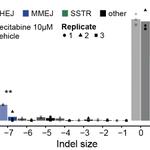
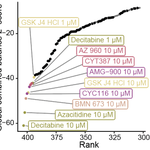
7/8 The strongest hit was the DNA methyltransferase inhibitor Decitabine. We found that this drug not only efficiently blocks MMEJ, but also inhibits another resection-dependent repair pathway: single-strand template repair (SSTR).

1
131