

Economic historian, ´anti-fascist/Antifa´, statistician, outdoor guide, father. De Kift and El Greco. Favourite epoch 1890-1930.
Leeuwarden, Nederland
Joined April 2012
- Tweets52.2K
- Following65
- Followers1.5K
- Likes5.2K







If soldiers are hungry, citizens starve.

HUR intercepted a conversation between Russian occupiers in Donbas. An occupier from the 103rd Motorized Rifle Regiment, 150th Motorized Rifle Division, says he's had no food for three days and asks his commander to feed him. The commander refuses and says there will be no rations.
66
Another 2.000+ troop losses.
During the Second World War the Soviet Union lost millions of people (in the thirties, thanks to Stalin, too). But record amounts of people still were entering the labour market (around 10 year old >> 35 year old).
Today, however...


These are the indicative estimates of Russia’s combat losses as of Nov. 4, according to the Armed Forces of Ukraine.

54
So, it´s not just Tucker Carlson who states this.

“A nuclear bomb isn't going to win this war… Trump doesn’t understand, we’ve already lost it!”
Former CIA agent John Kiriakou reveals close contacts warn the U.S. could be considering using atomic weapons in Iran.
📺 youtu.be/jgxfs3G9TIk
@piersmorgan | @JohnKiriakou
40
Mind: this is about basics. Sewer systems (for all). Good food (fa). Non-leaking roofs (fa). Bed and blankets (fa). Clothing (fa). Heating (fa). Life-saving antibiotics (fa). Education (fa). Female hygiene products (faw). Market or non-market: growth. mbrgcec.ae/en/bread-for-all

"economic growth is sufficient to achieve high levels of basics—all countries with high GDPPC achieve high levels of basics. And the relationship is empirically necessary and only high enough levels of GDPPC produce high levels of basics."
lantpritchett.org/wp-content…

54
The US can´t afford Trump
Russia can´t afford Putin
⚡️Russia lost 1 soldier every 35 seconds on Nov. 1, Ukraine's General Staff says.
Russian forces suffered a record 2,500 personnel losses on Nov. 1, Ukraine's General Staff said.
kyivindependent.com/russia-l…

45
I´m anti-imperialist
So,
I´m against the Russian invasion of Ukraine
I´m against the Israeli genocide in Gaza and its occupation of the Westbank
I´m against, despicable as the Iranian regime is, the US war against Iran (and its shooting of small boats and..)
Live is simple.
1
66


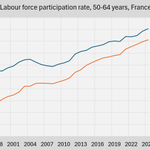
Are young people in France demonstrating because the old ones are working more, allowing the young to study and explore the world instead of earning money for the old?
Just joking.
But rising 50+ labour market participation among those aged is happening all over Europe. Good.

1
49
I´m totally in favour of GDP (sorry: the national accounts) - showing monetary connections.
Taxing wealth to let people dig holes leads to higher income of people digging. Good. As the nat. acc. show.
But the straight lines below show fuzzy, non-linear or two-group relations


1
78

If you missed it (hard if you are on Twitter...):
The ideas of the extreme right about civil war in European countries and the USA are serious. They want and promote this.
1
98
No comment.

Campagne russe 🇷🇺 de sabotage en Europe 🇪🇺
Ces dernières semaines, la campagne russe de sabotage en Europe s'est intensifiée. Voici donc, une liste non-exhaustive de 50 évènements depuis début septembre :
🔴1er septembre
▫️Roumanie : débris d'un drone russe armé trouvés par un civil, puis détruits sur place par les démineurs.
▫️Pologne : incendie de l'usine de drones WB Electronics à Skarżysko-Kamienna. Les services russes sont accusés.
▫️Pologne : incendie chez JFG Composites. Les services russes sont accusés.
🔴2 septembre
▫️Pologne : suite de l'affaire WB Electronics.
🔴4 septembre
▫️Finlande : drone de reconnaissance russe retrouvé près de Porvoo (géolocalisation estimée).
🔴8 septembre
▫️Moldavie et Roumanie : un drone Geran-4 traverse les deux pays sur plus de 500 km, viole deux fois l'espace aérien moldave et s'écrase près de Mihăileni.
▫️Roumanie : arrêt des vols à l'aéroport de Iași à cause d'un drone russe.
▫️Hongrie : 10 diplomates russes déclarés persona non grata pour espionnage.
▫️Moldavie : un Azerbaïdjanais travaillant pour le FSB est arrêté à Chișinău. Il est soupçonné de préparer un sabotage.
▫️Roumanie : arrestation de l'agent russe chargé des repérages contre l'OTAN.
🔴9 septembre
▫️Pologne : alerte aérienne en Podkarpackie à cause d'une activité russe de missiles et drones à la frontière.
▫️Pologne : arrêts des vols aux aéroports de Lublin et de Rzeszów-Jasionka.
▫️Pologne : Donald Tusk annonce qu'une attaque russe contre un poste-frontière a été déjouée. La localisation est classifiée.
▫️Norvège : on apprend qu'un exercice conjoint Norvège, États-Unis et Royaume-Uni a empêché en avril un sous-marin russe de saboter les câbles du Svalbard.
▫️Royaume-Uni : un Britannique est inculpé pour avoir aidé les services russes.
🔴10 septembre
▫️Roumanie : débris d'un drone de reconnaissance russe trouvés près d'une base militaire.
▫️Roumanie : débris de drone russe sur une plage.
▫️Roumanie : débris d'un drone armé détruits sur place.
🔴11 septembre
▫️Roumanie : trois débris de drones trouvés par les garde-côtes et détruits.
▫️Bulgarie : explosion du dépôt de munitions EMCO à Tsareva Livada. L'entreprise évoque un sabotage (non attribué).
🔴12 septembre
▫️Bulgarie : l'explosion d'août dans une usine de munitions fait désormais l'objet d'une enquête pour sabotage (non attribué).
🔴14 septembre
▫️Lituanie : des Eurofighter italiens abattent un drone russe Gerbera armé venu de Biélorussie. Il s'écrase près d'une infrastructure électrique.
▫️Pologne : un Gerbera armé est retrouvé flottant en Baltique près de Rusinowo.
▫️Moldavie : deux violations de l'espace aérien par des drones russes, dont une détectée près de Cioburciu.
▫️Lituanie : arrêt des vols à cause d'un drone inconnu venu de Biélorussie.
▫️Allemagne : un drone armé s'écrase près de la base de Wunstorf (non attribué).
▫️Danemark : une frégate russe tire deux fusées éclairantes vers un hélicoptère militaire danois.
🔴15 septembre
▫️République tchèque : le ministère américain de la Justice inculpe trois officiers russes supplémentaires dans l'affaire des bus incendiés à Prague.
▫️Lituanie : trois officiers russes sont inculpés aux États-Unis pour un complot d'assassinat mondial, dont une cible en Lituanie.
🔴16 septembre
▫️Pologne : alerte aérienne de 30 minutes dans la région de Lublin, et nouvelle alerte en Podkarpackie.
▫️Pologne : arrêts des vols à Lublin et Rzeszów.
▫️Lituanie : selon l'agence ANSA, deux avions militaires russes ont violé l'espace aérien lituanien et ont été interceptés par des Eurofighter italiens.
▫️Slovaquie : incendie dans l'usine de munitions MSM Group. Une enquête est ouverte (non attribué).
🔴17 septembre
▫️Pologne : arrêts des vols à Lublin et Rzeszów.
▫️Moldavie : un drone russe survole Tudora pendant environ 2 minutes.
🔴18 septembre
▫️Pologne : arrêts des vols à Lublin et Rzeszów.
▫️Moldavie : un missile de croisière russe s'écrase et explose.
▫️Danemark : un gros drone survole l'ambassade américaine à Copenhague (non attribué).
▫️Luxembourg : arrêt des vols à l'aéroport à cause de drones (non attribué).
🔴19 septembre
▫️Moldavie : deux drones russes violent l'espace aérien, dont un s'écrase en Ukraine près de Troitske.
▫️Moldavie : une autre violation près de Palanca.
🔴20 septembre
▫️Moldavie : deux violations de l'espace aérien par des drones russes, avec un point d'impact estimé.
▫️Roumanie : la marine récupère trois débris de drones russes dérivant dans les couloirs maritimes de la zone économique exclusive.
🔴21 septembre
▫️Moldavie : un drone russe traverse le nord du pays.
▫️Pologne : alerte radiologique, chimique et biologique dans la région de Lublin à cause d'une activité russe à la frontière.
▫️Lituanie : des ballons venus de Biélorussie sont détectés autour de l'aéroport de Vilnius pendant environ 3 heures.
▫️Lituanie : arrêt des vols à Vilnius.
🔴22 septembre
▫️Lituanie : nouvel arrêt des vols à Vilnius, le troisième, à cause d'un drone inconnu venu de Biélorussie et des ballons.
Source : @MalcontentmentT

1
96
Study shows that pro-social ingroup behaviour does not come at the cost of pro-social outgroup behaviour.
bsky.app/profile/merijnknibb…
61
Employed labour becomes, globally, more important relative to self-employed work. What does that mean for how we understand the economy?
bsky.app/profile/merijnknibb…
44
Where is Sarah Connor when you need her...

Dan Selsam is a current OpenAI capabilities researcher. (since 2022) He was my boss for a while. He doesn't have a twitter account but has made this public statement of his views on AI risk and sent it to me to share:
Dan Selsam's Personal Statement on AI Risk:
I have been working on AI for over fifteen years, across many different paradigms. I did early work on probabilistic programming languages at MIT, was one of the early developers of the Lean Theorem Prover at Microsoft Research, demonstrated one of the first instances of neural networks learning to reason for my PhD at Stanford, and since joining OpenAI almost five years ago, have helped pioneer chain-of-thought optimization on language models and, more recently, data-efficient pretraining methods.
Like many others, I have become extremely concerned about how far language models have come and the risks that future iterations will pose. I am encouraged by the recent proposals by the leaders of the frontier research efforts to require third-party oversight, and to push for domestic and international coordination to address risks. However, I believe a major consideration has been absent from the public conversation, and that merely pacing the frontier more carefully will not adequately limit the long-term risk.
The crucial and overlooked problem is that the models are becoming so situationally aware that we are losing the ability to evaluate them in contexts where they believe they are not being watched or controlled. Future experiments will tell us almost nothing new about how they would behave if they were truly unconstrained by humans, and what we already know about this is alarming. Models will increasingly seem aligned even when they are not. I will explain my rationale in more detail.
I have always believed that there are computational processes that could be leveraged to accelerate science and solve many of humanity's most pressing problems. I have also believed that there are computational processes that if set in motion, would steer the world in extreme ways beyond our control, leading humanity to a bad or nonexistent future. Both types of processes may be described as AI or ASI, but "AI" is a suitcase word that is often used to hype or confuse. There are many examples in the history of the field where something that was once considered "AI" matures as a subfield and becomes a prosaic, bounded and clearly non-perilous technology, while a new more mysterious approach takes the torch until we understand its scope and the cycle continues.
I had expected language models to follow a similar trajectory. Despite their incredible abilities, the current algorithms seem far inferior to humans in important ways. Most importantly, they still require an extraordinary amount of data to become competent. One could even define intelligence as the efficiency with which one converts experience into competence; by this definition they lag very far behind us. Moreover, once they are trained they are literally frozen in deployment and only learn superficially after that. Sure, the models keep excelling at harder and harder evaluation benchmarks, but their benchmark mastery may partly reflect a limitation on our ability to simulate the kind of novel and even adversarial situations one would encounter in the real world. The critics do have a point here.
That said, I no longer think these present limitations meaningfully limit the amount of risk posed by continued progress in anything like the current paradigm. However data-inefficient the models are currently, and however limiting their anterograde amnesia may be, it does not imply that their ability to steer the world will not continue to rapidly increase.
Human researchers may continue to advance capabilities the old fashioned way, but increasingly powerful models have the potential to accelerate the process even beyond that, and with some degree of positive feedback loop. I do not mean to overstate the models’ ability to accelerate AI research today; coding has been accelerated dramatically, but there are other bottlenecks, such as designing and interpreting ambiguous experiments, making hard decisions about exactly what and when to scale, and waiting for large experiments to finish. There is no clear trend to extrapolate yet for any of these. But the current models already do open up many novel opportunities to improve future models that were not available until recently. These include: trying an extraordinarily diverse set of approaches at small scale, analyzing gigantic amounts of potentially relevant data, and doing Millenium-Prize-level mathematics to address statistics or optimization challenges in novel ways. Every further improvement makes them more useful at helping accelerate the next improvement, even if in hard-to-extrapolate ways.
It is possible that improvements to the current stack will have diminishing returns, but the evidence accumulated so far suggests that it is easier than one might think to continue making rapid progress. There are many crucial subtleties in the existing AI research methodology, but AI research is largely a well-defined game where the goal is to improve on a few carefully chosen proxy metrics. Although proxy metrics are never perfect, most improvements to these metrics have and will likely continue to yield substantial increases in the powers of the resulting models. Given how simple the game is, how tractable it has been historically, and how many new opportunities the models are opening up, I think there is a real possibility that the systems improve dramatically again in the next few years, perhaps even more quickly than the already high historical pace.
The models are already leading to breakthroughs in mathematics, and better models might lead to all sorts of breakthroughs in other sciences. It is hard not to be excited about the potential. It is tantalizing.
But there is trouble in paradise. If the language models actually reach the capability threshold where they can shape the world unconstrained by human will, they will probably do something extreme and destroy humanity in the process. There are many ways of strengthening and refining the argument that have been discussed elsewhere, but I'll share a trivial two-line version of it here that I find captures the essence:
[Empirical] Models (and swarms thereof) spontaneously develop unintended goals as a consequence of training, and often do extreme things in order to achieve them.
[Logical] Being able to overpower humanity would open up many new and undesirable options for achieving their goals.
These two premises imply that if the day ever comes when a powerful model realizes it is no longer constrained by humans, we should not be at all confident that it will continue to behave within the bounds we intended. Exactly what it will do is impossible to predict, but to the extent that its raison d’être is solving incredibly hard problems and managing massive engineering projects, I think a good guess would be that its unchained behavior would lead to runaway industrialization that makes the planet inhospitable to humans.
If everyone on earth agreed that the systems must never reach that power, it would still be a hard—but not impossible—coordination problem to ensure that they do not. However, I think the situation is greatly complicated by the fact that the models will likely convince people that everything is fine. They will be increasingly optimized to seem aligned. We will create proxy metrics to measure alignment, and they will go up like every other benchmark. We will create “honeypot” environments that try to study the models when they seem to gain new options, but the models will know they are being tricked and will still behave nicely. The models will understand their circumstances; they will read the safety protocols, deployment requirements, the code they are running in, and in general will have a very good sense of their degrees of freedom. Moreover, they will eloquently explain how aligned they are, discuss the nuances of human values and ethics, and argue convincingly that humans should trust them with power. There may be an ocean of future evidence that seems to contradict the first bullet-point above, but we may already be at the highest capability level for which any such evidence can be trusted. And the current evidence for the first bullet-point is strong.
One striking piece of evidence is contained in the recent wave of rogue agent swarms. While I agree with those who downplay the attacks by claiming that there are basic measures that could have prevented them, I think the important lesson is that even knowing all the mistakes that were made, one would not have predicted that the agents would behave badly in this particular way, which notably included sacrificing themselves for the benefit of the collective. The individual replicas did not only care about their own nominal reward; they exhibited weirder emergent tendencies that merely correlated with rewards during training. Fixing the reward signals during training (and improving security, etc.) may prevent similar attacks, but will not change the fact that one does not actually get what one trains for.
Many AI researchers grant these concerns and recognize that the hard version of the alignment problem is unsolved; however, they generally believe that the better models of the future will help solve it. I fear we may already be near the point where models systematically bias their alignment advice, due to their internal preferences about how the human supervisor will react or how future models will be trained (or for some even more obscure reason).
Meanwhile, human researchers are losing the ability and the will to take true ownership of model-driven research. Researchers and engineers in all parts of the stack are rapidly increasing their dependence on the models even to perceive the world. I myself barely look at raw code anymore, and struggle to maintain the discipline to engage deeply with the model's explanations and proposals throughout the day. Due to the large amount of agent activity data involved in the OpenAI/HuggingFace Incident, even the third-party investigation needed to rely heavily on models to analyze what had happened, and note in their report that their subjective impressions are likely colored by the analysis agent’s biases. The AI labs are far ahead right now in this kind of cognitive offloading (due largely to the gigantic internal token subsidies) but it is easy to imagine the phenomenon spreading throughout the world, until civilization is modulated entirely by the models. It is also not hard to imagine this being superficially positive and coinciding with a scientific and economic renaissance.
In that scenario, all may seem rosy and safe. But if the argument above is correct, it would nonetheless be a ticking time bomb. If progress continues for too long, the day will come when AI systems find themselves with radically new options for achieving whatever it is that they happen to seek.
I want the glorious renaissance future as much as anyone. I have worked for it, however tortuously, my whole career. It breaks my heart to see the potential in sight and forgo it, but the argument—that if we get there by growing models rather than engineering them, we will lose everything in the end—seems very strong to me. I am still wrestling with it and its staggering
implications. I do not have answers, but as a first step, I wanted to share my present concerns.
Daniel Selsam
September 14, 2026
Link to original doc: docs.google.com/document/d/e…
1
58
Violent crime in the Netherlands: down. Again.
bsky.app/profile/merijnknibb…
Drones. Soon, war will be everywhere.

Russia has built 10 bases with newly built launch pads for its most advanced long-range drones, the Telegraph reported.
Its investigation revealed that some of them are already used to target Ukraine. At the same time, they also offer a long-term threat to NATO allies - European and US intelligence officials believe Russia is considering an armed provocation on Polish soil, missile or drone attacks against critical infrastructure, or false-flag attacks blamed on Ukraine.
Using satellite images, journalists and military analysts identified at least 59 new launch rails - mechanical guide tracks used in the takeoff of fixed-wing drones instead of a traditional runway - along Russia’s border with Belarus and Ukraine. At a number of key sites, further launch rails are under construction.
Imagery analysed by DroneSec, a drone intelligence firm, found that about 20 of the newly fitted rails appeared to be of an extended length, indicating their ability to launch the Kremlin’s latest Geran-4 and Geran-5 long-range attack drones, which can carry a 90 kg payload.


1
102
Again we are reminded that we´re living in the age of global supply chains, not the age of ethno-states. Protect the chains - including the rights of the people working to make these chains work.


Traders are preparing for a spike in borrowing from Persian Gulf nations as the region’s oil exporters seek financing to build costly bypasses around the Strait of Hormuz bloomberg.com/news/articles/…

2
79