
Swede, wannabe Italian, Bad at classical guitar; anesthesiologist, Stanford and NIH trained. UCSF Faculty 30 years. Pupillometrist. Standard disclaimers.
California, USA
Joined August 2020
- Tweets1.6K
- Following1K
- Followers2.9K
- Likes949




Nearly 75 years ago James Elam demonstrated that expired air contained enough oxygen to sustain life. With later studies (image: Ruch and Fulton, 1960) it was demonstrated that the “arm lift” method of resuscitation was essentially worthless.

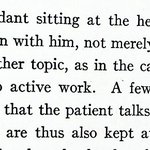
Gaston Labat (1876-1934) introduced regional anesthesia to the United States. He did not have the luxury of using propofol. Instead he promoted the patient to talk. ((Image is from his book “Regional Anesthesia” 1924).

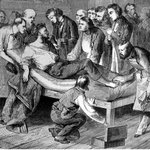
Nine score years ago (this month) William Thomas Green Morton (1819-1868) demonstrated the most important discovery in the history of medicine (image).

Quiz: Is the anisocoria in this famous self portrait of David Bowie (1947-2016), caused by sympathetic or a parasympathetic lesion? The painting is valued at about $100,000. Answer: A parasympathetic deficit.

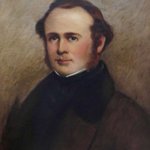
Horace Wells (image) became depressed after his botched attempt to demonstrate nitrous oxide anesthesia at MGH (1845). He was the first “second victim” related to anesthesia. 180 years later 75% of anesthesiologists have been a “second victim” at least once in their career.

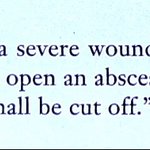
Surgical procedures were inherently dangerous prior to the introduction of anesthesia and antisepsis. Surgeons worried about killing patients. Maybe the “Code of Hammurabi” (1754 BC) prevailed even after the fall of Babylon. (Image: translation from the carved stone pillar).

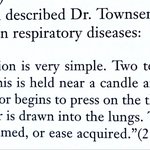
Volatile anesthetics are potent bronchodilators. Thirty years before the MGH demonstration of anesthesia, ether was being used to treat asthma. Dr. Robert J. Thompson gave these instructions for how to use ether (image from 1816). A teapot was the first inhaler.

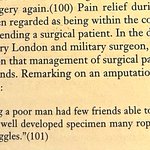
Before the discovery of ether anesthesia, the responsibility of controlling surgical pain was consigned to the patient and his friends…not the surgeon. See the diary notes of an early 19th century surgeon (John Knyveton).

The pupillary light reflex (NPi) will be depressed during and shortly after an acute painful stimulus. 70 years ago Loewenfeld demonstrated that effect (Image from her book “The Pupil”). The columns are “light on”. Pain is between the arrows. Bottom tracings: Horner’s pupil.

Richard Gill returned from Equador in 1938 with 25 pounds of curare. This image shows a native Jivaro with his blowgun and curare paste. In his book describing that 2 year expedition (White Water and Black Magic) he did not mention curare as an adjunct for general anesthesia.

In 1947 two English patients were permanently disabled following spinal anesthesia. The technique was abandoned in England for the next 25 years. Almost 80 years later a similar event happens (image). Neuraxial blocks are usually preferred for total knee replacement.

Is it likely that fake news could damage the reputation of a great physician? Gossip
by colleagues of Andrea Vesalius (Image from Keys) claimed that he performed an autopsy on a live subject. He was punished by sending him on a voyage to the Holy Land. He died in transit.

Dripps, Eckenhoff, and Vandam described the “suit prone” physician (excerpt from Introduction to Anesthesia, 1961). 70 years ago, malpractice attorneys began to sue physician anesthesiologists, sometimes without cause.

You are asked to give a second opinion because the patient is unsatisfied with their current management. Take this advice from “Book on the Physician Himself” by Cathell and Cathell. F A Davis Co., Philadelphia, 1908.

Dudley W. Buxton’s (1851-1932) book “Anesthetics” was the most popular book on how to deliver anesthesia for 3 decades.There were 7 editions between 1888 to 1921. He emphasized that the delivery of safe anesthesia cannot simply be a mechanical procedure (text from 1900 edition).

Alhazen (965-1040 AD) was an Islamic oculist who described the optics of vision. His ideas were based upon his study of the pin hole camera. This painting was purchased in Istanbul (2001).

Over 50 people have died in France while attempting to cool off in rivers and lakes. Meanwhile our federal government continues use fossil fuel deception tactics to undermine climate science.

The pupils are dilated in the dark while awake but paradoxically constricted in the dark while asleep. Giovanni Berlucchi (image - on right) explained this phenomenon (Arch Ital Biol 102:230,1964) and it has significant implications for monitoring the brain in the ICU.

Helen Taussig, MD (1898-1986) was a partially deaf woman who knew about gender discrimination. But she admired the writings of Ralph W. Emerson and understood his message (image). Because of her work on pediatric heart disease she was awarded the Presidential Medal of Freedom.
