

Economist & engineer; Asst Dir & Policy Fellow, State & Local Gov Init @HooverInst; Prev: JEC, Mercatus, OSU; Views expressed are mine & you can't have them.
Stanford University
Joined May 2012
- Tweets10K
- Following592
- Followers1.2K
- Likes20.1K




Pinned Tweet
File this under "Yet more evidence that firm location decisions are based on region-specific advantages, not economic development subsidies"
wral.com/why-geography-doome…


Impressive - this beats Shakira's World Cup song this year, definitely.

I can't stop listening to this song. Best thing that came out of the World cup being in the United States this year. 🇺🇸
Watching this compilation of fans from all over the world at the 2026 World Cup in America is so heartwarming.
USA USA USA 🇺🇸
2
119
"In other news today, Punxsutawney Cal emerged from his burrow, saw the looming shadow of California's wealth tax, and decided to move to Texas."

Wow...
I'm loathe to throw the flag of "professional malpractice" in economics, but transgressions like those mentioned here are hard to explain.
Also, there's a reason why the boilerplate first footnote ends with "All errors remain my own." QC is a professional responsibility.

Some of you will know that the economics literature on the minimum wage has at times been contentious.
(Here is a partial recap: onlinelibrary.wiley.com/doi/…. This one covers some other aspects: pubs.aeaweb.org/doi/pdfplus/….)
What is less well known is how petty the behavior of the leader of the "minimum wages can never lead to employment losses" side of the debate has been. @arindube has consistently attempted to keep citation counts for papers from the other side down by mangling and omitting references.
In his latest he does this by misnaming (and, I suppose, misgendering) two graduate students, Olivia Edwards and Joshua D. Nguyen (see image). Unbelievable stuff that should imo also lead one to discount his findings to a significant extent.

2
166
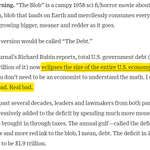
Maybe if we called it "The National Blob" people would take it more seriously? 🤔
wsj.com/politics/u-s-debt-sm…

1
44
For context:
Expected federal spending, FY2026: $7.4T
Expected federal deficit, FY2026: $1.9T
We're borrowing one out of every four dollars that we spend.
And the blob keeps growing...
cbo.gov/publication/61882

49
So, over $180B in improper payments in a single year.
For comparison, that's the equivalent of 14 aircraft carriers, which would more than double the current fleet of 11.


48
We found the "This is fine" guy.

Man who went viral for remaining in his seat as he ate food during the WH Correspondents' Dinner shooting says he didn't want his new tux on the dirty Hilton floor.
He also said he is from New York, so he hears sirens and activity all the time.
"I’m a New Yorker. We live with sirens and activity happening all the time," Michael Glantz, an agent at Creative Artists Agency, said.
"I wasn’t scared. There are hundreds of Secret Service agents hurtling themselves over tables and chairs, and I wanted to watch."
"First of all, I have a bad back. I couldn’t get on the floor, and if I did get on the floor, they’d have to bring in people to get me off the floor. And No. 2, I’m a hygiene freak. There was no freaking way I was getting in my new tux on the dirty Hilton floor. It was not happening."
1
127

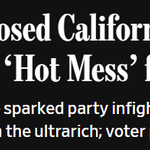
"This piece examines the source of the disagreement, explains why the proponents’ central defense of the tax is wrong, why that error undermines their revenue projections, and shows that our estimates are accurate and made in good faith."
fiscalrealitycheck.substack.…

62
🚨New publication: The Fiscal Reality Check 🚨
An analysis of:
Federal debt and interest burdens,
State tax and spending trajectories,
California's proposed wealth tax,
State and local pension burdens,
and other fiscal policy fiascoes...
fiscalrealitycheck.substack.…

68
"The U.S. middle class is shrinking, but not because more Americans are poorer. Instead, more households are climbing into the echelons of the upper middle class due to income gains in recent decades"
cbsnews.com/news/upper-middl…

One of the biggest criticisms of Milei’s free market agenda has been that poverty figures remained stubbornly high.
The poverty rate peaked at 53% in the first half of 2024, but the share of Argentines living in poverty was 28% by the end of 2025.
washingtonpost.com/opinions/…

3
59


I experienced this new EU border control system a couple times at Frankfurt and Munich in the past two weeks. After learning the hard way and missing two flights, I have the following advice for US citizens traveling to Europe: whether entering, leaving (yes leaving), or connecting, plan a 4 HOUR time buffer for the border control as suggested in this article. The only similar experiences I've had were in India.
1
70
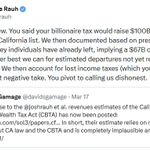
That's a heck of an abstract.

@davidsgamage encouraged me to closely read how @joshrauh came up with his revenue score and compare it to his. I had. But, took a closer look, and I wrote a brief comparison for everyone else.

2
84
This exactly mirrors my own experience, today and throughout my career.
I found a couple mistakes in early structural engineering software that caused the company to send out an update, and I would have never been able to recognize the flaws without fundamental understanding.


1
101


<chefs kiss>
"So yeah, if I was trying to promote collectivism, I probably wouldn't use a heat metaphor in winter. There are a lot of people who lived in collectivist countries who would dispute its association with warmth."
Idealists generally fail to study the relevant history

A hilariously bad metaphor, if you know how collectivist heating worked in the USSR.
In Soviet Moscow, they had a centralized heating system for the whole city. Heat was centrally generated and then distributed through a network of pipes to houses and other buildings.
The service was very, very cheap to the end users. Hooray! Workers of the world, unite!
But people got what they paid for.
A thermostat in your house would be too individualist, so they didn't exist. The level of heat was set collectively by government administrators.
They had to base their decisions on weather forecasts because it would take about 12 hours for a temperature change to work its way through the system. So when the forecasts were wrong (which was often), the heat level was wrong too.
On top of that, every building is different. So no matter what heat level the government chose, some people would be too cold and others would be too warm (except for the times when the heat ran out due to shortages, then everyone was cold).
People in buildings that were too hot would open the windows, even in the middle of winter, wasting heat that could have been used by others. And because there were no price signals, they hardly faced any costs when they did so.
The heating system didn't even have meters for individuals to measure their usage. Officials in post-Soviet Moscow estimated that the whole system used about as much natural gas per year as all of France.
The collectively owned underground pipes that carried the heat suffered from the classic problem: If everyone owns them, then nobody does.
The pipes fell into disrepair and would be replaced by above-ground temporary pipes (which could go anywhere since nobody owned the land either). And they would stay that way for years. That is, if you were one of the lucky ones who got temporary pipes in the first place. Others were just left out in the cold.
So yeah, if I was trying to promote collectivism, I probably wouldn't use a heat metaphor in winter. There are a lot of people who lived in collectivist countries who would dispute its association with warmth.
73