

Pitching Trainer @DrivelineBB Former @Whitesox / @ORUbaseball
Phoenix, AZ
Joined January 2017
- Tweets200
- Following395
- Followers611
- Likes674







Samuel Midgette retweeted

Brewers' pitchers FB velocities tonight:
Misiorowski: Avg 101.1, Max 103.5
Uribe: Avg 99.3, Max 100.3
Ashby: Avg 98.0, Max 99.3
Megill: Avg 98.9, Max 99.6
Enough said.

Samuel Midgette retweeted

An underrated aspect of being a good coach IMO is your ability to get athletes to "buy-in" to what you are trying to accomplish.
@DrivelineBB I believe this comes from the intersection of a data-driven objective approach & real relationship building.
More on this ⤵️⤵️

Everyone knows the league average fastball velo is up. Since 2024 it’s gained 0.5 mph.
But the fastball isn’t the biggest gainer. Sinker, sweeper, and curveball each have gained 0.8 mph.

Samuel Midgette retweeted

Depending upon your role, the game demands the following:
🔘500-700 throws per week
🔘2,000-3,000 throws per month
Your throwing program should ensure the first time you hit these weekly and monthly volumes is NOT in the month of June


Data is not optional in player development. However, data doesn't make decisions. It's context to help you make better decisions. 🧵
Velocity, ball flight, biomechanics reports, workload and game stats are all data. Every evaluation method this game has ever used has been built on information. We've just increased how much of it we have, and how aware we are of it.
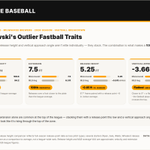
Misiorowski’s fastball is the best performing pitch in baseball right now, backed by the highest run value of any pitch thrown this season.
Elite velocity, extension, low release, and the flattest VAA among MLB starters’ fastballs combined.


I posted recently about fastball usage being down league wide, and why teams are throwing it less.
Let's look at which pitchers are throwing fastballs above league average, and what traits let them get away with it.

When working with a pitcher, it's easy to focus on what you can add: velocity, new pitches, better movements.
While fun to pursue, sometimes the answer is simpler.
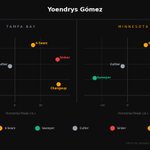
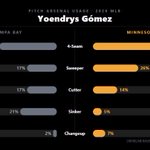
Look at what the Twins did with Yoendrys Gomez this year by just changing his pitch usage. 🧵

Gomez was traded to Minnesota in May.
With the Rays this year: 6.23 ERA in 17.1 innings.
With the Twins: 3.62 ERA in 49.2 innings, eventually becoming their closer.
His arsenal and delivery didn't change

Samuel Midgette retweeted

1/ Availability is the first development metric. A pitcher who isn't on the mound can't get better.
Three pro pitchers, one full season, zero IL stints. Here's how we managed their workload, why CW drove our decisions, and what it produced. 🧵

2026 regular season is in the books.
Going to drop a handful of these graphics over the next few weeks.
Take a look at how many outs a pitch type produced for every extra-base hit it gave up:

Traditional coaching treats the athlete's job as reproducing a pattern:
teach it, repeat it, reduce variation, automate it.
Rob Gray's book "Learning To Be an 'Ecological' Coach" challenges that:
What if practice builds an athlete who can solve a problem they've never seen?

That's why pitch tunneling and leveraging seam effects can give hitters so much trouble: they don't just challenge the swing. They challenge the prediction behind it.