

Daily military history tweets.
Joined May 2012
- Tweets25.5K
- Following3.7K
- Followers21K
- Likes28.2K
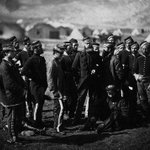

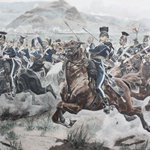




You're looking at survivors of Britain's 'Light Brigade' photographed by Roger Fenton shortly after their ill-fated charge at the Battle of Balaclava. It happened on this day in 1854.

Today in 1415, an English army led by Henry V defeats a much larger French force near Calais at Azincourt (or Agincourt).
A play by Shakespeare will later immortalize the battle:
"Gentlemen in England shall think themselves accursed they were not here."
On this day in 1854, the Light Brigade carries out a disastrous cavalry charge at the Battle of Balaclava. Tennyson publishes a poetic account of the fiasco just six weeks later: "Boldly they rode and well into the jaws of Death; into the mouth of hell rode the six hundred."

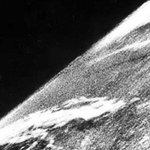
You're looking at the first photo of the Earth from space. It was taken by a camera mounted on a captured German V2 rocket launched by the U.S. military on this day in 1946.

Today in 1944, the carrier USS Princeton is crippled by fuel and ammunition explosions following a kamikaze strike at the Battle of Leyte Gulf. Amazingly, 1,361 of her crew escape the conflagration; 108 perish. Several vessels are damaged while assisting the stricken carrier.
On this night in 1415, King Henry V disguises himself as an ordinary soldier and tours the English camp at Agincourt to listen to his men's fears on the eve of battle — at least that's how William Shakespeare tells it.

On this day in 1648, the Treaty of Westphalia brings an end to the bloody Thirty Years War. The conflict bankrupts Central Europe's major powers and leaves as many as 8 million dead.

You’re looking at the Consolidated B-32 Dominator, an American heavy bomber that appeared in limited numbers in the final months of World War II.
Although it entered service in January 1945, only a handful reached combat units in the Pacific where they flew bombing missions over the Philippines and Formosa (Taiwan).
The B-32 could carry a 20,000-lb bomb load up to 3,800 miles, making it comparable to the B-29 Superfortress. Delayed production prevented it from overtaking the B-29 and the Dominator was cancelled after the war. Only 118 were manufactured. All surviving aircraft were scrapped. No complete example survives today.
Interestingly, the B-32 was involved in the last air engagement of World War Two. On August 18, 1945, Sgt. Anthony J. Marchione, 19, was fatally wounded when Japanese fighters attacked his B-32 during a photo recon mission over Tokyo. It was three days after Japan announced its surrender, but nearly two weeks before the official end of hostilities. Marchione would be the last American killed in battle during the war.

Today in 1917, a U.S. Army gun battery on the Western Front near Bathelemont, France fires the first American artillery shells of the First World War. It's a token gesture; the bulk of the United States' contingent to France won't be ready for major action until mid-1918.
Today in 1983, suicide bombers strike two international peacekeeping compounds in Beirut, Lebanon killing 220 U.S. military personnel, 58 French troops and six civilians. Hezbollah and Iran are blamed for the attacks, which lead to the withdrawal of the peacekeeping force.

On this day in 1944, US and Australian warships take on what's left of Japan's Combined Fleet at Leyte Gulf. Remembered as the largest sea battle ever, the four-day clash shatters the Imperial Japanese Navy. 'I felt that it was the end,' said Japan's navy minister, Admiral Yoni.

On this day in 42 BC, Marcus Junius Brutus, best remembered for his role in the murder of Julius Caesar, kills himself after his army is routed by Marc Antony at the Second Battle of Philippi.

On this day in 1942, 200,000 Commonwealth troops supported by 1,000 tanks attack German and Italian forces near El Alamein. The eventual Allied victory in Egypt — along with the Operation Torch landings and the Soviet liberation of Stalingrad — helps to turn the tide of WWII.

Today in 1739, Britain declares war on Spain. Although the decade-long conflict is nominally fought to avenge an English sea captain who lost his ear to a Spanish boarding party years earlier, the War of Jenkins' Ear is more about British commercial interests in the Caribbean.

Today in 1812, a jailed French general named Claude François de Malet escapes prison and attempts to seize power while Napoleon is away campaigning in Russia. The coup quickly falls apart and the conspirators soon face a firing squad.

On this day in 1956, Hungarian anti-communists rise up against Soviet rule. More than 3,000 civilians are killed when Moscow cracks down two weeks later.


You’re looking at soldiers from the Union Army’s legendary “Iron Brigade,” (possibly members of Company C, 2nd Wisconsin Volunteer Infantry Regiment.)
Formed in 1861, the brigade was made up of volunteers from Wisconsin, Indiana and Michigan and would become one of the most famous and respected fighting units of the Civil War.
Their distinctive, wide-brimmed Hardees set them apart from most Union infantrymen who wore the more familiar kepi-style caps, earning them the nickname “Black Hats.”
The Iron Brigade fought at some of the war’s most famous battles: Second Bull Run, South Mountain, Antietam, Fredericksburg, Chancellorsville, Gettysburg, the Wilderness, Spotsylvania, Cold Harbor and the siege of Petersburg.
At Gettysburg alone, the Iron Brigade suffered 1,153 killed or wounded out of 1,883 men engaged — a staggering 61% casualty rate.

Military History Now retweeted

#OTD 22/10/1943 #RememberRCN -U537 lands a German automatic weather station, code named Kurt in Martin Bay, Labrador. It transmits weather reports for several days before failing. Found in 1977 by a civilian archaeology team and is now on display at the Canadian War Museum.


