

We uphold, develop and provide accessible, efficient and effective justice delivery.
Joined March 2019
- Tweets596
- Following1.2K
- Followers11.8K
- Likes430





Upholding Humanity: Zimbabwe Leads the Charge at the Global IHL Dialogue in Geneva
Speaking as Chair of the Inter Ministerial Committee on Human Rights and International Humanitarian Law, the Secretary for Justice, Legal and Parliamentary Affairs, Mrs V Nyemba indicated yesterday in Geneva that respect for the rules of war is written into Zimbabwe’s constitution, its classrooms and its security training not simply signed up to abroad.
The Global Dialogue on International Humanitarian Law, being held in Geneva, Switzerland, from 3rd to 6th of November 2026, convenes international delegations to review the collective outcomes of workstreams dedicated to galvanising political commitment to IHL.
In the opening sessions conducted yesterday, Roundtable 1 examined a “whole-of-society” approach to building resilient foundations for IHL the principle that compliance with the laws of armed conflict depends on the engagement of government, institutions, communities and individuals alike, not on the state alone.
Mrs Nyemba opened the intervention by tracing Zimbabwe’s humanitarian framework to Section 3 of the Constitution, which champions human dignity, fundamental rights and the rule of law. Rather than treating humanitarian law as a peripheral or imported concept, she said, Zimbabwe has institutionalised these principles through a comprehensive domestic architecture.
That architecture rests on five elements: empowering humanitarian auxiliaries, so that volunteer and auxiliary structures are supported in extending the country’s humanitarian reach; institutional coordination at the highest level, with the agenda coordinated across government through a central inter-ministerial mechanism; military discipline and accountability, under which adherence to the rules of war is enforced through the security services; independent public oversight of state conduct; and civic and security education, which the delegation described as the long-term guarantor of a culture of compliance.
The education element is grounded in Section 7 of the Constitution, with structured constitutional and humanitarian education integrated directly into school curriculums and security service training institutions programmes; an approach the delegation presented as the means of fostering a culture of legal compliance that outlasts any single administration or deployment.
The delegation also placed digital safeguards within its humanitarian framework, citing the Cyber and Data Protection Act, which designates the Postal and Telecommunications Regulatory Authority of Zimbabwe (POTRAZ) as the Data Protection Authority under Section 5, secures sensitive health information under Section 12, and enforces a mandatory 24-hour notification window for data security breaches under Section 19. The protection of personal and medical data, it argued, forms part of the same commitment to human dignity that underpins the laws of war and Zimbabwe’s framework is adapting to risks that did not exist when the Geneva Conventions were drafted.
The delegation reaffirmed Zimbabwe’s readiness to cooperate closely with the International Committee of the Red Cross, the African Union and global partners, arguing that by bridging human rights education with forward-thinking digital resilience, a nation’s commitment to humanitarian values becomes its strongest shield.


Grassroots Empowerment: Ministry of Justice Brings Constitutional Awareness to Mberengwa
In a major move to decentralize legal literacy, the Ministry of Justice, Legal and Parliamentary Affairs has officially rolled out its Constitutional Awareness Campaign in Mberengwa, Midlands Province, engaging local residents directly on their fundamental rights and responsibilities.
Addressing a gathering of community members, Deputy Minister Advocate Nobert Mazungunye emphasized that the supreme law of the land belongs to every citizen, not just legal professionals and government officials. He highlighted that under Section 7 of the Constitution, ensuring access to justice for all remains a top priority.
"The Constitution is not merely a legal document reserved for lawyers, government officials or members of the judiciary," said Advocate Mazungunye. "It is the supreme law of our country." To bridge the information gap across remote communities, the Ministry is employing a multi channel outreach strategy utilizing community town halls, radio broadcasts and exhibitions at agricultural shows, educational expos, and the Zimbabwe International Trade Fair (ZITF).
During the session, Deputy Minister Mazungunye also briefed residents on the Constitution of Zimbabwe Amendment (No. 3) Act 6 of 2026, signed into law on July 7, 2026. The amendment addresses key national mechanisms, including voter registration, electoral boundary delimitation, Presidential and Parliamentary tenures and the composition of the Senate.
He stressed that understanding both the purpose and broader impact of constitutional changes is crucial for civic participation, while reminding citizens that constitutional rights go hand in hand with civic responsibility and respect for the rule of law.
Commending the initiative, Mberengwa District Development Coordinator Mr Arnold Magaya urged traditional leaders, educators, and civil society to build on the campaign's momentum. "Constitutional literacy is a shared responsibility," Mr Magaya noted, praising the Ministry for prioritizing rural communities.
The awareness drive will continue across the Midlands Province, ensuring citizens in every district gain firsthand knowledge of their rights.


Zimbabwe to Host International Corrections and Prisons Association Conference in 2027
Zimbabwe is set to host the International Corrections and Prisons Association (ICPA) annual conference in October 2027, following an announcement made at this year's ICPA conference currently underway in Belfast, Northern Ireland.
Speaking at the gathering, which has drawn delegates from around the world, Commissioner General of the Zimbabwe Prisons and Correctional Service, Dr Moses Cyril Chihobvu welcomed member countries to experience Zimbabwe as they attend the association's annual conference next year. He expressed gratitude to the ICPA Board for entrusting Zimbabwe with the hosting role. "We regard this honour not only as a privilege but as an opportunity for Africa to showcase its innovations, share its experiences and contribute to the global future of corrections," Dr Chihobvu said. "Zimbabwe and other African correctional services are advancing reforms that place rehabilitation and reintegration at the heart of correctional practice. We therefore look forward to ICPA 2027 as a platform for strengthening these efforts that leave no one and no place behind he added.
During a side meeting with the President of ICPA, Ms Heidi Washington of the United States, the Commissioner General received a warm endorsement of next year's hosting. "On behalf of ICPA, we are so excited to come to Zimbabwe in 2027 and learn about all the innovations and advancements going on in corrections there," Ms Washington said. "We will come together with our global community to share ideas and learn from one another. In addition, I look forward to seeing all the beautiful sights and scenes and everything Zimbabwe has to offer."
The Executive Secretary of ICPA, Natalia Boar of Australia, also endorsed the visit, saying it was an honour to learn about correctional practice while in Zimbabwe. She urged fellow participants to join her in the country for the 2027 conference.
The ICPA conference is an annual event where delegates from across the globe convene to share best practices in corrections. The last meeting to be hosted in Africa was held in Namibia in 2012, and Zimbabwe's hosting of next year's edition is expected to put the country in a positive global spotlight.
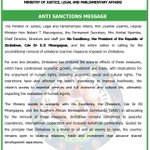
A friend to all, an enemy to none!
The Ministry of Justice joins His Excellency, the President Cde Dr E.D Mnangagwa and the entire nation in calling for the unconditional removal of the illegal sanctions.
#notoillegalsanctions #sanctionsmustgo


Congratulatory Message to His Excellency Dr E.D Mnangagwa on assuming the COMESA Chairmanship.
Congratulations, Makorokoto, Amhlope!!!
Ministry Staff Benefit from Health Screening Initiative
The Ministry of Justice, Legal and Parliamentary Affairs, in partnership with Santa Thadeu Health Services, is conducting a twoday wellness programme for staff and their immediate families.
The initiative has seen members of staff receive dental care, medical consultations, psychological support, laboratory tests and eye examinations, providing employees with an opportunity to address their healthcare needs conveniently within the workplace.
During a side interview conducted with participants of the program, preventive care has been at the core of what they critically indicated as a crucial step towards healthy living. The initiative reflects the Ministry’s commitment to staff well being, recognising that a healthy workforce is essential to productivity, morale and effective public service delivery.
#AHealthyWorkplaceforall!


Zimbabwe Highlights Human Rights and Constitutional Reform at 89th African Commission Session in Dakar
Zimbabwe reaffirmed its unwavering commitment to its human rights obligations under the African Charter on Human and Peoples’ Rights. Representing the Government of Zimbabwe, Secretary for Justice, Legal and Parliamentary Affairs, Mrs. Vimbai Nyemba, delivered a comprehensive statement outlining the country’s human rights record, legislative reforms, water security agenda, constitutional development and continued position on Western economic sanctions.
Zimbabwe’s participation was anchored in its long-held belief in constructive, objective and non-politicised dialogue. The 89th Ordinary Session one of two sessions the Commission holds annually brought together government delegations, civil society organisations, human rights defenders and continental institutions to deliberate on pressing human rights matters across Africa.
Opening her statement, Mrs. Nyemba said: “The Government of Zimbabwe continues to take decisive steps toward implementing progressive policies that enhance the promotion and protection of fundamental human rights. In line with our national development matrix, Vision 2030, and the National Development Strategy 2 (NDS2), my Government is systematically reforming legal frameworks to align them with our progressive Constitution.”
Her statement covered six major thematic areas: economic, social and cultural rights; water and sanitation; humanitarian responses; skills development; constitutional developments and the impact of Western sanctions on human rights.
On economic, social and cultural rights, Mrs. Nyemba acknowledged the compounding challenges posed by climate change, particularly the devastating El Nino induced droughts that have affected the sub-region. She also highlighted the Government’s social protection response. “Despite the compounding shocks of climate change, most notably the devastating El Nino induced droughts affecting our sub-region, the Government of Zimbabwe has successfully rolled out social protection safety nets to guarantee the right to food for vulnerable rural and urban populations,” she stated.
Addressing Zimbabwe’s humanitarian obligations, Mrs. Nyemba said the Government had facilitated the voluntary return and reception of Zimbabwean nationals affected by disturbances in the SADC region. The process was carried out in cooperation with affected host governments and regional partners; “Zimbabwe will continue to work closely with them, bilaterally and through SADC, to facilitate the safe, orderly and dignified return of its nationals,” she said, expressing Zimbabwe’s appreciation for the cooperation extended by the governments concerned.
Mrs. Nyemba also informed delegates about a constitutional amendment enacted in 2026. “The Constitution of Zimbabwe was amended in 2026. The principal amendments extend the election cycle from five to seven years and provide for the election of the President by a joint sitting of Parliament. The amendment also reassigns delimitation functions and the roles of the Electoral Commission,” she stated. The Constitution of Zimbabwe Amendment (No. 3) Act, 2026, was signed into law on 7 July 2026 by His Excellency the President, Cde Dr Emmerson Mnangagwa.
Closing her address, Mrs. Nyemba reaffirmed Zimbabwe’s cooperative approach to the African human rights system. “The Republic of Zimbabwe reaffirms its pledge to cooperate with the African Commission and all relevant human rights mechanisms. We stand ready to engage constructively with all partners to consolidate our democratic achievements and elevate the dignity of our people,” she concluded.
She also committed Zimbabwe to transparency regarding implementation: “The Government of Zimbabwe remains committed to keeping the Commission informed of these developments and to ensuring that they are implemented within the framework of the rule of law.”
Public Statement on the Domestic Violence and the Recent Loss of Lives
#preventdometicviolence #notodomesticviolence

Zimbabwe Attends 89th Session of African Human Rights Commission
Zimbabwe is participating in the 89th Ordinary Session of the African Commission on Human and Peoples’ Rights (ACHPR), which opened today at the King Fahd Palace Hotel in Dakar, Senegal.
The Zimbabwean delegation is led by the Permanent Secretary V Nyemba and Mr James Maridhadhi, Zimbabwe’s Ambassador is also in attend
The session running from 12 to 21 October 2026, is guided by various agendas which includes discussions on the human rights situation in Africa and cooperation between the Commission and national human rights institutions and non-governmental organizations.
Other activities include panel discussions and a Joint Special Mechanisms Forum marking the 40th anniversary of the entry into force of the African Charter on Human and Peoples’ Rights, alongside the commemoration of African Human Rights Day.

Congratulations to the National Anti-Domestic Violence Council!
May this new chapter be marked by renewed commitment, impactful action and meaningful progress in the fight against domestic violence. We wish you excellence as you work to build safer families and communities.
#Access to Justice for all!

Citizens Must Remain at the Heart of Justice Delivery : DM Hon.NT Mazungunye
The Deputy Minister of Justice, Legal and Parliamentary Affairs, Hon. N.T. Mazungunye, officially opened the Ministry’s 2026 Strategic Plan Review Workshop in Bulawayo on behalf of the Minister of Justice, Legal and Parliamentary Affairs, Hon. Ziyambi Ziyambi, as the Ministry intensifies efforts to align its priorities with Zimbabwe’s national development agenda.
The strategic workshop, which is running from 28 September to 2 October 2026 at Rainbow Hotel, Bulawayo, has brought together key stakeholders in the justice sector to review the Ministry’s strategic direction in light of the country’s broader governance and development objectives.
In his official remarks, Hon. Mazungunye described the review as a defining moment in Zimbabwe’s development and in the continuing transformation of the public service and justice delivery systems. He highlighted that the workshop offers an important opportunity for the Ministry to reflect on achievements made so far, confront unfinished business and sharpen its focus as the nation advances towards Vision 2030.
Zimbabwe has entered a new phase under the National Development Strategy 2 (NDS2), 2026–2030, which is aimed at building an empowered, prosperous and upper middle income society under the leadership of His Excellency President Dr Emmerson Dambudzo Mnangagwa. Against this backdrop, Hon. Mazungunye said the Ministry of Justice, Legal and Parliamentary Affairs should continuously align policy, legal and regulatory frameworks with national priorities, while providing the legal certainty necessary to foster development, uphold the rule of law and preserve social cohesion.
He further indicated that the Ministry’s mandate goes beyond the administration of laws, describing the institution as a custodian of the legal architecture of the State. Through its policy and legislative functions, he said, the Ministry plays a key role in translating national priorities into law, strengthening institutions, upholding human rights and creating conditions for sustainable national development.
Hon. Mazungunye also said legal integrity remains inseparable from national development, noting that economic transformation depends on confidence in the legal order. He said, 'securing property rights, predictable business rules, efficient company registration systems and the protection of intellectual property are all essential to building investor confidence and enabling citizens to participate fully in the formal economy'.
While making reference to correctional services, Hon. Mazungunye said the justice system must go beyond confinement and place greater emphasis on rehabilitation, restoration and reintegration. He said reducing repeat offending is not only a correctional goal, but also a broader national objective that contributes to safer communities and stronger social cohesion.
At the centre of the Ministry’s work, he said, must always be the Zimbabwean citizen. Whether seeking legal aid, registering property, starting a business, exercising constitutional rights or reintegrating into society after incarceration, citizens ultimately judge Government through the services they receive.
The Deputy Minister acknowledged progress made under National Development Strategy 1, including the decentralisation of access to justice, improvements in legal aid services, stronger justice delivery infrastructure, legislative modernisation and digital transformation across the justice sector. However, he said these gains must now be consolidated and translated into measurable improvements in the quality of services experienced by the public.
He urged participants to ensure that the Strategic Plan under review is ambitious, practical and results oriented. The plan, he said, must assign responsibility, anticipate risks and measure whether interventions are delivering meaningful outcomes for citizens.
Hon. Mazungunye concluded by urging that the Strategic Plan must remain a living instrument of action, responsive to the changing needs of society and firmly anchored in the Constitution and the national interest.
#Accesstojusticeforall


UN Special Rapporteur pays courtesy call on Government
United Nations Special Rapporteur in the field of cultural rights, Professor Alexandra Xanthaki, has said her visit is an open dialogue with both the State and civil society organisations, to understand the fantastic initiatives, successes and challenges, and ways to improve the implementation of cultural rights in the State. She said this in a side interview after a courtesy call with the Minister of Justice, Legal and Parliamentary Affairs, Hon Ziyambi.
The Special Rapporteur further highlighted that she will present a report to the main United Nations body, the Human Rights Council, which will be discussed in March 2027 with other States.
Secretary for Justice, Legal and Parliamentary Affairs, Mrs Vimbai Nyemba added: "We are happy to have the delegation in our country. Zimbabwe is very constitutional and, in terms of our Constitution, cultural rights are observed and they form the Bill of Rights." She said that, as a country, Zimbabwe takes a whole of Government approach, with every Ministry dealing with issues of culture to promote cultural rights.
Professor Xanthaki will visit other Government Ministries, such as the Ministry of Tourism and Hospitality Industries, the Ministry of Youth Empowerment and Vocational Training and the Ministry of Primary and Secondary Education, as well as other commissions such as the Zimbabwe Human Rights Commission and the Zimbabwe Gender Commission, and will provide a debrief to Government on the 9th of October before leaving the country.


Government operationalises Anti-Domestic Violence Council
Government has operationalised the Anti-Domestic Violence Council, the statutory body created under Section 16 of the Domestic Violence Act to coordinate the national response to abuse in the home. The inaugural meeting of the newly constituted Council was addressed by the Permanent Secretary of Justice, Legal and Parliamentary Affairs, Mrs Vimbai Nyemba.
Addressing the Council composed of 12 members drawn from government ministries, traditional leadership, civil society organisations and faith-based groups, with efforts ongoing to secure full representation from the church and traditional leadership the Permanent Secretary congratulated the appointees and said their presence "marks a significant milestone in our collective commitment to combating domestic violence in Zimbabwe."
The Council's statutory mandate is fourfold: keeping domestic violence under constant review, disseminating information and raising public awareness, promoting the establishment of safe houses for survivors, and providing regular reports to the Minister on the status of domestic violence in the country.
The reoperationalisation comes at a time when Zimbabwe is confronting a disturbing run of fatal domestic violence cases: a man in Kadoma fatally stabbed his wife and nine-month-pregnant daughter; a man in Harare's Glen Lorne suburb shot his wife in front of their four children before taking his own life; and, most recently, the Tshuma case shocked the international community when a husband allegedly murdered his wife and two daughters in the United Kingdom before fleeing across jurisdictions.
The timing coincides with mounting national concern over the scale of the problem. "These tragic incidents underscore the urgency of our mission. The reconstitution of this Council is both timely and necessary, representing a decisive step in strengthening Zimbabwe's national response to domestic violence. This scourge is not merely a legal issue but a profound social challenge that undermines the fabric of families and communities. It demands a coordinated, multi-sectoral response," the Permanent Secretary added.
She further acknowledged the scale of the task, saying the Council must "strengthen referral mechanisms, enhance coordination among stakeholders, and ensure that our laws and policies translate into tangible protection on the ground," adding that "no single institution can address domestic violence in isolation."
She urged the Council to establish "practical and measurable priorities," to promote public awareness campaigns, and to ensure that victims and survivors are treated with dignity, confidentiality and respect, with prevention and community engagement "at the forefront" of its work.
In this respect, the Council calls upon all members of the public to reject all forms of domestic violence and to desist from using violence, threats, intimidation or abuse as a means of resolving family and relationship disputes. Conflict and disagreement may occur within families and relationships, but violence must never be accepted as a response.
No To Domestic Violence

Land rights must have a clear legal basis - Justice Secretary Mrs V. Nyemba
Leopard Rock, Vumba : 24 September 2026
Land rights must have a clear legal basis, be properly recorded where registration is required, and be capable of verification, protection and enforcement, the Secretary for Justice, Legal and Parliamentary Affairs, Mrs V. Nyemba, said in a keynote address at the opening of the Estate Agents Council 2026 Zimbabwe National Land Conference at Leopard Rock, Vumba eralier this morning.
Addressing institutions and professionals who collectively influence how land in Zimbabwe is planned, administered, legally protected, financed, developed, transacted and preserved for future generations, Mrs Nyemba said the rule of law was fundamental to securing bankable tenure.
"From Government's perspective, the rule of law is fundamental to securing bankable tenure. At the Ministry of Justice, Legal and Parliamentary Affairs, we recognise that land rights must have a clear legal basis, be properly recorded where registration is required, be capable of verification and be effectively protected and enforced. The integrity of the legal framework is consequently inseparable from the integrity of the land administration system," she said.
Mrs Nyemba said land had never been merely an asset or a parcel on a map. "It is closely connected to our identity, dignity, families and livelihoods. It provides the foundation upon which we build communities, sustain economic activity and advance national development. The manner in which we govern, administer and secure land has implications far beyond an individual property transaction. It affects the protection of rights, fiscal development, public confidence, investment and the ability of land to contribute productively to our nation."
As the conference is being guided by the theme: "From Title to Capital: Delivering Bankable Tenure Through Data Integrity, Institutional Reform and Intergenerational Stewardship." The PS highlighted the broader significance of land and the need to translate secure tenure into tangible economic opportunity, challenging participants to look beyond the title deed as evidence of an interest in land and to recognise secure tenure as a foundation for investment, access to finance and sustainable national development.
"At the centre of this process is the title deed. It provides legal recognition and certainty in respect of an interest in land. But bankable tenure is not created by the title deed alone. It is created by the confidence that surrounds the title. I believe that confidence rests on reliable information, effective institutions and a legal framework that enables rights to be verified, protected and enforced. When these elements work together, secure tenure can facilitate access to finance, support investment and unlock the productive value of land. This is particularly important as we implement the National Development Strategy 2, 2026 to 2030 and advance towards Vision 2030. Our collective task is to strengthen a tenure system that provides certainty, facilitates investment and supports national development."
Turning to data integrity, Mrs Nyemba said a title deed derived much of its practical value from the accuracy and reliability of the information upon which it is based, and that accurate, secure and readily verifiable property records gave greater certainty to all who relied on them.
"For citizens, reliable land records provide assurance that their interests are properly recorded and protected. For investors and financial institutions, they provide greater certainty in verifying ownership, facilitating transactions and extending credit, while reducing the risks of fraud, multiple allocations and competing claims," she said.
Government's objective in her remarks was clear; to reduce delays and uncertainty, strengthen safeguards against fraud and build confidence in the land market, turning title into a practical pathway to investment, financial inclusion and sustainable socio-economic development.
The Secretary further stated that legal and institutional frameworks must evolve with the needs of society and the economy. "Laws are not carved in stone; they are living instruments that must keep pace with development, urbanisation, smart cities, digital conveyancing, new financial instruments and regional integration".
Mrs Nyemba said the responsibility extended beyond Government to estate agents, conveyancers, valuers, planners, developers and financial partners. "Property transactions involve significant financial commitments, and the public must be assured that registered professionals uphold the highest standards of integrity, competence, transparency and professional conduct," she said, adding that professional integrity was integral to bankable tenure. She drew on a Shona proverb "Kuturika denga remba kubatirana", meaning that putting a roof on a house requires people to work together to argue that a title deed secures a right in land but cannot on its own provide roads, water, electricity, schools or sanitation. "Bankable tenure must therefore be part of a broader vision of well-planned, serviced and sustainable communities," she said, calling for collaboration across Government, local authorities, land institutions, financial institutions, developers and professional bodies.
Mrs Nyemba concluded by welcoming delegates from Zambia, Botswana and Rwanda, describing their presence as a powerful expression of African solidarity and South-South cooperation.
The Chairperson of the Zimbabwe Land Commission, Commissioner Tendayi Ruth Walker Bare; the Permanent Secretary for National Housing and Social Amenities, Eng. T. K. Chinyanga; the Chief Registrar for Deeds, Companies and Intellectual Property, Mr Willie Mushayi and other key stakeholder were present.


Meanwhile, our Justice Choir Team in Gwanda gave it all they had, pouring out tremendous energy during the Inter Ministerial choir competition!
Stay tuned for more updates:


Happy Birthday His Excellency, the President, Cde Dr E.D Mnangagwa.
May the years ahead bring you greater joy and abundant wisdom!!!
and Happy Holiday Zimbabwe.

Justice Pulls Through in Tug of War!
The Ministry is participating in the Inter Ministerial Sports Festival 2026, currently underway in Gwanda.
In a display of strength, coordination & team work, the Justice tug of war women's team secured a convincing victory over Local Gvt.


Zimbabwe champions inclusive multilateralism at 63rd Human Rights Council session
Geneva: Zimbabwe has called for an inclusive and balanced approach to multilateralism, with the country's delegation telling the United Nations Human Rights Council that cooperative diplomacy anchored in the UN Charter remains the world's most viable path through mounting geopolitical tensions.
Zimbabwe was represented by the Secretary for Justice, Legal and Parliamentary Affairs, Mrs Vimbai Nyemba, at the Interactive Dialogue with the Independent Expert on the Promotion of a Democratic and Equitable International Order, held during the 63rd Ordinary Session of the Human Rights Council, currently under way in Geneva, Switzerland.
Addressing the Council, Mrs Nyemba said multilateral diplomacy remains viable even amid prevailing geopolitical complexities, adding that it affords the international community an opportunity to build a more inclusive, equitable and resilient system of global governance. This, she said, was only possible if multilateralism is channelled through cooperative frameworks anchored in the principles of the UN Charter and international law.
The Permanent Secretary said the legitimacy of the United Nations depends on its capacity to remain relevant, responsive and representative. Zimbabwe accordingly called for the acceleration of long-delayed institutional reforms, including the reform of the Security Council and international financial institutions. She further stated that the reforms should strengthen the capacity of the UN to facilitate dialogue across geopolitical divides, while ensuring that human rights remain central to the work of the organisation across all its pillars.
Concluding her address, Mrs Nyemba called for the unconditional lifting of unilateral coercive measures (UCMs) imposed on Zimbabwe and other countries, arguing that they obstruct the establishment of an equitable global economic order and continue to undermine the credibility of multilateralism.

Constitutionalism must live on in every officer’s career: PS Nyemba
The Secretary for Justice, Legal and Parliamentary Affairs, Mrs Vimbai Nyemba, earlier today delivered a Constitutional Awareness programme to in-service correctional officers at the Zimbabwe Prisons and Correctional Service (ZPCS) Ntabazinduna Prisons Training College in Bulawayo, urging the country’s prison officers to treat constitutional awareness as a career long duty rather than a one off lesson.
Opening the engagement, Mrs Nyemba commended ZPCS for institutionalising continuous constitutional learning among serving officers. “Constitutionalism is not a subject that one studies once and then puts aside,” she said. “It is a continuing responsibility that must inform the conduct of every public officer throughout his or her career.”
Beyond professionalism and discipline, officers also need a sound appreciation of the constitutional principles that govern the exercise of their authority, the Permanent Secretary added.
Mrs Nyemba framed the programme as a direct fulfilment of Section 7 of the Constitution, providing officers already serving within the correctional system the chance to refresh their understanding of the supreme law and reflect on how its principles should guide their everyday responsibilities.
The Permanent Secretary noted that ZPCS occupies a unique and indispensable position in Zimbabwe’s justice delivery system, with officers’ powers directly shaping the rights, freedoms and dignity of persons in their custody. A working understanding of the Declaration of Rights, she said, is therefore non-negotiable.
Closing her address, Mrs Nyemba urged the officers to take the Constitution beyond the training room and called on ZPCS to remain professional, disciplined, accountable and humane anchored in the supreme law.
