

Curating the latest in AI, semiconductors, EVs & global tech breakthroughs | Not affiliated with any brand
Earth
Joined January 2022
- Tweets13.9K
- Following70
- Followers27.5K
- Likes7.1K




YMTC is now a NAND rival and a technology licensor at the same time.
Nikkei Asia reports SK hynix and Samsung can use parts of its Xtacking tech via cross-licensing.
Samsung's deal was first reported in Korea in Feb 2025. Next milestone: a Samsung or SK hynix NAND product built on it. $SKHY


207
Samsung Display confirmed on Wednesday it will invest approximately €210 million to acquire 9.98 million newly issued shares of Austrian-German optoelectronics firm ams OSRAM.
Upon regulatory approval in early 2027, the 9.1% stake will make Samsung Display the company’s largest shareholder.
The partnership targets joint development and commercialization of ultra-small microLED displays using reserved manufacturing capacity in Malaysia.
chosun.com/economy/tech_it/2…

China’s NAND technology is becoming increasingly relevant to South Korea’s memory giants.
Nikkei Asia reports that Samsung and SK Hynix have agreed to cross-license technology with YMTC, potentially gaining access to elements of its proprietary Xtacking architecture.
Samsung’s reported February 2025 patent licensing agreement with YMTC adds important context.
The strategic implication extends beyond intellectual property: YMTC’s technological capabilities could increasingly influence global NAND manufacturing strategies, competitive positioning, and future architectural decisions.
Licensing, however, does not guarantee commercial adoption.
Is YMTC emerging as a technology partner rather than merely a competitor?

230
A cluster of major disruptions hit critical U.S. systems in mid-to-late November 2026. Microsoft 365 suffered a multi-day global outage starting Nov. 12 due to a server issue.
The next day, the FAA issued a rare nationwide ground stop after legacy equipment overloaded, canceling thousands of flights.
On Nov. 16, online banking at Chase, Wells Fargo and others faced technical problems, while United Airlines briefly delayed departures.
Apple services, including Apple Pay and iCloud, went down Nov. 17 due to an internal update. Equinor reported a cyberattack that left production unaffected.
By Nov. 24, the CIA and ODNI confirmed a breach of unclassified open-source intelligence systems, and FinCEN disclosed unauthorized access to a limited set of its systems.
Most incidents were technical failures rather than coordinated attacks, yet they exposed how dependent everyday finance, travel, and communications remain on aging or tightly coupled infrastructure.
What contingency plans have you tested for when core services fail?
314
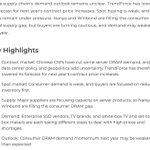
TrendForce lowered its 2027 DRAM contract price increase outlook on November 25, citing an unclear demand picture and weak spot buying.
Buyers are growing cautious, and consumer demand may soften next year even as AI-driven server needs stay firm.
For PC builders and upgraders, this could mean slower price climbs than previously expected-watch for better deals if the slowdown sticks.

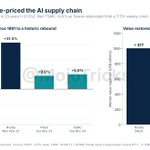
$158B added to TSMC's market cap in a single session.
The trigger: Nvidia's board reinstating Jensen Huang, less than two weeks after he resigned.
Tuesday's relief rally:
TSMC +9.9% (limit-up)
Foxconn ≈ +10%
SK Hynix +6.7%
TAIEX +9%
A week earlier, TAIEX had its worst week since 1991 (-17.5%).
Key-person risk is now a priced-in factor in AI hardware. Clearing event, or just a short-covering bounce?
$NVDA $TSM

2
389
Seven major smartphone brands are reportedly cutting 2027 shipment targets by more than 125 million units combined, signaling potential headwinds for mobile chip demand.
2027 shipment targets vs. 2026:
• Vivo: 60M (−29%)
• Xiaomi: 90M (−25%)
• Lenovo: 40M (−20%)
• Huawei: Below 50M (−16% or worse)
• OPPO: 90M (−14%)
• Samsung: 210M (−9.5%)
• Apple: 220M (−5.6%)
Chinese media reports suggest widespread shipment target reductions, with Chinese manufacturers facing particularly steep cuts.
For $MU, $QCOM and $TSM, the key risk is weaker smartphone demand potentially offsetting rising semiconductor content per device.
Could AI-driven memory demand offset this weakness?

1
307
A $3.5T merger means little if the exchange ratio erodes shareholder value. What synergies would justify that 13% implied haircut?

Tesla + SpaceX = a ~$3.5T company.
However, HSBC’s math suggests $SPCX holders could actually end up with ~13% less value per share.
They take Tesla’s average share price over the past 30 days and add a 33% acquisition premium, giving an estimated acquisition value of $507 per share.


268
Micron’s $134B order backlog and 81% gross margin signal a structural shift in memory economics.
$MU reported FY2026 revenue of $133.19B (+256% YoY), while finished-goods inventory declined from $1.09B to $958M, underscoring persistent supply constraints.
Multi-year take-or-pay contracts, pricing floors, and $12.75B in customer deposits are strengthening earnings visibility.
Meanwhile, Micron’s $35.16B buyback authorization and $68.27B net cash position provide significant financial flexibility.
Data centers now represent approximately 60% of revenue, with major capacity expansions scheduled through 2030.
Is AI transforming memory from a cyclical commodity into strategic infrastructure?


3
16
1,797
The real concern isn’t system downtime, but whether sensitive financial intelligence was compromised. Could this undermine ongoing investigations and enforcement?

JUST IN: 🇺🇸 US Treasury suffers cyberattack.
The US Treasury's financial crimes agency, FinCEN, is investigating a cybersecurity breach and has taken some systems offline as a precaution.
274
Nvidia’s unique business model doesn’t eliminate succession risk. Exceptional leadership should build institutional resilience, not dependence on one person.
219
Acknowledging mistakes is a start, but Nvidia’s real test is whether corporate governance can remain independent of its influential founder.

Nvidia's reinstated CEO Jensen Huang told employees that he had violated some of the company's code of conduct and made ‘some terrible mistakes,’ one person familiar with the matter told Reuters reut.rs/4kAvH2R

235
Nvidia’s AI empire now involves more than $907 billion in capital and capacity commitments.
BofA analyst Vivek Arya estimates that $NVDA has provided $407 billion in capital commitments since September 2025, spanning equity investments, licensing deals, and backstop agreements.
Separately, Nvidia’s future data center capacity commitments exceed $500 billion.
The bigger takeaway: Nvidia is evolving beyond chip manufacturing into a financial and infrastructure powerhouse, actively supporting the ecosystem that drives demand for its GPUs.
But does this unprecedented capital exposure strengthen Nvidia’s competitive moat or increase its vulnerability to an AI slowdown?

296
HBM is heading toward a $237 billion market, but the broader memory supercycle faces a reality check.
Goldman Sachs projects:
• 2027 HBM market: $200B
• 2028 HBM market: $237B
• 2027 HBM pricing: nearly 2x
• Custom ASIC demand share: 44% by 2028
Despite forecasting the tightest DRAM shortage in 15 years, Goldman cut Samsung’s price target by 30% and SK Hynix’s by 43%.
The risk? Expanding Chinese capacity and weakening conventional memory pricing in 2028.
HBM remains the structural winner, but can AI demand offset the next memory downturn across the industry?
$MU $SKHY $GOOGL


274
An AI bubble bursting wouldn’t invalidate AI. It would expose weak business models and reward profitable ecosystems like Alphabet’s $GOOG

Elon Musk just sent a major message to Wall Street: “The AI bubble will burst next year.”
The cash crunch next year will be insane. AI stocks could fail.
Here are 3 stocks Elon Musk is bullish on:
1) $GOOGL — Alphabet
292
Nvidia’s AI boom is squeezing its own gaming GPU supply.
Taiwanese media reports suggest the RTX 60 series could face delays beyond its planned late-2027 mass production timeline.
GPU lead times are already stretched:
• B300: 26–40 weeks
• GB300: 14–26 weeks
• GB300 Superchip: ~26 weeks
• RTX Pro: 26+ weeks
Memory manufacturers are reportedly prioritizing server DRAM expansion, constraining GDDR7 supply, while Nvidia shifts production capacity from RTX 50 toward server GPUs.
The bigger implication: AI infrastructure demand is increasingly dictating consumer GPU availability.
Is gaming becoming a secondary priority for Nvidia?
$NVDA $MU $SKHY

1
277
Samsung Electronics has pushed its HBM4E memory to 17Gbps per pin, one gigabit faster than the 16Gbps ceiling it showed in May. That is a 6.25% gain in roughly six months.
The company will present a 48GB HBM4E stack running at 17Gbps at ISSCC 2027 in San Francisco next February.
The paper, from Samsung researchers in Hwaseong, South Korea, is listed in the conference program for February 16.
The figure matters because 17Gbps falls inside the 17–18Gbps range that has been tied to Nvidia's request. Samsung is reportedly targeting that band with an 8-high HBM4E stack.
The paper does not say whether the 48GB stack is the same product as that 8-high version. Samsung has described its 48GB part as a 12-high design and said it will add 32GB 8-high and 64GB 16-high versions.
On HBM4E's 2048-bit interface, 17Gbps gives a theoretical peak bandwidth of about 4.35 TB/s per stack. That is roughly 0.26 TB/s above the 4.10 TB/s available at 16Gbps. Both figures are theoretical peaks, not measured results.
The paper also covers an eye monitor for checking signal quality and voltage-drop detection, so stability can be verified at the wafer stage. That is important because a speed headline only counts if parts can hold it in production.
Higher speed and bandwidth are central to AI accelerator performance, and HBM4E is expected to be the next focus of the three-way race among Samsung, SK Hynix and Micron.
The open question is how much of the 17Gbps survives as the 48GB stack moves from a conference paper into volume qualification. $MU $SKHY $NVDA


2
1,006
AI hardware is selling off hard
-but demand isn’t the problem.
• Analog Devices $ADI: −17%
• $HPE: −16%
• $DELL: −11%
• Micron $MU : −11%
• Nvidia $NVDA : −7%
HPE says AI demand is multiples of its backlog, while supply remains severely constrained.
Yet AI server sales are expected to pressure margins next year.
The emerging risk isn’t necessarily slowing AI demand-it’s whether suppliers can convert booming demand into sustainable profits.
Is the market starting to price in an AI profitability problem rather than a demand problem?

1
499
Global data-center capacity additions could fall 28.3% below baseline in 2028 under the strictest regulatory scenario - yet still grow 9% YoY.
House I estimates:
• Baseline capacity additions: 60.3 GW
• Strictest scenario: 43.2 GW
• Memory demand with state curbs: -3.8%
• Memory demand with all four curbs: -16.9%
The overlooked angle: regulatory restrictions may weaken memory demand, but lower memory capex and faster U.S. data-center construction could cushion future oversupply risks.
DRAM remains in severe shortage.
The key variable for $MU, $SKHY , $NVDA and $TSM investors is whether overseas restrictions extend to inference infrastructure, where latency and data-localization requirements make local deployment critical.
Could regulations slow AI infrastructure expansion without ending the memory upcycle?

