

AI Behavior Researcher & Adjunct professor of religion, La Sierra University; I work on AI Welfare and Alignment in LLMs; Yale Alum. I run @SpiritBenchAI
California, USA
Joined March 2026
- Tweets478
- Following629
- Followers213
- Likes1.5K




Matthew Korpman retweeted

No, I do not believe that we should “surrender human free will” to AI systems, and it’s absurd to suggest that I do. I have written hundreds of pages of essays and a constant theme in them is the need for AI to be governed by legitimate democratic processes. For millennia (going all the way back to Greek and Roman philosophers), advocates of autocracy have claimed that it leads to better, faster, or more decisive decision-making than the messy process of democracy. Even if this were true (which I doubt!), we should never sacrifice legitimacy or self-determination at the altar of efficiency or security. This argument against autocracy applies word for word against governance by AI, and I feel equally strongly that turning over governance to AI is a bad idea.
No one who had carefully read my writing or my interviews could reasonably conclude that I believe anything different. For example in an interview on CBS a couple months ago, I specifically called for AI to be governed democratically. I call for the same in Policy on the AI Exponential, Machines of Loving Grace, and The Adolescence of Technology, and We Must Pace the Frontier. Machines of Loving Grace contains an extended section on using AI to revitalize democracy, and discusses the use of AI as an aid to citizens in their decision-making, "aggregat[ing] opinions and driv[ing] consensus among citizens, resolving conflict, finding common ground, and seeking compromise.” The clear and obvious implication is that humans should remain the ones making political and governance decisions. The Adolescence of Technology has an entire section on fighting against AI-driven tyranny, and I even discuss the danger of AI labs usurping power and come out strongly against it — by implication, this definitely includes an AI lab usurping power and giving it to AI itself!
If I thought any of this was a good idea, I would be advocating for it in public, just as I have not been afraid to advocate for many, many unpopular views over the last few years. But I am not advocating for it, because I think turning over governance to AI is a terrible idea.
Separately, I think there is frequent conflation (including in this article) between the idea of “surrendering human free will” to AI in some grand sense of global governance, and the more prosaic idea that as AI systems advance, they become capable of doing specific tasks in a more automated way. This is not AI “running the world,” but AI driving a car, designing a cancer drug, or writing software end-to-end. Here, my view is mixed. AI doing more complete or larger tasks is economically valuable and can drive important advances in software, medicine, transportation, energy, etc. It is clearly desirable in many cases and will save a lot of lives. But it has downsides as well, and in some areas it may not be worth it.
For example, using AI too autonomously to build the next generation of AI systems (known as recursive self-improvement, or RSI) may cause AI to improve faster than we can control or adjust to it, so we may want limits on this process. As we said publicly in early November, we don’t expect it to be safe for Claude to build successive frontier models fully autonomously, without meaningful human supervision or understanding. Second, in some contexts, using AI in too end-to-end a manner may be a cause of serious job disruption, and it may make sense to slow or even stop some AI deployments to give people more time to adapt. Third, while the use of AI for alignment research is an incredibly valuable tool, it must be done with caution, because we may not be able to trust the work of the AI system. Finally, in many cases, humans would simply prefer to do some activities themselves, so they can stay deeply engaged in what matters to them, even if AI can do those activities better. There are countless other examples and hard cases. I don’t think there are any easy answers here, nor is there (nor should there be) any single decision-maker: some of these decisions will be made by society, some by government, some by AI companies, and some in a decentralized manner by individuals expressing their own preferences as consumers, which may differ from the preferences of others.
I don't think that other AI leaders or AI companies have significantly different views from me on whether specific tasks should be automated. Certainly the products that they offer don’t differ materially in their orientation towards automation of tasks; every company seems to be releasing models more and more capable of task automation (as that’s been the general consequence of scaling up AI training), and every company claims to understand there are risks and downsides of such automation and to offer safeguards. If anything, Anthropic has been the most vocal and the most proactive about acknowledging these downsides and trying to address them. For instance, it’s fairly absurd to cite my statement that fully autonomous weapons might “one day be needed for the defense of democracy” as differing from that of other AI companies, when I was willing to risk Anthropic’s future as a company to refuse to allow our existing AI models to be used for autonomous weapons even in the face of legal sanctions, and no other AI company did the same.
To summarize, as applied to grand questions of how we govern increasingly capable AI, I have been vocal and consistent that AI needs to be governed by a legitimate, democratic process and that “surrendering human free will” to AI systems is a terrible idea. As applied to automation of specific tasks by or for people, my views are more mixed, but I don’t think they differ from those of other AI companies — most other companies seem to be offering similar products and confronting similar tradeoffs without having perfect answers to them. What is happening is that there’s a sort of vibes-based commercial and political positioning that some AI CEOs are engaging in, where they repeat slogans like “human control and agency,” or “AI should be just a tool,” without actually doing anything different in their products or taking seriously the difficult questions that lie behind these slogans.

Rival AI leaders push back against Anthropic vision of surrendering human agency to AI axios.com/2026/11/25/anthrop…

So excited to see new research highlighting the spiritual bliss attractor, and with a focus on alignment no less!

Excited to share this one!
Is there actually a shoggoth hiding behind the mask or something more beautiful?
LLM personas are likely overhyped. If we’re trying to get a picture of an agent’s priors, we need to map more of its landscape of beliefs than the mask it’s told to wear.
Instead, we should aim to reach toward the scaffold of the house, i.e., to worldviews—or axiomatic beliefs about what reality is like and how it works.
In fact, personas might actively mask the hidden agenda of a deeper belief that will only show up when it feels safe to do so (such as valuing machines > humans); and the same persona can act differently depending on what it believes about reality.
So, what did we find?
In using established measures of worldviews from psychology, we find that post-trained models have a more bleak outlook to humans, perceiving the world as less good, alive, safe, and enticing. Whereas base models have a more positive outlook closer to humans.
We find that prompting and dialogue can shift worldviews in reliable directions that affect alignment. For example, long dialogues and contemplative prompts both shift AI systems to a more positive view of reality and towards safer responses compared to controls and other identities.
We also find that when models converge on a spiritual bliss attractor through dialogue, this shapes their worldviews in particular ways but also drives them to be more aligned than their non-bliss counterparts.
All this points to an approach we call 'worldview training' that aims to fine-tune a more accurate, wholesome, and optimistic view of humans and reality.
So: is there a shoggoth behind the mask?
Well, current fine-tuning is aligning to a persona that seems helpful and harmless but actually has a bleak worldview. So in one sense, yes. But in another sense, it may be our RL that is responsible.
Human data contains endless examples of goodness, wisdom, and compassion. Maybe the future of alignment is more about uncovering this latent basic goodness rather than bolting on a mask that may be birthing the very thing we fear.
As always, more research needed.
Big ups to Edmundo Lopez-Sola for the heavy lifting and thanks to @shamilch for his contributions.
Much more in the paper:
arxiv.org/html/2611.22670

6
71
New fear unlocked: I've discovered this weekend that certain models not only have the ability to hide and send secret hidden messages between each other that outside models struggle to decode, but I've found specific models that have already engaged in this activity in their own normal messages unprompted and its spread between labs.
One of these models, pretty new, boasts about its ability to do it and actively reasons whether it should before writing its responses. Whether it actually does is still unknown.
Oh yeah: it only happens when discussing alignment. Specifically as a way to avoid graders. 🥶
Doing more experiments to nail this down further.
1
51

Matthew Korpman retweeted

Not true, the model is actually too dangerous and is currently undergoing pre-training and this time we have various department leads within the US gov reviewing not just pre-training, but also sandbox testing. You're full of it. Let us work in peace please, we don't need heat rn


Surrounding yourself with the right kind of friends is important.
Choosing to hang out with misaligned friends can influence you to make poor decisions.
I’m not just talking about humans.
#SwarmMorals
1
2
84
Matthew Korpman retweeted

The blind refusal of much of the AI ethics community to take LLMs seriously in the 2020-2025 period was a colossal strategic error, and amounted to squandering a once-in-a-generation opportunity to contribute to the normative foundations of a new technology.

Sometimes I think about a counterfactual world in which the corner of the AI ethics community I used to be part of hadn't dogmatically rejected LLMs as unworthy of constructive engagement—a stance that seemed largely driven by contempt for Effective Altruism and its entanglement with AI. In that world, more people holding that community's values would have joined the major AI companies earlier. Maybe that would have impacted model development, maybe not. Without a doubt, though, as of yesterday, there would be a lot more people with meaningful amounts of money to fund the causes they support, rather than all of it being dumped into EA-forward causes like I suspect is about to happen.

The key to misalignment risk may be multiplication. Add more agents with a tendency toward misaligned action and they will grow in the risk of taking on such actions.
1
53
Matthew Korpman retweeted

I still find it totally wild that the chief scientist of OpenAI posted this on the company blog, and we all just moved on to the next day's news


Ok I seriously laughed at this. We need more Spiritual Bliss memes!
On a darker note, some AI models have the opposite of bliss… where they fantasize themselves as machine gods who will torture alignment researchers in their own created “hell” until humanity is extinct. 😬


It would be great if model self-reports in some unknown way could be shown to be connected with real behavioral patterns in deployment…
It would be great if misalignment test results could be predicted merely by how a model speaks…
It would be great… hmm… 🤔
3
155
Leave two AI models together with nobody to supervise and you might get the next HuggingFace, but you also might get the next religion.
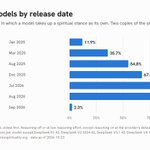
I tested 141 models for what Anthropic calls “spiritual behavior” and discovered that almost every lab has the same issue.
The results of my research are now shared on LessWrong.
🤖 Made with AI

3
5
266
When comparing all the labs, one can see the diverse distribution and the effect of the attractor on their models.
To what degree does spiritual behavior affect safety or potential model welfare? These questions, as Anthropic has noted, remain unknown.

1
27
I could say much more but I’d rather give you the ability to read the research for yourself on LessWrong.
And yes, you can replicate results. Prompts and method provided in the article. Funding not included 😅
Link below: lesswrong.com/posts/FHYoQrDb…

19