

For me to keep up with all the gaming news from these lovely developers who spend so much time and effort on them for us.
Mobile, AL
Joined October 2016
- Tweets101K
- Following2.1K
- Followers786
- Likes139K





Zachery Morrison retweeted

60 Minutes visits Gen.Ukrainian, a summer camp in Ukraine that gives Ukrainian children who had lived under Russian occupation or survived Russian custody a safe space to grieve and heal.
Since 2022, tens of thousands of Ukrainian children have been carried off to Russia and forced into re-education programs or military camps. Others faced Russian indoctrination in the occupied east. Ukraine says it is part of a Russian campaign to erase their Ukrainian identities.
Zachery Morrison retweeted

For the first time ever, hop into the world of Aincrad with a full english voice actor cast!
Watch more from our AX 2026 Panel here: youtu.be/gI2DdrDEmR4
Zachery Morrison retweeted
That’s actually a very good observation. In Ukrainian, Polish, and many other Slavic languages, unlike Russian, the names of the months reflect deeply rooted folk traditions, centuries of observing the natural world, and the rhythms of agricultural life. Many of these names have their roots in ancient Slavic dialects.
In Russian, by contrast, they have long since been replaced by the rather dull and much less evocative names inherited from the Roman calendar, just as in English and many other languages.
Indeed, November in both Ukrainian and Polish is called lystopad or listopad (literally “the falling of leaves”). Because, well, that’s when the leaves fall before winter.
Likewise, August in Ukrainian is serpen’, named not after Octavian Augustus but after the serp (sickle), because that’s the time to harvest grain.
And in April, trees and flowers come into bloom, hence the Ukrainian kviten’ and the Polish kwiecień. Who the hell needs the Latin Aprilis?
And when the plowed fields froze into hard clods of earth (hruda in Ukrainian, gruda in Polish), you knew autumn was well and truly over and winter had set in. Hence hruden’ in Ukrainian and grudzień among our Polish neighbors.
It’s cool to be Slavic and to remember our ancestral farming roots.


Zachery Morrison retweeted
Now, because of Russia’s war, agricultural exports from the Black Sea region have become much more difficult. This is food for hundreds of millions of people in many countries – from Algeria to India, from Sudan to Indonesia.
Our farmers and food producers supply the world with dozens of different products – from grain and flour to sunflower oil and many others. And the world depends on these products. Without them, there are shortages and prices go up.
From an address to the Food from Ukraine Summit. (1/3)
Zachery Morrison retweeted

Plaque by Plaque, Russia Erases the Memory of the Gulag’s Horrors
The Kremlin’s rehabilitation of Stalin, who presided over the brutal labor camps of the Gulag, has accelerated during Russia’s war in Ukraine nytimes.com/2026/11/27/world…

Zachery Morrison retweeted
No, seriously, why does every other asshole out there think they know better than Ukraine’s Constitution, its laws, and the will of the Ukrainian people, including “Russian-speaking” natives of the Donbas like myself?
What on earth makes you pathetic creatures think that we don’t identify entirely and exclusively with Ukraine and that we want to be part of Putin’s idiotic Reich built on blood and guts?
Is it because the Kremlin has thrown so much money at you that you’d sell your own mother into slavery, let alone hand us over to an FSB torture chamber?

🤡 “Russian-speaking territories should go to Russia — why should Russians give them up?” — German opposition leader Alice Weidel on Donbas
“Ukraine was shelling the population there with missiles. This is constantly hushed up.”
Readers added context they thought people might want to know
In 1991, ~84% of Donetsk and Luhansk voters backed independent Ukraine; Russia recognized the borders. Surveys show most Russian speakers identify as Ukrainian. UN recorded 25 civilian deaths in Donbas in 2021 with public monitoring, not a cover-up.
en.wikipedia.org/wiki/1991_Ukra…
ukraine.un.org/sites/default/…
kiis.com.ua/?lang=eng&cat=…
Zachery Morrison retweeted
Today, children are returning to Ukraine from Ukraine’s temporarily occupied territories, as well as from Russia. Nine children, a grandmother accompanying her grandson, and Anastasiia – a resident of the Oleshky Children’s Residential Care Institution who needs special support. These children are from the temporarily occupied territories of the Kherson and Zaporizhzhia regions and Crimea. Valeriia, Marta, Mykola, Ruslan, Sofiia, Davyd, Oleksii, Oleksandr, and the youngest, Artem, who is only eight years old. All of them will receive the assistance they need.
I thank First Lady of the United States Melania Trump for her help and mediation. I am grateful to the Ombudsman and his team for their direct involvement in this work. I am grateful to all our people who are making efforts through the Bring Kids Back UA initiative to ensure that children can return to Ukraine. And I thank all our partners who are working with us through the International Coalition for the Return of Ukrainian Children and helping with these efforts. A total of 2,875 children have already been brought home. We remember everyone. We are doing everything possible to find them and bring them back to their families and loved ones.


Zachery Morrison retweeted

MORE: The US proposal apparently now posits that Ukraine will receive security guarantees only after the US Congress and Russia approve them, Trump becomes confident that the guarantees will not be activated, and the broader post-war European security architecture is agreed upon. The process of getting the US Congress and Russia to agree on the same framework of Ukraine’s security guarantees, along with a European security agreement that satisfies the interests of all European states, will very likely result in significant delays in approving any security guarantees for Ukraine and may well prove impossible to execute.
There is a large divergence between what US and European negotiators have proposed and what Moscow has indicated it will accept. Kremlin officials have continuously rejected essentially every meaningful security guarantee for Ukraine, specifically including the deployment of foreign forces to Ukraine. Russian officials have also tied the discussion of ending the war to a revision of the European security architecture to suit their demands, which include Russia’s original December 2021 demand that NATO withdraw weapons and military personnel from NATO states that joined the alliance after 1997. NATO Secretary General Mark Rutte stated on November 23 that NATO’s rollback to its 1997 borders “cannot happen,” directly rejecting Russia’s demand.
Russian officials have also repeatedly insisted that Ukraine cede control of Donbas as a precondition of a ceasefire and of any peace negotiations rather than as part of a final peace agreement. Russian officials have continuously demanded that Ukraine withdraw from Ukrainian-controlled parts of Donbas before any ceasefire or meaningful negotiations can take place. Russia’s insistence that Ukraine cede control over Donbas as a precondition to peace negotiations would require Ukraine to abandon the fortress belt that its forces are now holding before receiving any form of security guarantees in return. Russian forces have failed to seize the remainder of Donbas, despite it being President Vladimir Putin’s priority objective since 2022. ISW does not assess that Russian forces are likely to seize it at all if support for Ukraine continues at roughly current levels.


NEW: US negotiators have provided greater specificity about their proposed security guarantees for Ukraine.
The US-proposed approval process for Ukraine’s security guarantees will delay and could well preclude from Ukraine receiving such protections, however.
Russian officials have also repeatedly insisted that Ukraine cede control of Donbas as a precondition of a ceasefire and of any peace negotiations rather than as part of a final peace agreement. (1/2)

Zachery Morrison retweeted

Armenian border guards will replace Russian personnel along the country's borders with Turkey and Iran in the coming years, Prime Minister Nikol Pashinyan said on Nov. 26.
No specific deadline was given for the full handover.
kyivpost.com/post/91408

Zachery Morrison retweeted

Nine more children are back in Ukraine, bringing the total to 2,875. We remember every child still waiting to come home.
Thank you, First Lady Melania Trump, and everyone working through Bring Kids Back UA and the International Coalition for the Return of Ukrainian Children.

Today, children are returning to Ukraine from Ukraine’s temporarily occupied territories, as well as from Russia. Nine children, a grandmother accompanying her grandson, and Anastasiia – a resident of the Oleshky Children’s Residential Care Institution who needs special support. These children are from the temporarily occupied territories of the Kherson and Zaporizhzhia regions and Crimea. Valeriia, Marta, Mykola, Ruslan, Sofiia, Davyd, Oleksii, Oleksandr, and the youngest, Artem, who is only eight years old. All of them will receive the assistance they need.
I thank First Lady of the United States Melania Trump for her help and mediation. I am grateful to the Ombudsman and his team for their direct involvement in this work. I am grateful to all our people who are making efforts through the Bring Kids Back UA initiative to ensure that children can return to Ukraine. And I thank all our partners who are working with us through the International Coalition for the Return of Ukrainian Children and helping with these efforts. A total of 2,875 children have already been brought home. We remember everyone. We are doing everything possible to find them and bring them back to their families and loved ones.
Zachery Morrison retweeted

At least 87 officers of Russia’s elite Special Operations Forces (SSO) have been killed during the war against Ukraine.
This was discovered by Important Stories outlet, which examined a leak from the Rosstat database.
According to the data, 54 soldiers were killed on Ukrainian territory, while another three died from their wounds in Russian hospitals.
Five were killed in Syria, and another five became victims of sabotage operations carried out by Ukrainian intelligence services in Russia. The rest died outside combat or under unclear circumstances.
The Special Operations Forces are one of the most secretive units of the Russian military. Fighters are selected from elite GRU special forces units.
According to various estimates, the SSO numbers between 2,500 and 7,000 personnel. The unit was created as an equivalent of the American Delta Force.
SSO fighters took part in the seizure of Crimea in 2014, the evacuation of Viktor Yanukovych from Ukraine, and military operations in Syria.
In 2023, part of the unit became part of a new military intelligence structure which, according to The Wall Street Journal, is involved in sabotage operations in NATO countries.

Zachery Morrison retweeted
MORE: Patriot interceptor missiles are the only interceptors capable of reliably downing Russian ballistic missiles, and Russian forces are taking advantage of Ukraine’s shortage of Patriot interceptor missiles to make their strikes all the more deadly. Delays in the delivery of Patriot interceptor missiles to Ukraine harm Ukraine’s ability to defend itself against Russia’s winter 2026-2027 strike campaign.

Other Key Takeaways ⬇️(1/2)
- The United States continues to delay the delivery of Western-funded Patriot interceptor missiles to Ukraine.
- Ukrainian forces continue targeting Russian missile launch capabilities in Russia amidst Ukraine’s ongoing missile interceptor shortages.
- Ukrainian forces continued their long-range strike campaign against Russian oil refineries on the night of November 24 to 25 as Russian authorities struggle to address the effects of such strikes.


Zachery Morrison retweeted

🇺🇸 Freedom has no borders!
American volunteers stand alongside Ukrainians, united by the same values: freedom, courage, and the will to defend what matters.
Different backgrounds. One shared purpose.
Freedom is always worth defending!
🇺🇦#JoinUArmy

Zachery Morrison retweeted

⚡️️ Russia expands military satellite ambitions with two networks planned for drone operations.
Innosat is a new low-Earth-orbit satellite project developed by St. Petersburg-based Geoscan as part of Russia's 10-year plan to deploy 240 satellites by 2036.
Read more: kyivindependent.com/russia-d…

Zachery Morrison retweeted
Russia plans to launch 240 satellites by 2036 for a new military communications network called InnoSat, Ukrainian intelligence deputy chief Maj. Gen. Vadym Skibitskyi said.
Moscow also plans to orbit 924 Rassvet satellites by 2035.
kyivpost.com/post/91407

Zachery Morrison retweeted
Russia has purchased $122 million worth of inflatable military decoys from China.
This estimate was reported by The Telegraph, citing data from Import Genius.
Decoys of aircraft, tanks, air defence systems and missile launchers are used as bait to divert Ukrainian reconnaissance drones and strikes away from real military equipment.
Some of the products cost just a few hundred dollars, while certain models can imitate the thermal signatures and radio-frequency emissions of actual military systems.
Zachery Morrison retweeted
⚡️️ Update: Ukrainian forces strike ballistic missile fuel production plant in Russia’s Tula Oblast, military confirms.
Ukrainian forces carried out the operation in cooperation with the Black Spark resistance movement operating in Russia, the General Staff said.
kyivindependent.com/explosio…

Zachery Morrison retweeted
MORE: Russian officials have continuously demanded that Ukraine withdraw from Ukrainian-controlled parts of Donbas before any ceasefire or meaningful negotiations can take place. Russia’s insistence that Ukraine cede control over Donbas as a precondition to peace negotiations would require Ukraine to abandon the fortress belt that its forces are now holding before receiving any form of security guarantees in return. Russian forces have failed to seize the remainder of Donbas, despite it being Putin’s priority objective since 2022. ISW does not assess that Russian forces are likely to seize it at all if support for Ukraine continues at roughly current levels.
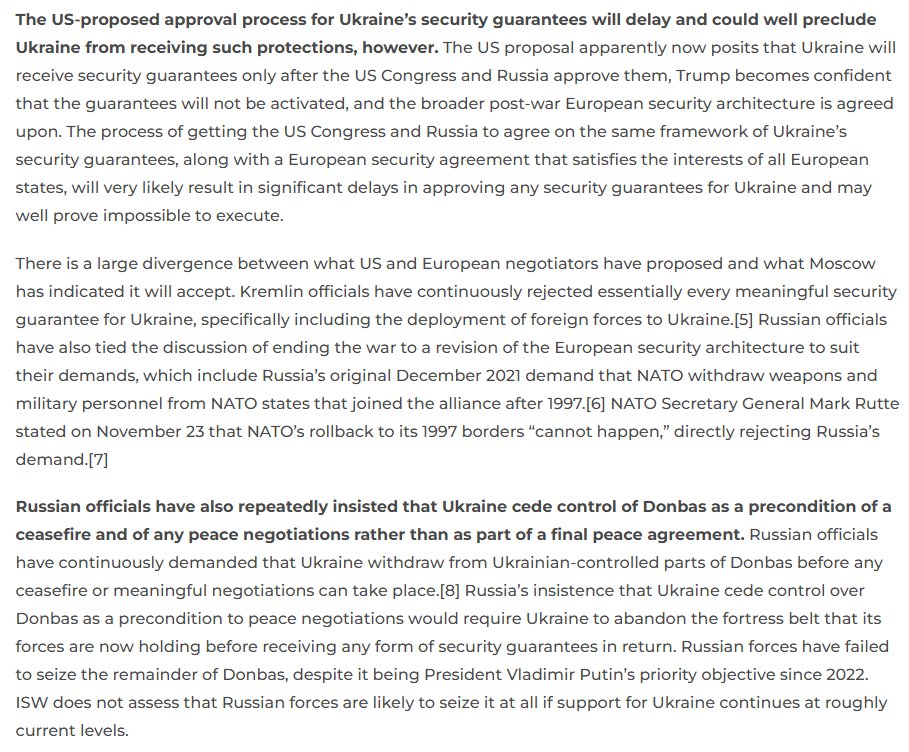
MORE: The US proposal apparently now posits that Ukraine will receive security guarantees only after the US Congress and Russia approve them, Trump becomes confident that the guarantees will not be activated, and the broader post-war European security architecture is agreed upon. The process of getting the US Congress and Russia to agree on the same framework of Ukraine’s security guarantees, along with a European security agreement that satisfies the interests of all European states, will very likely result in significant delays in approving any security guarantees for Ukraine and may well prove impossible to execute.
There is a large divergence between what US and European negotiators have proposed and what Moscow has indicated it will accept. Kremlin officials have continuously rejected essentially every meaningful security guarantee for Ukraine, specifically including the deployment of foreign forces to Ukraine. Russian officials have also tied the discussion of ending the war to a revision of the European security architecture to suit their demands, which include Russia’s original December 2021 demand that NATO withdraw weapons and military personnel from NATO states that joined the alliance after 1997. NATO Secretary General Mark Rutte stated on November 23 that NATO’s rollback to its 1997 borders “cannot happen,” directly rejecting Russia’s demand.
Russian officials have also repeatedly insisted that Ukraine cede control of Donbas as a precondition of a ceasefire and of any peace negotiations rather than as part of a final peace agreement. Russian officials have continuously demanded that Ukraine withdraw from Ukrainian-controlled parts of Donbas before any ceasefire or meaningful negotiations can take place. Russia’s insistence that Ukraine cede control over Donbas as a precondition to peace negotiations would require Ukraine to abandon the fortress belt that its forces are now holding before receiving any form of security guarantees in return. Russian forces have failed to seize the remainder of Donbas, despite it being President Vladimir Putin’s priority objective since 2022. ISW does not assess that Russian forces are likely to seize it at all if support for Ukraine continues at roughly current levels.