
Labor, Public, Applied Econometrics | AP @ClarkUniversity | PhD @UWMadison | https://teapaw.org/t.co/NBn2L4k6qz
Worcester, MA
Joined April 2010
- Tweets594
- Following908
- Followers362
- Likes2.7K




Pinned Tweet
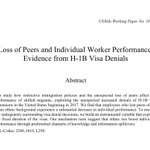
Very happy that my PhD JMP has found an incredible home. This is special as it was part of the process of discovering my interest to understand the equilibrium of unequal outcomes.
From the very inception of the idea, I can only recall tremendous support from everyone at grad school with whom I spoke, who came to my presentations and stayed back to chat more, hours of discussions with my best buddies and my committee members. Many thanks to you all and I hope to pay it forward! ❤️ #EconTwitter

Under incomplete info, preferences and beliefs both drive choices. Varying info and eliciting compensating differentials identifies both, circumventing non-innocuous variance normalizations as a dollar's value is invariant across info. @MoshiAlam et al.
econometricsociety.org/publi…

I love pluto. Looking forward to working the new interactivity updates and the new errors message framework looks great!

Pluto 1.0 is here, marking six years of continuous development of one of Julia’s most popular interactive notebook environments. This major release brings meaningful advances in reproducibility, sharing, accessibility, educational tooling, and developer experience—strengthening Pluto’s mission to make scientific computing more interactive, approachable, and engaging for learners, educators, and researchers worldwide.
#JuliaLang #Plutojl #ScientificComputing #OpenSource #DeveloperTools
discourse.julialang.org/t/pl…

88
Genuine issue for those starting research. A counter argument is that AI frees up time to read papers, think more etc. The worry is if the induced impatience leads to reduce spending time with own thoughts to understand own's comparative advantage and figure out something new.

I feel using Codex/Claude has made me more impatient with research. The process is quicker, and I get to explore much more than I could before. but i also feel i want to get too much done in a short period of time. i want to do good work, and pay attention to what i am doing.
1
107
This is a great thread. Really hard when evaluation rests on a paper. I teach the econometrics sequence to undergrads & grads. For undergrads I had to lower the weight on assignments and push it to exams when the variance in exams insanely increased. More pop quizzes maybe. 1/

Before AI, the standard teaching approach worked reasonably well for both motivated and demotivated students.
Now you kind of have to choose.
You can teach them to learn with AI and they'll be superpowered, but doing so makes assessment / grading near impossible. 1/
1
2
158
Going through grad school with @AmritaKulka i can attest that she is fabulous to work with. Highly recommended.

RA opening at @warwickecon
Work with urban economists @AmritaKulka and Nikhil Datta on a UK Housing and Planning System project & help develop policy recommendations and communications to policy, media and civil society stakeholders.
Apply: bit.ly/4ers9eC

3
123
Looks interesting. Look forward to reading it.
🧵 seems to point at being careful about the denominator as well in E[Y1(0)/Y2(0)] in presence of treatment
And generally of course E[a/b] \ne E[a]/E[b]

What do diff-in-diff event-study designs really tell us about the employment effects of min wages?
My new paper with @NeumarkEcon tackles this using the stacked design of Cengiz-@arindube-@attilalindner-@benzipperer and the related LP-DiD design in Dube-Lindner’s HLE chapter. 🧵

1
151
This came up on my youtube feed yesterday and was great to hear on a run! Especially with the same examples @ChadJonesEcon used repeatedly to communicate the main ideas. Listening to it reminded me of “the strength of weak ties” paper that @sndurlauf talked about in his social interaction class in Madison.

A recent video presentation of "AI and Our Economic Future" from the Stanford GSB Alumni Reunion (i.e. for a broad audience): youtube.com/watch?v=xBpGn3BD…

69
It was a wonderful visit, thanks for having me!

The Economics Group at Indian Institute of Management Calcutta successfully hosted a seminar by Prof. Moshi Alam on:
“A New Way to Estimate Optimal State-Contingent Transfers: The Case of Transfers Across Locations”
The session explored new perspectives on place-based redistribution policies, location-specific income transfers, and their implications for economic policy and welfare analysis, leading to engaging academic discussions and insights among participants.
#IIMCalcutta #Economics #ResearchSeminar #PublicPolicy #AcademicResearch
@MoshiAlam


1
49
Happy new year!! 🎊
Please come to the Urban session at #ASSA2026 to hear about our work on identification issues and solutions to recover Optimal Place-Based Transfers with discussion by @TradeDiversion and other exciting papers.
#econtwitter

Thanks a lot for having me. Loved the discussions and it was lots of fun! The high quality of student engagement is a testament to the intellectual vibrance of the econ group at @IIM_Calcutta. As my first seminar in my hometown, this was extra special.😊

Had a wonderful day of #Economics seminars at @IIM_Calcutta. Delighted to have had @naveensunder @MoshiAlam and #SiddharthChatterjee deliver excellent seminars on topics in human capital and development, labor economics and microeconomic theory.


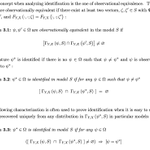
Using observation equivalence à la Matzkin (2007)
w/o identification different parameter values can give the same joint distribution of (Y,X)
=> same moments
=> same prediction
E.g. DGP: Y = X'b + u; u = aX
b unidentified but perfect E[Y|X] = X'(b+a)
#econtwitter

98
Wages are far beyond employer-employee bargaining.
This is a wonderful overview of collective bargaining’s role in wage distributions📈📉
Other papers in this sphere that I love:
- Bhuller et al. 2022 JEP
- Card & Cardoso 2023 JEEA
- Corradini et al. forthcoming QJE
- Lagos 2024

How do unions and collective bargaining work around the world? And how do they affect the wage structure?
A new paper with Suresh Naidu @snaidunl and Benjamin Schoefer @Schoefer_B out as @nberpubs WP and prepared for the Handbook of Labor Economics.
Thread below. 👇

2
336
The discussion that is often missed in executing challenging field work to get the right data for identification. Congrats to the authors! #EconTwitter

Here’s a behind-the-scenes look at our recent @QJEHarvard paper—a project that began in one of my PhD classes at @EconUniMannheim and evolved into a full-scale field experiment on LinkedIn.
1
2
438
Probably the first time I heard about the process of research was when Arunava sir
said that the returns to hard work come late in academia, so enjoying the process is important to keep one going. Thank you for inspiring and shaping the minds of generations of Indian students!🫡

Take a bow Prof Arunava Sen. #EconISIDelhi salutes you as you retire! Look forward to seeing you as emeritus faculty soon. #EconTwitter


The important and consequential tradeoff with the ease of zoom interviews is if the job market can’t lead to fly out timings being closely concentrated, and hence offers as well.
This Post is from an account that no longer exists. Learn more
261
Comparisons aside, this was really good!

First time I have seen a math explainer video with production values and pedagogy that both exceed a typical @3blue1brown release imo (with great respect to the latter who has set a very high bar!):
youtu.be/jvPPXbo87ds
183
Great thread on the two recent papers on zeros in estimating treatment effects.
In general, besides any transformations, it’s always useful to think about the DGP that generates the zeros.
Nice parallel to read along with Gandhi Lu Shi (2022) on zeros in demand estimation.

2 useful papers today on how you can get basically any answer you want from regressions using arcsinh(y) or log(y+1)
I made these graphs to show the problem: The mean of the transformed var (black lines) varies like crazy by what units you choose for y
🧵 on my own take-aways

5
More evidence on systemic information frictions in the labor market.

What are people’s perceived costs of looking for a new job? Do these expectations predict on-the-job search behavior? My co-author and student Armando Miano @ArmMiano, on the market this year, explores these questions in his JMP: scholar.harvard.edu/amiano/r… 1/9

1