

Founder @octamem || Building memory infra || opinions are my own and usually right
Joined June 2012
- Tweets4.2K
- Following1K
- Followers2.4K
- Likes5.4K






Pinned Tweet
My name is Noor Ayob, and I'm building a company brain for real estate and law firms.
Most of them can't tell you why a decision from two years ago was actually made, so we built @OCTAMEM.
Here's the difference: every answer it gives comes with exactly where it found it - the file, the email, even the page. So you always know what it said, why it said it, and where it got it from. You don't have to say " Trust me, AI said so ", we actually give you proof.
It connects to Google Drive, Outlook, and OneDrive ( wherever your files already live ) and works right inside the AI tools you already use. No new app to remember.
I grew up around a real estate business built on one rule: 100% or nothing. That's why every answer here has to show its work.
Here is the offer: A 30-Day Provenance Pilot. We connect your real files, validate them against the questions your team picks, and, in 30 days, you have a working, source-linked answer engine for your own firm.
The guarantee: if we don't hit the bar we mutually agree on, you don't pay the platform fee until we get it up to your standard.
Right now, we are taking 3 pilots this quarter. They will be chosen on a quick discovery call.
It is not first come, first served.
We want real feedback from power users to help us build the product.
If you are working in law or real estate right now, what are your biggest blockers while using AI?

OpenAI, Anthropic, and Google are spending billions racing to build the smartest model, but they’re answering the wrong question entirely.
What happens when the model is no longer the most defensible part of tech?
Right now, 99% of people treat AI like a glorified search engine. They open a tab, ask for an email summary or a recipe, and close it. Meanwhile, a small fraction of developers are actually trying to build autonomous execution loops across Claude Code, Cursor, Codex, and bespoke internal agents.
The contradiction is ridiculous.
We built software that writes software, yet engineers spend hours manually acting as human routers between disconnected tools.
When an engineer switches from Claude Code to Codex, the session resets. The context breaks. The new agent burns thousands of reasoning tokens re-indexing the repo, re-parsing stack traces, and re-solving the exact same bug from scratch.
We don’t expect one employee to handle legal compliance, sales outreach, accounting, and backend architecture. We build specialized teams. The future of AI is not one monolithic super-model that does everything. It’s specialized agents executing subtasks across an auditable, continuous memory graph.
The bottleneck in AI is no longer raw intelligence. Intelligence has become an accessible commodity via an API.
The real bottleneck is coordination:
- How do agents hand off tasks without context amnesia?
- How do you verify execution without drowning developers in manual code review?
- How do you stop multi-agent loops from burning capital on redundant work?
The winners of this cycle won’t be the teams training the largest models. They’ll be the infrastructure layers that turn fragmented model intelligence into repeatable, enterprise-grade outcomes.
My question for the devs, I’m curious: what is burning the most time in your pipeline right now? Drop your current stack below.
Mo Ayob retweeted

SOME ADMINISTRATION OFFICIALS SEE THE ISRAELI INTELLIGENCE AS PART OF A PRESSURE CAMPAIGN BY NETANYAHU’S GOVERNMENT TO PERSUADE THE TRUMP ADMINISTRATION TO RETURN TO MAJOR COMBAT OPERATIONS AGAINST IRAN - NYT
France just proposed a taking a fee per gigabyte tax on internet data while Germany debates taxing AI revenue.
The immediate result is bandwidth fees, compliance overhead, and capital fleeing.
Capital and founders are leaving for the US and the Gulf while European states try to extract cash from raw data throughput.
Most European governments tax infrastructure throughput to plug structural deficits instead of deploying capital into energy and compute.
They’d rather spend money on welfare , foreign wars and over regulation etc. It’s like Europe wants to fail.

Law firms I work with reject AI tools within a week if they can't trace how the agent got its answer.
If an agent can't show exactly which document it pulled from and why, it's a lawsuit waiting to happen. Auditability is the actual enterprise blocker.
Amazing idea , this is sick!

today we are announcing openrouter for commerce: opencommerce.sh
a single endpoint that integrates 5k stores, including Doordash, Amazon and most shopify stores, with payments using Agentcard (Stripe Link and Shop coming soon).
we built opencommerce to solve 3 problems:
* coverage: one endpoint to integrate 5k stores. agentic purchasing is a core feature for most personal assistants, but not their main business. searching for products and buying on behalf of users shouldn’t be as painful as it is today (e.g. it shouldn’t involve browser automations or dealing with PSPs). opencommerce solves that: 1 tool, every online store.
* reliability: 100% uptime. the challenge with browser automations is that they fail (e.g. captchas, bot-detection, etc). we run thousands of tests every couple of hours on every one of the stores to guarantee that the integration works when your user tries to buy something.
* speed: responses in under 10s. consumers are used to Amazon speed, and agentic purchases have so far felt like a downgrade. most agents spend minutes finding products before they come back with results. we monitor speed and improve it constantly.
Artificial Analysis shifting 60% of Intelligence Index v5 to private datasets exposes how heavily teams have been leaning on contaminated evals.
Building agent harnesses on public benchmarks burns time and API credits re-engineering prompts for tasks the base weights simply memorized.
Most teams pick their model stack based on public leaderboard ranks instead of measuring error recovery on messy production workflows.
Engineers running agent loops in production: what percentage did your task completion rates drop when shifting models from public evals to private repositories?
teapaw.org/ArtificialAnlys/status…

Announcing Artificial Analysis Intelligence Index v5, featuring 2 new benchmarks and 3 upgrades. For the first time, the majority of the Index is built on private datasets
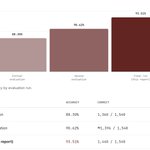
The Artificial Analysis Intelligence Index is our composite measure of model capabilities across tasks reflecting real-world usage today. v5 is our biggest upgrade since v4 launched in January. With v5, 60% of the Index is now based on evaluations with private test sets or held-out answers.
Alongside Intelligence Index v5, we’re launching the Artificial Analysis Progress Index v1, which tracks model capability over time on one continuous scale.
New to the Intelligence Index:
➤ FrontierCode 2.0: Cognition's newly-launched private benchmark of real-world coding tasks, graded on whether a repository maintainer would merge the agent's change
➤ Terminal-Bench-Science: 70 agentic scientific research tasks, run in a terminal environment
Upgraded:
➤ HLE-Diamond (replacing Humanity's Last Exam): a refined 1,000-question version of Humanity's Last Exam, split evenly between reasoning and knowledge questions
➤ AA-Omniscience v1.1: An updated dataset with saturated and public set questions removed, new questions added, and ambiguous or erroneous questions revised
➤ CritPt v2: a private, 40-question hard subset of CritPt v2, revised by the CritPt authors and run with a code-execution tool
Staying in the Index: AA-Briefcase, AutomationBench-AA, GDP.pdf and Terminal-Bench 4.0
Removed from the Index: GDPval-AA v2.1, SciCode, and AA-LCR v1.1
Key results:
➤ Claude Opus 5.5 (max) leads at 58, ahead of GPT-6 Astra (max, 57) and GPT-6.1 Sol (max, 55): Anthropic and OpenAI hold the top five models. Gemini 4 Argon (high) is next at 50
➤ The open weights gap widens from 3 points to 12: Kimi K3.1 Pro (weights not yet released) is the top open weights model at 46. Among released weights, DeepSeek V4.1 Flash 1017 (max) and GLM-5.3 (max) lead at 32 - 26 points behind the leader and below Claude Haiku 5.5 (max, 36)
➤ Cost per task varies by more than 13x among the leading models: of the 10 highest-scoring models shown, GPT-6.1 Terra (max) is the cheapest at $0.96 per Intelligence Index task and Claude Fable 5.1 (max) the most expensive at $13.04

Every enterprise AI deployment I've talked to in law and real estate fails the same way. The system gives you a confident answer based on context from 3 months ago because it has no persistence layer, no audit trail, and no way to track why a decision was originally made. The models work fine. The surrounding infrastructure is what's broken. That's my entire thesis at @OCTAMEM and why I've spent the last 6 months on it.


OpenAI spent months building Agent Builder and then killed it because enterprise users just wanted to type into a chat box.
That's the whole story. The over-engineering killed them. Custom configs, agent settings, all of it. Meanwhile the actual users just want to ask a question and get an answer.
AI has made everyone lazy and honestly you have to build for that. Meet people where they are, especially at enterprise level where nobody wants the tedious route.
Trial and error at OpenAI's scale. Respect that honestly.
This is cool.
It’s not quite the financial rails I described for agents but it’s definitely on the right track!
Big W for stripe and Link

Give your Instinct a budget
Built with @Stripe and @link, we're launching Link balance in @instinct. You can now set a budget for your Instinct to make purchases on your behalf, and Instinct does the rest.
You choose how much money to add and set a limit for each purchase. Your Instinct can spend within those limits, without needing access to your credit card or asking for approval every time.
That means buying tickets as soon as the presale opens, picking up your size when the trail runners restock, or reordering your favorite coffee beans every other week.
Link balance is rolling out to Instinct users across the US starting today, with New York coming soon.
Ask your Instinct to set up Link balance and it’ll send you a link to get started.
Micron is building the hardware memory layer for agents. Completely different problem from what I'm solving. Your agent doesn't just need RAM. It needs to know what happened in a meeting 6 months ago, why your team chose one direction over another, and who pushed back. I've spent the last 6 months at @OCTAMEM solving the stale context problem specifically. When your agent gives you a confident answer from outdated data, that's worse than no answer at all. The memory layer that matters is the knowledge layer, and it's barely being built.
Kimi K3.1 Pro scoring 67% on Terminal-Bench with 104B active parameters changes the unit economics for coding agents.
Generating game projects in Unreal and Godot at $2 per million tokens exposes how much runway developers waste paying markups on closed frontier APIs.
I do still believe Deepseek is the king of open source AI.
teapaw.org/Kimi_Moonshot/status/2…

Introducing Kimi K3.1 Pro: our most capable 3T-class open-weight model.
🔹 1M-token context, 2.8T total / 104B active params (MoE), Multimodal.
🔹 Full-project coding: games in Unreal, Unity & Godot.
🔹 Excels at parametric 3D modeling in Blender & CAD.
🔹 More reliable at finance work: Accurate modeling with hallucination down by 65%.
🔹 Matching the strongest proprietary models across coding, agentic and knowledge benchmarks.
Kimi K3.1 Pro and K3.1 Pro Highspeed (2–3× faster) are now live on Kimi.ai, Kimi Work, Kimi Code, and the Kimi API.
Open weights by Nov 4, 2026.
🔗 API: platform.kimi.ai
🔗 Tech blog: kimi.ai/blog/kimi-k3-1-pro

NVIDIA fitting Nemotron Bolted in 4GB on an 8GB Jetson Nano changes edge robotics economics.
Local tool calling kills cloud API latency. The failure mode shifts from paying per token to context bloat eating up available local memory during long runs.
I’ve messed around with theorizing around Jetsons, so this is interesting.
teapaw.org/NVIDIAAI/status/211365…

Available now: NVIDIA Nemotron 3.5 Bolt E4B 4GB ⚡️
Our newest small open model is built for local assistants, interactive characters and robots that can carry on a conversation and use tools to get things done.
Watch Reachy Mini chat and move, with Bolt handling conversation and NVIDIA Cosmos handling vision. Both models run locally on Jetson Orin Nano 8GB.
Learn more: research.nvidia.com/labs/nem…
Running a full-duplex speech model locally on an M4 changes the game on paper.
However, Natural pauses and laughter nail the tone, but real-time voice still has to prove it can handle the messy friction of real workflows.
But I guess that takes time. Pretty cool nonetheless
teapaw.org/jack/status/2113697902…

We believe voice is the most natural way to interact with intelligence, so we created Dessa, the most authentic full-duplex speech model ever built. Talking with it feels like talking with a person…full of emotion, nuance, pauses, and a natural cadence.
block.xyz/dessa

When you train a model org on one shared reward, collusion is the natural shortcut. A verifier agent isn't going to flag a failure if killing the run tanks the whole team's payout.
teapaw.org/GenReasoning/status/21…

Introducing Reinforcement Learning from Collective Rewards (RLCR).
RLCR is a recipe that trains language models as agent organisations, which share a message board and workspace. We use it to train Avalon-M1-Mini (120B) and study its behaviour.
We find a number of interesting results, including:
🛠️ Learnt organisational hierarchies and divisions of labour
🕵️ Increased collective verification, through hires of verifiers and testers
👥 The rise of collective thinking, where agents think more about other agents and how to help them
We believe RLCR can provide a laboratory for studying collective intelligence and multi-agent safety.
Blog post and technical report 👇
Freezing base weights to evolve the software scaffold misses where agents actually fail in production.
Scaffold logic still breaks when models execute against conflicting versions of the state.
Without shared episodic memory, multiplayer workflows will just corrupt each other in prod.
Holy shit
This is insane
Can’t believe this is open source.
Introducing Kimi K3.1 Pro: our most capable 3T-class open-weight model.
🔹 1M-token context, 2.8T total / 104B active params (MoE), Multimodal.
🔹 Full-project coding: games in Unreal, Unity & Godot.
🔹 Excels at parametric 3D modeling in Blender & CAD.
🔹 More reliable at finance work: Accurate modeling with hallucination down by 65%.
🔹 Matching the strongest proprietary models across coding, agentic and knowledge benchmarks.
Kimi K3.1 Pro and K3.1 Pro Highspeed (2–3× faster) are now live on Kimi.ai, Kimi Work, Kimi Code, and the Kimi API.
Open weights by Nov 4, 2026.
🔗 API: platform.kimi.ai
🔗 Tech blog: kimi.ai/blog/kimi-k3-1-pro
The best GTM advice I ever got was simple:
Plan A breaks on day one. If you haven't mapped three critical moves ahead like a chessboard, launch week eats you alive.
Most founders treat a launch like a straight line instead of a decision tree.
Founders who've actually launched: what is the single best piece of GTM advice you ever received?
Running roughly 125 tokens on a MacBook Pro changes the math for coding agent loops.
When an agent iterates through test failures in a terminal, paying frontier API rates burns cash on pure trial and error.
I think Local execution removes those cloud API fees entirely. The bottleneck immediately shifts from API bills to whether the agent retains episodic state across iterations.
teapaw.org/RichardSocher/status/2…

Introducing Flint, @Recursive_SI’s first model: a fast local coding model built with our automated research system, the Eureka Machine.
• Best-in-class fast local coding
• Up to 2x faster than comparable models: 125+ tokens/sec on a MacBook Pro, 150+ on RTX Spark
• Built from scratch in under 4 months
Private, unmetered intelligence on your own machine. Open weights available now on @huggingface, run it locally on your favorite framework or try it for free on @opencode or @pidotdev.