
Researching how exercise, nutrition and aging alter musculoskeletal function
California
Joined April 2009
- Tweets5.5K
- Following317
- Followers32.5K
- Likes7.4K
After six days of loading, we measure the size and strength of the ligaments by loading them into the 3D printed grips that we designed for our @instron material tester.


Our pre-clinical studies are still going strong too. If you ever wonder how we exercise our 3D engineered human ligaments, here my student Jared Ong is loading them into their gym (bioreactor) and placing them in the incubator.


I'm super excited to start playing with our new @KangaTech_ KT360 RFD. We are hoping that this will help us develop the next generation of training plans to reverse tendinopathy. Studies on PHT, PT, AT, shoulder, and elbow programs are all in the works.


Check out our latest paper. This one is on training the tendons of the fingers.
rdcu.be/d1zMi
If you want a synopsis of the paper, check out this YouTube video.
youtu.be/XXrDQ8PCAmI?si=qBZ_…
Comments always welcome
25 years ago today, I got into my baggy pants and married the woman of my dreams. Happy anniversary @BarbMiltner1

The argument for a Kelpie is strong. I love watching our beautiful Roxy in this video
youtu.be/DZmASddJ0Co?si=teGN…


EHL update #7 to engineer ligaments we fill out culture plates with Sylgard rubber. Here I am putting 1.5ml into over 500 plates.

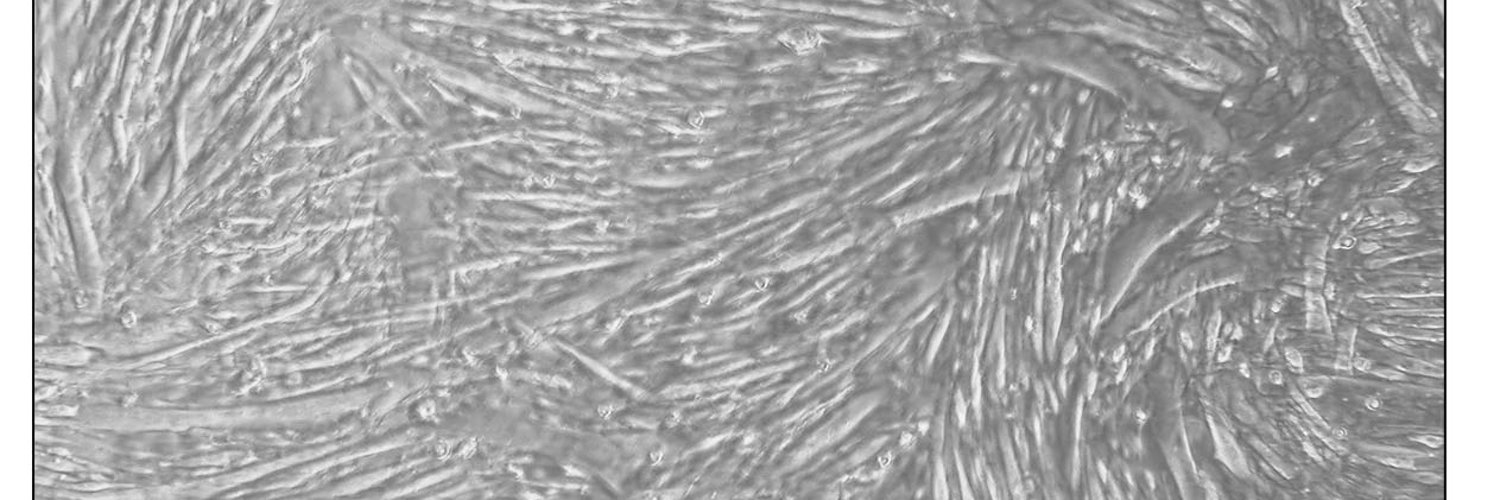
EHL #6 for the first 48+ hours, the cells we isolate are rounded but attached. If everything I knew was just destroyed, I would stay rolled in the fetal position until I knew I was safe too.

EHL update #5 if you haven't over-digested the tendon you see these: cells held together like beads on a string within the fibrillin matrix that isolated them from the collagen matrix.
Now we wait and see how the cells grow.

EHL update#4. This is something very few people have ever seen. If you grab the corner of the collagen, all those pieces stick together (even though they were out together just 20 second before)! Collagen is super sticky. This is why you never see any free ends of collagen.

Engineered human ligament (EHL) update. After digesting overnight, this is what we are left with. Remember, I chopped the tendon up into about 8 pieces. I took everything out of the two tubes and this is what is left. The collagen that wasn't broken down (we want the cells).

The first thing we have to do is get the cells out of all that collagen. For this, we put the ligaments into collagenase and let it slowly break down the matrix overnight.

Thanks to the generous person who donated their ruptured ACL and the remaining healthy tendon great to our research. From this one donation, we will be able to make more than 1000 engineered human ligaments.

Congratulations to my outstanding undergraduate student Ariana Banerjee for winning a presentation award @ABRCMS. This is always one of the best science meetings of the year.

Last, she shows where you find you favorite tendon genes.
This is a truly beautiful paper that we hope you enjoy.


In this paper, @SteffenDanielle shows that there are two DISTINCT populations of fibroblasts in tendons: one in the middle (making Col1) and the other on the outside (making Col3).
If there is Col3 in the middle of your tendon, it is regenerating.

