

Researching corporate power, public debt & EU financial governance @CGPE_Sussex also: capitalist futurity, social networks, political ecology, Middle East, Iran
Brighton, England
Joined May 2014
- Tweets5.7K
- Following2.4K
- Followers2.7K
- Likes132K





Anthropic says their technology is on the verge of developing autonomous computer worms. You know, the good old self-replicating malware.
Has there ever been any other private business trying to bully its way to growth like this?


Neoliberalism can be pronounced dead only if reduced to an economic model. It is, however, a method of economisation.
Maziar retweeted

“If Israel did to Gaza…” If?
That is going very far in this territory


"Anxiously Nonchalant and Forcedly Ironic: Podcast Socialism’s Subscription Model and the Affective Economy of Doom, Detachment, and Defeat"
Maziar retweeted

An open letter in solidarity with Iran’s political prisoners drew vitriolic condemnation from parts of the anti-imperialist left — but the criticisms are short-sighted and misplaced, argues @yassinhs, a former political prisoner in Syria, for @newlinesmag. newlinesmag.com/argument/the…


It's cliche that Turkish Islamists follow their Iranian cousins, but nuclear hedging was precisely what Iran did. And failed terribly.
Similarities are plenty, but also differences.

To unpack the three scenarios a bit more:
1/ Rely solely on NATO
Since 1952, Turkey has relied on NATO and especially the US for extended nuclear deterrence. But repeated crises in US-Turkey ties have eroded Ankara’s confidence in American security guarantees.
The F-35 saga added an operational dimension to those doubts.
Turkey is now the only NATO nuclear-sharing country not transitioning to the F-35. Without another nuclear-certified aircraft, it risks shifting from an active participant in nuclear sharing to essentially a host for US nuclear weapons.
That makes exclusive reliance on NATO increasingly less attractive.
2/ Make a run for the bomb
Still unlikely.
Turkey learned from its post-Arab Spring regional isolation and tensions with the West, including over the S400, that prolonged estrangement from both is costly.
A nuclear weapons program, overt or covert, could jeopardize the relationships Ankara has worked hard to rebuild. The costs remain too high.
3/ Hedge
This is the most plausible path.
A hedging state develops the technological and institutional capabilities that could make weaponization faster if circumstances change. Its answer to the bomb is essentially: maybe, not now, but perhaps later.
For Turkey, the appeal is even advanced hedging toward nuclear-threshold status can remain compatible with the NPT.
But widespread hedging carries its own dangers. It can trigger reciprocal hedging, shorten breakout timelines, fuel arms-race dynamics and incentives for preventive strikes, and blur the line between nuclear and non-nuclear states, which weakens the nonproliferation regime even without producing new nuclear-armed states.
A finance bro wouldn't be taken seriously for projecting a 10% chance that banks will kill all humans.
Ecologists and biologists weren't taken seriously for far milder claims, and they study extinctions for a living.
Why is an AI guy prompted to think he knows such things?


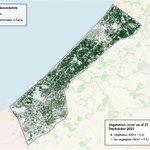
Vegetation cover vs vegetation lost
Green pixel means presence of vegetation within 10mX10m area, not that it covers the entire area
From ‘securitisation’ to ‘relational ecologies’: war, environment and vegetation loss in Gaza by Rahul Gandhi
Full article:
bristoluniversitypressdigita…

Russia openly boasts about attacking Ukrainian homes. US openly boasts about attacking Iranian oil tankers. No pretence of legality, or even some nonsense necessity.
Not that civilians were ever actually safe from these murderous militaries, but like this there's no end in sight.

So, Netanyahu was warned by the UAE about Hamas plans, and did nothing for more than a week:
The so-called Axis of Resistance played an essential role to enhance the ecosystem of war in the Middle East, not as a force against it. Beneficial and indispensable to the US and Israel.
