
Soil Moisture Active and Passive (SMAP) mission launched on January 31, 2015. This account is no longer active.
JPL and GSFC
Joined October 2010
- Tweets517
- Following24
- Followers9.4K
- Likes121





This account has moved! Information and science results from SMAP can now be found on @NASAEarth.
NASA SMAP retweeted

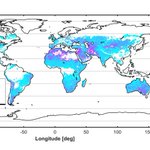
PO.DAAC featured this week on the NASA Earthdata website! This image shows derived sea surface salinity created from Soil Moisture Active Passive (SMAP) data. Please visit the Earthdata website for more information: earthdata.nasa.gov

Data from SMAP are now being used operationally by the U.S. Department of Agriculture to monitor global croplands and make commodity forecasts. go.nasa.gov/2J8mTke
SMAP Sees Sea Surface Salinity
@PODAAC announced the availability of updated version 2.0 SMAP Sea Surface Salinity data from Remote Sensing Systems at a spatial resolution of 70km.
smap.jpl.nasa.gov/news/1265/…

Ok, I'll play #RebrandASatellite @NOAASatellites! Since I spin 'round 'round like a record studying soil moisture, I suggest my new brand is...

NASA SMAP retweeted

It's the #FirstDayofFall! Here's Earth today. From our vantage point in space, we work to better understand our home planet & improve lives

NASA SMAP retweeted
Our @NASAEarth satellites continue to track #Harvey as new soil moisture data shows how it saturated areas in Texas: go.nasa.gov/2iKpO66

NASA SMAP retweeted

Special Feature: Hurricane Harvey's Rapid Wind Intensification seen by NASA's SMAP facebook.com/NASAHurricane/p… #Harvey

NASA SMAP retweeted

Help us reach our goal of adopting the entire planet by #EarthDay April 22. go.nasa.gov/adopt #AdoptThePlanet #NASA

NASA SMAP retweeted

Have you adopted your piece of Earth yet? NASA celebrates #EarthDay with #AdoptThePlanet activity! go.nasa.gov/2nI5eQH

NASA SMAP retweeted
SMAP! Goes The Memory earthobservatory.nasa.gov/bl… jpl.nasa.gov/news/news.php?f… Data via @NASASMAP #NASA #soil #moisture

New findings help track soil moisture "memory" in the top 2" of soil. On average ~1/7 rain 🌧️ remains 3 days later. nasa.gov/feature/jpl/study-t…

NASA SMAP retweeted
#EarthdataEnablesScience In 2016, #NASA EOSDIS delivered over 1.5 billion data products to more than 3 million users worldwide! xitter.cf/ATredennick/status/823…

We use long term @NASAEarthData (@NASA_Landsat) to develop forecasting models to predict how vital ecosystems will change in the future.

NASA SMAP retweeted
Who uses @NASAEarth science data? She does-to study dryland ecosystems. go.nasa.gov/2iNS9D3, #EarthdataEnablesScience – at Maryland, USA


NASA SMAP retweeted
.@NASASMAP reveals the life cycle of a 2015 Texas flood & its impact on marine life: jpl.nasa.gov/news/news.php?f…

My radiometer measured #HurricaneMatthew’s wind speeds at 4:52am PDT at up to 132 mph. SMAP has excellent sensitivity to extreme winds.

NASA SMAP retweeted

#NASAProud of our #WomenInSTEM! Meet #cloud scientist Dr. Yolanda Shea @WomenNASA: go.nasa.gov/2dkbIlk @NASAEarth You can be one too!

Hear firsthand how science inspires students in the @GLOBEProgram. Shot in beautiful @RockyNPS. youtu.be/3aTQtoPD7dE #FindYourPark
I may ❤️ soil moisture, but I can also estimate ocean winds! 📡💨🌊 go.nasa.gov/2aeK6vM #EarthRightNow
