
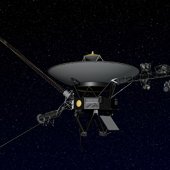
This account has been archived. Follow @NASAJPL & @NASASolarSystem to get the latest updates on Voyager 1 & 2, the longest operating spacecraft in deep space.
- Tweets625
- Following50
- Followers819K
- Likes2.2K




ALT A dark, nearly black background with faint streaks of sunlight forming diagonal beams. In one of these beams, near the right side of the image, a minuscule, barely visible pale blue dot—Earth—stands out, appearing fragile and isolated against the vast emptiness of space. Taken on Feb. 14, 1990, by NASA's Voyager 1 spacecraft from 3.7 billion miles (6 billion kilometers) away, this iconic photograph underscores the profound vastness of the cosmos and Earth's tiny presence within it


ALT Earth is a single, bright blue pixel in the vastness of space. Rays of sunlight scattered within the camera optics stretch across the scene, one of which happens to have intersected dramatically with Earth. The original image was taken on Feb. 14, 1990. What you see here is an updated version from 2020 using modern image-processing software and techniques. Credit: NASA/JPL-Caltech

ALT A dark, nearly black background with faint streaks of sunlight forming diagonal beams. In one of these beams, near the right side of the image, a minuscule, barely visible pale blue dot—Earth—stands out, appearing fragile and isolated against the vast emptiness of space. Taken on Feb. 14, 1990, by NASA's Voyager 1 spacecraft from 3.7 billion miles (6 billion kilometers) away, this iconic photograph underscores the profound vastness of the cosmos and Earth's tiny presence within it
ALT A dark, nearly black background with faint streaks of sunlight forming diagonal beams. In one of these beams, near the right side of the image, a minuscule, barely visible pale blue dot—Earth—stands out, appearing fragile and isolated against the vast emptiness of space. Taken on Feb. 14, 1990, by NASA's Voyager 1 spacecraft from 3.7 billion miles (6 billion kilometers) away, this iconic photograph underscores the profound vastness of the cosmos and Earth's tiny presence within it

ALT A dark, nearly black background with faint streaks of sunlight forming diagonal beams. In one of these beams, near the right side of the image, a minuscule, barely visible pale blue dot—Earth—stands out, appearing fragile and isolated against the vast emptiness of space. Taken on Feb. 14, 1990, by NASA's Voyager 1 spacecraft from 3.7 billion miles (6 billion kilometers) away, this iconic photograph underscores the profound vastness of the cosmos and Earth's tiny presence within it

ALT A dark, nearly black background with faint streaks of sunlight forming diagonal beams. In one of these beams, near the right side of the image, a minuscule, barely visible pale blue dot—Earth—stands out, appearing fragile and isolated against the vast emptiness of space. Taken on Feb. 14, 1990, by NASA's Voyager 1 spacecraft from 3.7 billion miles (6 billion kilometers) away, this iconic photograph underscores the profound vastness of the cosmos and Earth's tiny presence within it


ALT In the darkness of space, Earth shines as a bright blue marble with white, swirly clouds. North and South America are visible as brown and green land masses.
ALT A dark, nearly black background with faint streaks of sunlight forming diagonal beams. In one of these beams, near the right side of the image, a minuscule, barely visible pale blue dot—Earth—stands out, appearing fragile and isolated against the vast emptiness of space. Taken on Feb. 14, 1990, by NASA's Voyager 1 spacecraft from 3.7 billion miles (6 billion kilometers) away, this iconic photograph underscores the profound vastness of the cosmos and Earth's tiny presence within it


ALT A collage of small thumbnail images that contain the planets, seen as tiny dots from the Voyager 1 spacecraft beyond Pluto. A simulated view of Voyager superimposed over the collage and the orbital paths of the planets shows the spacecraft's orientation in space as it looked back toward the inner solar system.
ALT A dark, nearly black background with faint streaks of sunlight forming diagonal beams. In one of these beams, near the right side of the image, a minuscule, barely visible pale blue dot—Earth—stands out, appearing fragile and isolated against the vast emptiness of space. Taken on Feb. 14, 1990, by NASA's Voyager 1 spacecraft from 3.7 billion miles (6 billion kilometers) away, this iconic photograph underscores the profound vastness of the cosmos and Earth's tiny presence within it

ALT This view of Uranus as a thin crescent was recorded by Voyager 2 on January 25, 1986, as the spacecraft left the planet behind and set forth on the cruise to Neptune. Voyager 2 was 1 million kilometers (about 600,000 miles) from Uranus when it acquired this wide-angle view. It is a color composite of blue, green and orange frames revealing Uranus's light bluish hue.

ALT Close-up view of Saturn and its rings set against the dark background of space. The planet’s yellowish hues and bands are visible, with a portion of its iconic rings cutting across the top right. Two small white moons can be seen near Saturn, while a small dark dot closer to the lower edge of the rings is actually a shadow of a moon.


ALT A photo of OSIRIS-REx over Bennu with the text, "TAG! You're it."


