

CEO @Duarte & best-selling author. Passionate about persuasion and visual stories used in business. Love hugs from hubby, three kids, and two grandsons.
Mountain View, CA
Joined May 2008
- Tweets14.5K
- Following1.7K
- Followers49.7K
- Likes7.3K
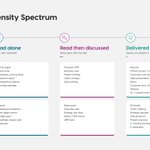




It’s common knowledge now that you shouldn’t have dense slides…but the reality is, there’s a density spectrum.
And figuring out the right balance of density for your specific context goes a long way in determining whether you can actually inspire your audience to act.
Most meetings are what I call “read then discussed”. Those are often things like proposals, strategies, exec briefings, OKR reviews, etc.
These need enough slide density that your deck can be read and understood before you walk through it.
You obviously don’t want to cram your slides in these situations, but making them too sparse to understand without you giving context is just as big of a mistake.
Things like case studies, reports, white papers, and budget packs are in the “read alone” category. Those should be dense enough that everything makes complete sense without you providing any context at all.
On the complete opposite side of the spectrum is the “delivered live” category.
These slides are conceptual and sparse so that you can give your audience verbal context live.
This makes the purpose of your slides to amplify and make your content memorable and sticky.
These are often things like keynotes, product launches/roadmaps, sales presentations, all-hands meetings, etc.
Your slide density needs to match the kind of presentation you’re delivering.
If you pack your keynote slides full of dense information, they’ll read your slides instead of immersing in and experiencing your idea.
If you leave your reports too sparse, no one will know what the data means.
Don’t just assume you should avoid dense slides. You never want to put too much information on a slide, but putting too little in the wrong context is just as big a problem for your audience.

Leaders have strong intuitions about the future and the direction we should go.
In January 2008, I sensed a crash was coming, and at our kickoff, I wanted to convey that the team to be prepared for a rainy day.
But I also wanted them to deliver on our promise to customers, which was to create " The Greatest Show on Earth”.
So, at the kickoff, I handed out umbrellas to my employees with “the show must go on” printed on them.
I came in hot with a ton of urgency, and my company was shell-shocked by it. Afterward, people told me that I’d lost credibility because of it.
Then the crash came…and I was vindicated in a way.
But it was too late for some people on my team. I’d already lost the room.
I saw the same pattern in our company kickoff this year…
I came in with an urgent push for everyone to “get on the bus” with AI, but it didn’t land the way I expected.
Employees weren’t ready to fully buy in to the vision. They had questions. My urgency came off as a threat to some.
In both cases, I had studied deeply and had time to form my vision and point of view.
But my team hadn’t.
And there was a disconnect because I didn’t adapt my message to where my employees were.
They hadn’t been brought up to speed on all the preparation, research, and work I had put into the vision.
I was asking my team to move fast toward something I’d already made peace with. But they were still working out what it meant for them.
That’s why my message wasn’t landing like I thought it would.
When you’re announcing a change, show your team the thinking that got you there…all the reading, the work, the time you spent arriving at the answer.
Address their questions and objections before you bring a sense of urgency around your vision.

When the Mac first came out, big design firms thought it was a joke. They were EXTREMELY slow to adopt the new technology (and many of them fell behind because of it).
Because the Mac’s fonts were jaggy, it couldn’t kern properly, and it didn’t do leading, many of the established firms figured their existing equipment would outlast it.
But this created a gap in the market.
Many companies in the Bay Area wanted work produced digitally, but many of the big firms wouldn’t touch that kind of work.
So, many of these design firms stuck with what was working at the time and dismissed digital because they didn’t see it impacting their work long-term.
Boy, were they wrong…
We hopped in right in that window!
Many of the incumbents in the market ended up adapting eventually, but new competitors grew rapidly while they were resting on their laurels.
I think we’re living in a similar moment right now with AI.
While most companies are adopting it, few are deeply integrating it into their processes.
And I believe that incumbents in many industries don’t feel the urgency to take this moment as seriously as they should because what they’re doing is already “working”.
Don’t make this mistake.
Make AI core to your business; don’t just dabble in it. This moment is WAY bigger than when the first Mac was launched!
What communication skills become more valuable in a world where AI can generate your slide deck, write your content, and even create visuals?
I’ve been thinking through and researching that exact question for months.
Because the reality is, AI is making it dramatically easier to produce the assets we use to communicate.
But that doesn’t mean it’s getting any easier to communicate effectively (I would actually argue the opposite is often true!)
For L&D leaders specifically, that’s making it harder to know which skills they should actually be training their teams on right now.
That’s why I created this survey to understand which communication skills they believe will matter most in an AI-first workplace, how they’re helping those skills “stick” after training, and how they’re measuring success.
And I’ll be compiling the findings into a report so L&D leaders can see how their peers are approaching these same questions.
So, if you lead L&D and are willing to spend about 18 minutes taking this survey, I’d love to hear your perspective.
And I’ll share the results with anyone who takes the survey.
Link to the survey:
surveymonkey.com/r/R8J5XKT


There’s one moment in your high-stakes presentation where your audience decides whether they’ll commit to your idea. If you miss it, you can give a “great” presentation that doesn’t change anyone’s mind.
This moment is called “crossing the threshold”, and it happens in every single presentation you’ll ever give.
It’s the stage in Campbell’s Hero’s Journey where your audience has been given a unique idea that shows them the problems with their ordinary world, and they’re faced with a decision:
Will they adopt your idea…or will they stick with the status quo?
Your presentation takes them to the threshold, but it’s ultimately their choice whether to cross the threshold or not.
Getting them to take the leap requires you to create clear contrast.
Who were they when they first walked into the room before your presentation? This is their “ordinary world”.
What problems were they facing, what fears did they have, what goals were blocked?
Clearly address those in your presentation.
Then contrast that against who they could be when they leave the room.
What will life look like when they “cross the threshold” and accept your idea? What obstacles will be removed? What goals will be achieved? How will they feel?
Drawing attention to this gap forces your audience to deal with the imbalance between where they are now and where they want to be.
And that is what gets them to adopt your idea and act, whether you’re pitching to stakeholders, proposing a budget, or trying to rally your team around a new strategy.
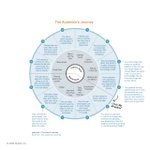
Note: The below graphic is Duarte’s visual expression of Chris Vogler's 12 step expression of Campbell’s 17-step journey.

Many leaders know how to visualize data, some know how to analyze data, but few know how to communicate data well.
That gap is why I wrote DataStory.
It was obvious at the time I wrote it that the world was drowning in data (and now it’s grown exponentially).
I’d been building models to explain what I was seeing, but I didn’t have a clear plan of what to do with them.
Then I got a call from one of our largest clients asking whether I had anything I could say about data.
I curated everything I’d built into a story and gave a keynote.
When I finished, the executive who had hired me jumped out of his seat in front of the whole room and said:
“If I’d known what you just said 20 years ago, I can only imagine where we could be.”
That was the moment I knew the world needed this.
So, I hunkered down and wrote the book.
Last week marked the 7th anniversary!
If your role requires you to prove ROI, get budgets approved, or convince people with numbers, this book could be a great resource for you.
duarte.com/resources/books/d…

At our annual kickoff, I told my team that they needed to take AI seriously or they might not be a fit here anymore.
This left some people feeling overwhelmed and wondering whether they still belonged (where most of our kickoffs leave them feeling energized).
I had been convinced that we should be an AI-first company for two years.
I even restructured things so that I could step away from the day-to-day and immerse myself in AI.
But for most of my team, the morning of the kickoff was the first time they heard about any of that.
I came in excited and laid out the vision, but it didn’t land the way I expected.
Later in our anonymous Q&A, employees had questions about AI’s environmental impact, whether using AI more would hurt output, whether their hard-earned skill sets would still be needed, and more.
All of these were questions about values, belonging, and mastery…
But I was coming at it from a strategy perspective, which is why it didn’t resonate with them.
Even when your vision is right as a leader, you have to give your team time to absorb it.
You may have been thinking, dreaming, and creating this vision for years. You can’t expect your team to see it the way you do within an hour.
And I talk more about how to close this gap in my Forbes C200 piece that just went live.
forbes.com/sites/committeeof…

There was a moment when I almost killed my company before it ever started, which would’ve been one of the worst mistakes of my life.
When Duarte first started, it was my husband Mark’s thing. He was really into the desktop publishing industry and was “that guy” who would read all the manuals.
The company was making very little money writing resumes and newsletters, but it was nowhere near enough to live on.
And I was working 13 hours a day at a “real” job (while also raising a toddler).
This was fine for a couple of years because small projects were trickling in, but when I got pregnant with my second kiddo, the excitement wore off and the grind set in.
We were working SO HARD for SO LONG and seemingly getting nowhere.
So, one day, I gave Mark an ultimatum…
This had to start producing more income, or he had to throw in the towel and go get a “real job”.
He asked me to read a copy of Macworld Magazine…and that’s when everything changed.
I saw a real business opportunity in desktop publishing at the time, so I made him a deal:
If I could sell it, he could keep it.
Within 24 hours, our fortunes flipped. I called Apple, NASA, and Tandem (now HP) to pitch our services that day, and we ended up winning each of those accounts over time.
That gave us just enough to keep going.
Then, things snowballed from there. We hustled for more work, knocked on doors, and ended up landing some big contracts.
Eventually, we ended up with so much work we couldn’t handle it all. We hired, moved into an office, and the rest is history.
But I often think back to that conversation I had with Mark.
What would’ve happened if we decided to stop pursuing the vision that day?
Quitting would’ve been easier. It might have even been the “logical” decision.
But if we did, we would’ve quit right before the breakthrough we had been waiting for.
As leaders, we often have visions and dreams that are larger than life.
We want to take risks, make big changes, and bring transformation to our organization.
But then our big visions run up against big obstacles.
And what we do next determines whether our vision dies or comes to life.
Maybe for you that’s a big initiative that hasn’t shown an ROI yet. Or a new direction for your team that you’re betting your career on.
Whatever it is, if you truly believe in your vision, it’s worth fighting for.
Oftentimes, we are just a few moves away from a huge breakthrough. Things can truly change in an instant.
Do you have a vision like this right now?
Should your presentation be data-driven or emotionally story-driven? Getting this right can determine whether your presentation succeeds.
Your presentation shouldn’t rely on just one or the other…it needs a good balance in order to persuade your audience.
We learned from Aristotle that every presentation needs three ingredients to persuade.
- Solid evidence and data
- An emotional connection that makes people care
- Enough understanding of your audience to be credible
The ratio of these ingredients is dependent on who’s in the room.
Are they data-driven decision-makers who thrive on statistics and factual evidence? Or are they more likely to be swayed by personal stories and emotional connections?
When you show up with analytical or emotional energy that doesn’t match your audience, you’re failing to connect AND actively hurting your credibility.
Let me show you what I mean:
If you’re presenting to analytical audiences:
Think engineers, analysts, and finance teams…they’re wired for data.
Use a thin layer of emotion with intention. Geeks are still human, so showing how their lives will change if they take action from the data motivates them. But don’t go overboard.
They want to know that the data has been carefully considered. That doesn’t mean barrage them with gobs of charts. Instead, curate what you share.
Give them the analytical foundation they crave without overwhelming them.
If you’re presenting to emotionally driven audiences:
Sales teams, creative departments, customer-facing roles…these audiences want to feel something.
Let them become immersed in the emotional journey. Overuse of data makes their eyes glaze over.
Show that data backs up your story, but focus on what it means for them personally. How does this change their day-to-day reality?
The key is blending both the best ratio of analytical and emotional arguments for maximum impact.
Attach data to anecdotes. Instead of just showing statistics, tell the story about the people behind those numbers.
And connect data to something your audience cares about. Don't just say “our product creates 30% efficiency.” Say, “Our product creates 30% efficiency…imagine how much more time you’ll have each day for higher priorities if each task is completed faster.”
The right balance makes you credible.
The bottom line is you need to connect with your audience on a personal level. Think of finding this balance like following a recipe…you need the right ingredients in the right proportions for your specific audience.
The true power of effective presentations drives people to action.
What about you? Do you lean too heavily toward data or emotion in your presentations?
sloanreview.mit.edu/article/…

Today is @tim_cook's final day as CEO of @Apple . I wonder if building something from nothing is just as hard as inheriting something iconic.
When Cook became CEO, he stepped into the shadow of one of history’s most mythic founders. He could have tried to imitate Steve Jobs but led as Tim Cook instead.
He brought operational rigor to a company known for creative magic by protecting what made Apple Apple.
In his farewell message to employees, he pointed to the culture, shared purpose, and people who brought out the best in one another. <-- that's what's lasting
Thank you, Tim, for driving Apple to huge success.
People often ask me what the biggest mistake I’ve ever made is…
We’d worked with the honorable Al Gore for five years.
We built presentations around the concepts in An Inconvenient Truth long before it was a documentary. We refined the messages and built the slides to support his roadshow.
Then the producers called asking if we would donate our time to convert the deck to make it movie-ready. It was a lot of work.
In exchange, they would put our name in every press release for the film.
I said no. We would have to charge for it.
We’d already given. We’d made sacrifices. We’d stretched. And I honestly said out loud:
“Who is going to go see a movie about a slideshow anyway?”
Oops, I was wrong.
Very wrong.
An Inconvenient Truth went on to win an Academy Award.
But I think about that phone call sometimes.
Donate $10,000 in services...
…and Duarte mentioned in every press release...
It was global reach that would have cost much more than $10,000 in any other format.
I made the decision at the time because we were so busy.
The good news is, a famous blogger figured out that we worked with him (because we’re named in the credits) and told the world anyway.
And that might’ve ended up giving Duarte even more attention than the press releases would have.
This is just one example over my career of things “working out” even despite mistakes I made.
As a leader, you’re going to make many decisions that you wish you could take back.
But it’s important to keep moving forward and not get discouraged, because things often have a way of working themselves out.

In 2009, @danielpink gave a groundbreaking TED Talk called The Puzzle of Motivation. His goal was to show everyone that the ways we used to motivate employees simply wouldn’t work anymore.
We needed to adapt to a new model…one built on intrinsic motivators like autonomy, mastery, and purpose instead of only offering rewards for good performance.
So, how did he convince leaders to adopt this new paradigm?
A huge part of it had to do with how he structured his TED Talk.
Daniel’s presentation closely resembled what we call the Presentation Sparkline™ at Duarte.
It toggled between “what is” (their current reality of varying results with appealing to extrinsic motivation) and “what could be” (the reality of a better way to motivate employees long-term) several times throughout.
This contrast helped his audience clearly see the need for them to change their ways and adopt a better method.
And this positioned his recommendation as the most logical method for them to adopt.
Like many leaders, Daniel Pink had insights powerful enough to completely change the trajectory of teams and organizations.
But if he didn’t present them using a proven structure, the people who needed them most might not have seen them that way.
They may have never seen the urgent need to change course.
Presenting your ideas and recommendations is no different.
You need to present them in a way that helps your audience see the urgent need to adopt them, or even your best ideas might never gain traction.
I recently did a comprehensive breakdown of Daniel Pink’s TED Talk that walks through all the other strategies he used, and how you can use them to make your ideas and recommendations even more compelling. Link to the youtube video: youtube.com/watch?v=xc-595EY…

You will not have every answer in every meeting. Your instinct may be to guess your way through or to piece something together on the spot. But you should actually do the opposite.
When you speculate on an important question and the room senses it, you lose credibility with stakeholders.
But if you can say “I don’t know” tactfully, you gain credibility instead.
Here are 3 phrases you can borrow to do that:
1. “I don’t want to speculate here. Let me confirm that and follow up with you.”
2. “That’s a valid question, and I want to double-check before I give you a half-right answer.”
3. “That's not my area of expertise, but I'll connect with the right person and bring back a clear recommendation.”
You want to accomplish these 3 things with an “I don't know” statement:
1. Be honest about where your knowledge starts and ends.
2. Highlight that you're striving for accuracy.
3. Share a clear next step that will provide that accuracy.
You’re still the one in charge of the moment, even when you don't have the answer.
Guaranteed way to get an audience to stop listening to you?
Put a dense chart on a slide.
You’ll get tuned out for at least 30 seconds while they process your visual.
People can’t read and listen at the same time. You think you can. I think I can too.
We can’t.
So the moment a busy slide goes up, every head in the room drops into it to try to decipher what’s on it.
They resurface half a minute later, having missed everything you said while they were down there.
Here’s a better approach:
Find the one thing that matters and make it obvious.
If you have a bar graph where one data point is 25% higher than the next, add an arrow that points it out.
Label it with something descriptive, like “$4M gap”
Fade everything else back so you can direct your audience’s eyes to the one thing that matters most.
That helps you make your point impossible to miss.
And if you want to take this a step further, here is a great slide design resource. youtube.com/watch?v=ZtUfK_H1…

I got a C-minus in speech.
And a D in English.
That one year in college was pretty much the whole of my higher education for a long time. Two grades I was ashamed of, and then I was done.
For years, that felt like a Scarlet Letter.
I’d built a company that tells the world’s best communicators how to communicate. And the whole time, there was a voice in the back of my head:
“You’re a poser. You’re going toe-to-toe with Stanford MBAs and Harvard MBAs in the Silicon Valley, and you’re just posing.”
The funny thing is that, in 20 years of walking into rooms and telling powerful CEOs what to say, not one of them ever asked where I went to school.
Not once.
They cared about one thing:
Could I help them?
And I could.
The credential I was so ashamed of not having turned out to be the thing nobody was even looking for.
(I did get an executive MBA eventually. But by then I’d already learned the lesson.)
And the book I wrote (me, the student who got a D in English) became the bestselling guidebook Harvard Business Review has ever published.
So if there’s a voice in your head telling you that you’re not qualified, that you don't have the pedigree, that someone’s about to find you out:
That voice is not your audience.
Your audience just wants to know if you can help them.
Show them you can.

When a change initiative starts to lose steam, many leaders look to the team first. They might think the team doesn’t “get it.”
But what’s actually happening is usually upstream.
The leader stopped retelling the story.
The contrast between where they are and where they’re going has faded.
The future they’re chasing stopped feeling real.
At the organizational level, change works like a fire, not a “launch”.
The announcement sparks the dream.
But the fires die without stoking them.
And most of us underestimate what it takes to keep it going.
We hand the team a vision and assume it’ll carry itself. Then, six months in, when people drift, we assume it’s their commitment instead of our communication.
The team loses the plot because we stop telling the story.
How many times in the last 90 days have you actually told the story of where you’re going?
As leaders, we feel constant urgency to move faster with AI. But we lose something critical if we keep moving at a frantic pace trying to keep up…
Over the past two years, I’ve been working almost exclusively in AI.
I’ve poured my heart and soul into building tools, workflows, automating processes, and trying to make sense of what the future looks like.
Then a few months ago, I came to a realization:
AI runs at such an urgent pace; trying to keep up with all the models and changes happening in the industry is h-a-r-d.
So, I intentionally slowed down. Each day, I spend a couple hours in “slow motion”. My running list of 40 urgent things became a list of the 3 most important things to get done each day.
And when I did this, I started approaching the same work with a completely different energy.
I had a sense of wonder again.
So many great leaders throughout history worked hard to maintain this sense of wonder about their work.
Steve Jobs did it constantly as he marveled at the products Apple was able to make.
Richard Feynman, a well-known physics professor, conveyed wonder in his lectures (with just a chalkboard!) that students would attend without even being enrolled in his class.
Both of these leaders took time to see the beauty in the craft and help others have moments of wonder.
And that’s what we need desperately as leaders in the age of AI.
Urgency is the kryptonite to wonder.
Don’t let your most creative energy and the joy you get from your work be crushed by the break-neck pace of AI.
Being a good leader means adapting your communication style to suit the situation you’re in. Over the years, I’ve noticed there are 4 key moments when leaders need to communicate differently:
1. The Dream moment
This moment is the beginning of the company, a new endeavor, or an ambitious goal. People don’t need all the details yet, but they need to believe in the future you’re pointing to.
Your job here is to create longing, to help them see a more ideal future and feel pulled toward it. If people can’t imagine it, they won’t move toward it.
2. The Resistance moment
This moment is when a person or group resists the future you’re working to build. The key thing to know is that resistance usually isn’t emotional. It’s rational. People are asking themselves: “Is the sacrifice worth the reward?”
At this moment, logic alone won’t help. What people need is acknowledgment: of the cost, the uncertainty, and the fact that opting in is a choice. Address the emotions people are feeling, and you're more likely to win them over.
3. The Endurance moment
This is the middle of the journey, and it’s the hardest part. If you’ve been in business for a while, you know it. Energy is lower. Progress feels slower. And the finish line still feels far away.
At this point, people don’t want or need hype. They need to feel seen and heard. Naming how hard the journey is and why it still matters goes a long way here.
4. The Transition moment
Something has to end before something new can begin. Once you’ve achieved the goal, your job is to mark the end clearly. This is where clarity, symbolism, and closure matter.
Acknowledge the journey everyone has been on, the good and the bad, congratulate them for the achievement, and mark it with a celebration, whatever that looks like for your organization.
Sometimes, change fails because people resist it. But more often than not, it fails because leaders don’t meet people where they are.
Name the moment you’re in, communicate accordingly, and notice how everyone rallies around the cause more effectively.
