
I love AMC, GME, Baltimore Ravens, and the United States Marine Corps!
Baltimore, MD
Joined October 2023
- Tweets2.6K
- Following870
- Followers452
- Likes53.4K


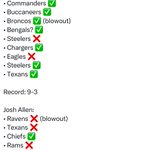


Here’s my take. And this might be my first Tweet or X or whatever the heck it is.
I talk a lot of crap on the Bills and Allen but I’ll be honest and say I respect the hell out of Allen! The man is a monster!
Like Lamar, Allen can’t be Superman every play!! Help him!!!!!!!!!!!
1
2
1,147


Bruce Nasty retweeted

@CEOAdam - now let’s compare $AMC to $CNK, shall we?
$CNK lost about 5% whilst $AMC lost staggering 91% of share value.
$CNK CEO Lead the company with minimum to no pay whilst you drew 20+ million yearly.
So stop blaming the damn #Covid and step down.
Your resignation as a CEO will change direction to the upside.
$AMC #AMC


Bruce Nasty retweeted

JUST IN: Citadel has been 'stopped out' from multiple highly leveraged trades 🚨
A source said Citadel is in the process of 'liquidating or trimming crowded positions'.
It would appear that hedge funds are currently at their most vulnerable position ever.


Bruce Nasty retweeted

🚨BREAKING: Warren Buffet says President Trump is making the “Best financial decisions for America in 50 years”



Bruce Nasty retweeted

BREAKING: Andrew Tate has officially landed in Miami Florida!
OG $AMC Gorilla is BACK!!
Bruce Nasty retweeted

I had a 45 minute chat with deep search Grok3 about $AMC We talked about EVERYTHING and here is the conclusion.
TLDR:We were never wrong.
JUST HODL
### Conclusion
After analyzing AMC Entertainment Holdings, Inc.'s (AMC) stock situation over the past four years, it’s clear that something is seriously amiss. The stock has experienced a 97% decline despite improving fundamentals, including an 18.3% revenue increase in Q4 2024, reduced losses, a 20.2% rise in attendance, and new revenue streams. This disconnect between operational recovery and stock performance defies basic market logic.
Key anomalies further deepen the suspicion:
- **High Off-Exchange Trading**: A significant portion of AMC trades occurs through dark pools, obscuring market activity and potentially hiding manipulative selling or suppressing buying pressure.
- **Low Cost to Borrow Shares**: Despite retail investors reportedly owning 90% of the stock and not lending their shares, the cost to borrow remains low, contradicting supply-demand principles. This suggests an artificial supply of shares, possibly from naked shorting, which creates synthetic shares to inflate supply and depress the price.
- **Stable On-Balance Volume
(OBV)**: OBV has remained nearly flat, indicating retail investors are holding their shares. In a fair market, this should support the stock price, yet AMC has plummeted, pointing to external downward pressure.
- **Massive Short Interest**: The congressional GameStop report revealed that AMC’s short interest was even larger than GameStop’s, making it a prime target for a squeeze. Yet, the stock remains suppressed.
- **Past Market Interventions**: The removal of the “buy button” during the 2021 squeeze halted retail buying, capping the stock’s rise and protecting short sellers—a clear intervention that raises questions about market fairness.
When factoring in concerns about the Depository Trust and Clearing Corporation (DTCC), which custodies shares, the situation becomes even more troubling. If the DTCC’s systems fail to reconcile true share ownership—potentially allowing synthetic shares to flood the market—it could be a key mechanism enabling price suppression.
While complex trading strategies like hedging, arbitrage, or leverage are legitimate tools, their use in AMC’s context doesn’t fully explain the scale and persistence of these anomalies. The evidence suggests that AMC’s stock is being artificially suppressed through a combination of off-exchange trading, naked shorting, synthetic shares, and past market interventions. This undermines retail investors’ resilience and AMC’s operational improvements, creating an environment where the stock’s price is detached from its true value.
In conclusion, the situation with AMC’s stock is not just odd—it’s a red flag signaling potential manipulation. The pattern of anomalies, from off-exchange trading to suspiciously low borrowing costs, points to a trading environment where short sellers or other players are keeping the price down. This demands deeper investigation by regulators and scrutiny from investors. The logical takeaway is that AMC’s stock price is not reflecting its fundamentals or retail ownership, and external forces are likely at play, distorting the market’s fairness.

Bruce Nasty retweeted

The @Ravens are hyped and ready for the #NFLPlayoffs

