
Chief Economic Correspondent at Axios and author of Axios Macro newsletter. Author of "The Alchemists" and "How to Win"; Formerly: NYT, WashPost.
Washington, DC
Joined June 2010
- Tweets2.9K
- Following1.8K
- Followers88.8K
- Likes7.4K
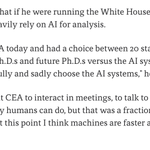



I spoke with @jasonfurman about his nifty new vibecoded econ site, but mainly about how AI tools have gotten way better at the work of economic research and analysis than I think many appreciate — with big implications for we humans who do that sort of work.
axios.com/2026/10/23/ai-econ…


Any other degens out there double-screening Kevin Warsh at the IMF in Bangkok and Broncos-Seahawks in overtime?
Must-read! Order today!

"The Invisible Hand of Maria Edgeworth" is out today!
"Histories of economics usually feature its fathers, whom Smialek keeps as main characters, but the author focuses on the woman standing beside them who believed economics belonged to everyone" - @PostOpinions
"Charming, engaging and highly instructive" - @nytimesbooks
penguinrandomhouse.com/books…


Not even a subtweet, frankly…

Mark Carney is asked about interest rates and inflation by @colbyLsmith and he prefaces his answer with this: "Thirteen years as a central banker, I defend the right of my central bank to do whatever they think is right."
NYT: Just on these stimulus measures, though, the Bank of Canada looks like it’s on the cusp of raising interest rates and following other major central banks around the world in combating elevated inflation, so do you see any of this working at cross purposes with the central bank? How do you think about inflation?
Carney: Thirteen years as a central banker, I defend the right of my central bank to do whatever they think is right. Core inflation is running at 2%, headlines run into 3%, but core runs into 2, and so the inflation pressures are much less in Canada than some other jurisdictions that you might be familiar with, and the fiscal position is much stronger. You know, we borrow 110 basis points through the U.S. — that tells you a lot, and the economy is growing. This is not European low interest rates because of that. It’s because we got our fiscal house in order and the central bank has a lot of credibility.


I did not know that @mckonomy was the originator of the tradition of the Fed chair and a couple of other top officials doing a scheduled stroll in front of the mountains in Jackson Hole for the benefit of photographers (and those of us who need a fresh photo for our stories)

For years, the Fed chair would give an address in Jackson Hole, Wyoming, and Wall Street and news organizations wouldn't have a recent photo of the chair to accompany stories. In steps Bloomberg's own @mckonomy . @tracyalloway , @TheStalwart and @tomkeene learn the origin of the now traditional "Fed perp walk." Listen to the Odd Lots podcast at bit.ly/3PsKJKY or watch at Bloomberg.com/video.
Big news from Jackson Lake Lodge: The price of a large drip coffee in the lobby is UNCHANGED this year at $6.42.


Things are getting awkward in the Soros diaspora.
Stanley Druckenmiller renders an unfavorable opinion of Treasury Secretary Scott Bessent's use of buybacks to defend against higher yields in a market that is functioning normally.
"I have spent five decades trading on a simple premise: Markets aggregate information no committee possesses, and prices are how that information reaches decision makers. The long-term Treasury yield is the most important price in the world. It is also the only fiscal disciplinarian the U.S. has left."
"Every basis point of artificial yield suppression is a subsidy to procrastination."
"Return buybacks to their stated purpose: small, scheduled, off-the-run liquidity operations announced at quarterly refundings, never off-cycle responses to yield levels. Term out the debt honestly and pay the price the market sets."
"If the 30-year must trade at 5.5% to clear, that isn’t a crisis. It is an invoice. Then do the only thing that durably lowers long-term yields: address the primary deficit."
wsj.com/opinion/let-the-bond…


Tapping the sign…
[as a guy who enjoys the occasional sports wager while understanding it is a negative-sum transaction for entertainment value, simultaneously deploying much more cash toward positive-sum investing in shares of the future cash flow of profitable enterprises]

Periodic reminder: sports betting is a negative sum game in a closed system where your probability of gain decreases over time.
Investing in stocks and bonds is a positive sum game driven by endogenous economic growth where your probability of gain increases over time.
Negative sum games should NEVER be part of a financial plan as they cannot reliably fund future liabilities.
Self-recommending, as they say.

Some personal news...
Today I'm excited to announce the launch of the Housing Frame, a Substack where I'll be analyzing the economy through a housing lens. My debut piece is the Housing Recession is Over. Follow and subscribe here: conorsen.substack.com/p/the-…
Kevin Warsh is a true believer that AI will transform the economy, and how the Fed works to guide it. Before becoming chairman he even built bots named "Milton" and "Tobin" that thought like two great 20th century economists.
But while he pushes ambitious experimentation and research on the AI front, for now interest rate policy remains in its tried-and-true paradigm relying on government economic data, which points toward raising the federal funds rate to combat stubborn inflation, pending late summer data.
axios.com/2026/08/10/kevin-w…
