

Sharing new innovations from the frontiers of neurology #neurotwitter 🧠
Joined May 2008
- Tweets1.5K
- Following216
- Followers4K
- Likes1.9K





🌍 Dementia is rising fastest in poorer countries
Across 22 cohorts (38,418 people, 18 countries), incidence was 9.7 per 1,000 person-years — higher in women (10.6 vs 8.6) and low- and middle-income countries (13.6 vs 8.3).
pubmed.ncbi.nlm.nih.gov/4286…

Can a cholesterol pill prevent seizures after a seizure emergency?
Of 314 people after a first status epilepticus, 21.3% later developed unprovoked seizures. Statin use after the event was tied to about half the risk (HR 0.48).
pubmed.ncbi.nlm.nih.gov/4274…

💉 A lower-cost MS drug held its own
In 218 people newly diagnosed with relapsing MS, 92.2% on rituximab versus 94.8% on ocrelizumab stayed free of new MRI lesions (months 6–24) — noninferior. Infections: 82% versus 69%.
pubmed.ncbi.nlm.nih.gov/4238…

In GBA1 Parkinson's, earlier DBS may protect thinking skills.
Among 343 people with DBS (91 GBA1 carriers), carriers implanted later declined cognitively faster than those implanted earlier. No timing effect in non-carriers.
pubmed.ncbi.nlm.nih.gov/4281…

🧠 A brain-shrinkage pattern that predicts dementia
In 130 people with early-onset Alzheimer's memory problems, each standard-deviation increase in signature atrophy raised dementia hazard by 24% (HR 1.24).
pubmed.ncbi.nlm.nih.gov/4264…

Thrombectomy for smaller artery strokes: no benefit, more brain bleeds.
In DISCOUNT (244 people), good outcomes at 3 months were 62% with thrombectomy versus 68% with standard care. Symptomatic brain bleeds: 11% versus 3%.
pubmed.ncbi.nlm.nih.gov/4248…

🩸 MS progression, tracked in a blood test
In 2,329 people with MS, elevated GFAP meant ~40% higher risk of near-term progression. When treatment lowered GFAP, progression risk fell by up to 67%.
pubmed.ncbi.nlm.nih.gov/4254…

A vitamin B3 supplement failed to slow early Parkinson's — symptoms worsened slightly more on it.
In NOPARK (410 people, 52 weeks), motor scores rose 2.45 points on nicotinamide riboside versus a 0.27-point fall on placebo.
pubmed.ncbi.nlm.nih.gov/4284…

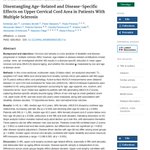
🦴 The spinal cord tells MS's story before age does
In 1,295 people with MS, upper cervical cord shrinkage ran beyond normal aging — visible from age 30, steepest in the 50s. Cord measures could sharpen disability prediction beyond brain scans.
pubmed.ncbi.nlm.nih.gov/4281…

Could a daily aspirin prevent dementia — but only for some?
In ASPREE (n=13,541), those with top platelet-count genetic scores had 3.5x lower dementia risk on aspirin, with more bleeding. Hypothesis-generating — but personalized prevention is the dream.
pubmed.ncbi.nlm.nih.gov/4278…

🌍 MS now affects 3.1 million people worldwide
The MS Atlas update — 133 countries covering 93% of the population — puts prevalence up 54% in a decade, including 40,000+ children and adolescents. Better diagnosis and longer survival explain much of it.
pubmed.ncbi.nlm.nih.gov/4269…

Frequent cannabis use looked worse, not better, in drug-resistant epilepsy.
Frequent users had more than twice as many convulsive seizures per year as nonusers (3.00 vs 1.32). Small and retrospective — but worth an honest conversation.
pubmed.ncbi.nlm.nih.gov/4280…

📈 Strokes in young adults nearly doubled in 30 years.
From 1993 to 2020, stroke rates in adults 20–54 rose from 34 to 62 per 100,000 — while falling in older adults. Ischemic stroke drove the rise.
Vascular risk doesn't wait until 65.
pubmed.ncbi.nlm.nih.gov/4277…

Hearing aids didn't stop dementia — but they helped more people get better.
In the CHOICE trial (703 adults with MCI and hearing loss), hearing aids didn't cut 24-month dementia conversion — but 15% improved cognitively vs 2% with education alone.
pubmed.ncbi.nlm.nih.gov/4280…


🧬 The “red hair” gene and faster Parkinson’s
MC1R variants in 60%+ of Europeans meant 30% faster Parkinson’s motor decline over 12 years.
The twist: MC1R is druggable. A gene test could one day guide prognosis and drug development.
pubmed.ncbi.nlm.nih.gov/4270…

Your blood tells a different story than your memory test.
In 1,967 patients on lecanemab, the plasma proteins tracking amyloid clearance behaved differently from the ones tracking cognitive decline — two separate biological stories in one treatment.
pubmed.ncbi.nlm.nih.gov/4278…

🧠 A spinal-fluid test that separates Parkinson's carriers who have disease from those who don't
In 76 LRRK2 G2019S carriers, an α-synuclein seeding assay flagged disease with 97% accuracy — positive in 80% of those with Parkinson's, negative in nearly all carriers without it.

For a gene variant where carriers often wonder "will I get it?", that's a meaningful step toward an answer — and a tool for smarter trial enrollment.
pubmed.ncbi.nlm.nih.gov/4280…

A new lead in C9orf72 ALS — and it starts with DNA repair.
A gene called PAICS protects cerebellar neurons by fixing DNA damage; restoring it rescued neurons in zebrafish. Very early days, but it opens a fresh therapeutic door in ALS.
pubmed.ncbi.nlm.nih.gov/4181…

🤖 AI found a biological footprint for migraine. A model identified who has migraine from non-headache health and genetic data alone — and found four distinct biological subtypes. Not a clinical tool yet, but migraine is more legible than we thought. neurology.org/doi/10.1212/WN…
