

Researcher. Written for @Forbes, @Cointelegraph, @CoinDesk [email protected]
Istanbul
Joined May 2009
- Tweets1.7K
- Following345
- Followers2.5K
- Likes1.3K




Pinned Tweet
Honored to win the ACJR award for Best Crypto Op-Ed for my piece on Ethereum security problems and the proposed recovery fund debate.
Big thanks to @ACJRnetwork and everyone involved. Very good company to be in.


Protos redesigned its site sometime between October 17 and 19. They also updated the masthead and About page: both used to describe @Protos as focused on Bitcoin and crypto, but now mention stocks and traditional markets too.

On September 24, @CasPiancey, their head of investigations, wrote about AI summaries eating into ad revenue, people reading less, and journalists having to cover more topics. His example: “You don’t cover crypto, you cover crypto and stocks.”
CoinDesk’s summary says Luna acquired Cointelegraph in 2022, but it was the MENA franchise.
I checked archived versions of Luna’s site: Cointelegraph disappeared from its homepage portfolio between April 24 and July 10, 2025.

To @CoinDesk's publisher and editorial leadership,
We are not for sale. Your article is based on false information and contains multiple factual errors.
We welcome scrutiny, but we will not stay silent when speculation is presented as fact. If manufacturing controversy is your strategy for attracting readers, selling events, or keeping your business afloat, that says more about your business model than it does about ours.
Whatever commercial pressures you face, they are not an excuse to mislead your audience. Your readers deserve journalism, not manufactured drama designed to generate a few more clicks.
To the publisher specifically: you are responsible for the standards of the publication you operate. Are you building a credible source of information, or simply rewarding whatever produces the most sensational headline?
Publishing a story that attracts attention is not an achievement when the underlying facts are wrong.
Correct the record, clearly acknowledge the errors, and give the correction the same visibility you gave the original claims. Do not quietly change the wording and pretend the original reporting was sound.
Credibility is earned through accuracy and accountability, not sensationalism.
Your readers deserve better, and your publisher should demand better.

Look who’s back on Google: @Cointelegraph.
Around 80% of its pre-2026 archive is back online, and articles are showing up in search again.
They bought CT.com way back in 2018 and used it for short links. The initials have aged well 👀


I am unblocking and refollowing @Cointelegraph after they restored their articles prior to 2026 yesterday (some of which are mine). Perhaps this is in anticipation of Google unbanning them or now more traffic is generated from LLMs?
Cointelegraph took the pre-2026 archive down in a site revamp reported on April 30, 2026, and the oldest material shows up in its sitemaps again on October 1, 2026. There is no public announcement of the restore.
Former Cointelegraph writer Gareth Jenkinson said on April 30 that a website revamp had deleted everything posted before January 2026. Other writers said the same that day, and Spanish-language pages were reported as only partly removed at that point.
The site does not say when the archive came back. What is public is the sitemap timing, checked today (October 2):
Monthly article sitemaps from 2013 through about 2021 all share one last-modified stamp: October 1, 2026, 14:04 UTC.
Sitemaps for 2022 through December 2025 share an earlier bulk stamp: August 17, 2026.
Old URLs are live again. A 2013 piece, US officials to investigate digital currencies oversight, returns normally and still shows its original August 14, 2013 publish date.
So the restore looks staged: a large slice of the later archive was reindexed around August 17, and the oldest archive was put back into the sitemaps on October 1. Those dates are sitemap regeneration times, not an official “we restored the archive” notice.
@gazza_jenks

Crypto infrastructure earned ~$762k in fees from laundering @bitget stolen funds.
Another ~$260k in referral fees went to addresses linked to the hackers’ wallets.
My breakdown of the fees and recipients:
sergeenkov.com/bitget-hack-f…

Collected what can be verified so far about @hsinju's death. Maybe it saves someone some time.
sergeenkov.com/hsin-ju-chuan…
The linked paper is an opinion ("Perspective") article. It explicitly states it is "not proposing that ADHD be reclassified exclusively as a circadian disorder" and that "evidence on remission of ADHD with circadian interventions is lacking."
doi.org/10.3389/fpsyt.2025.1…


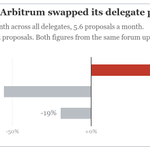
Arbitrum (@arbitrum) pays its delegates $54,000 a month between them, down from $67,000 under the programme it replaced last year. Over the same change the number of proposals they vote on fell from 5.6 a month to 2.5, so the cost of getting one proposal voted on went from $11,964 to $21,600.
The programme got smaller and each vote it buys got more expensive.
For scale, the DAO pays one advisory firm $250,000 a month on a two year contract to work on Arbitrum alone. Everyone who votes, together, gets a fifth of that.
No delegate can earn more than $700 on a single constitutional vote. And the most common reason one lost their reward was missing the five day deadline to post a comment explaining how they voted.
All four figures come from the programme operator's own update, published in April. The two pairs sit four paragraphs apart in it and are never divided.

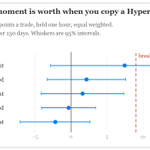
Copy trading the @HyperliquidX leaderboard is sold as a product by exchanges. In a backtest the moment a leader enters carries no information at all, and the fee alone decides the outcome.
I simulated 9,125 copied entries over 150 days, equal weighted, each held one hour. The traders were picked four ways: those who build positions gradually and those who finish most days in profit, each as a fixed list and as a list rebuilt monthly.
Before fees the four land between −2.2 and +2.1 basis points a trade. Every 95% interval brackets zero.
Break even needs 9 bps, the round trip taker fee at the entry tier, and that is a floor because copy platforms take a cut of profit on top. After the fee the four lose between 6.9 and 11.2 bps a trade. The loss is arithmetic: a fixed tariff applied to an edge of zero.
Market drift does not explain it. Over the window the mean coin returned −0.07 bps an hour, so a cohort that sits long every single time picks up about a hundredth of the fee.

A @Polymarket volume figure built from chain data is short by about a third. If the query was written before April, it returns nothing at all. Those figures are how the market gets sized, valued and compared with other venues such as Kalshi.
In the last week of August the three contracts took about $558M of taker volume. Reading only the main one loses $171M of it.
The main contract handles ordinary yes or no markets and carries 69%. A second handles markets with several outcomes, an election with a field of candidates, and carries 29%. The rest goes through a third contract for multi leg bets.
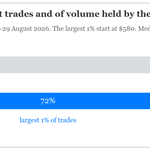
Volume here sits in very few trades. The median fill is $3.60, and the largest 1% of fills carry about 70% of the money. So the multi outcome book is 18% of the trades and 29% of the money, and counting trades will never tell you whether a missing venue matters.
Polymarket replaced all three contracts on 28 April. The old addresses still resolve and still hold three years of history, and they have taken no trades since. A query pointed at them returns an empty result with no error, so it reports a market that went quiet.

The only major precedent for a Treasury buyback of this scale is the 2000-2002 program, when the Treasury retired $67.5 billion of old 30-year bonds.
Day one back then looked just like yesterday: a sharp spike in long-bond prices and chaos among traders, which then settled into steady repricing.
But the effect held for the entire life of the program, so shorting the rally was a losing trade.
Andrey Sergeenkov retweeted

Who can apply?
You should apply if your project has existing traction and is actively advancing privacy on Ethereum and across the open internet.
Our two categories for this epoch are:
- Privacy: everything from private transfers, shielded pools, wallet/RPC privacy, encrypted mempools, and zero-knowledge (ZK) tooling
- Open internet: includes secure messaging, metadata-protecting communication tools, private compute hardware, and the privacy libraries that everything else is built on.
Important dates:
Deadline to apply: 10 September, 2026
Epoch Accelerator: 6 - 10 October, 2026
Epoch allocation window: 14 - 21 October, 2026
Apply now: octant.fillout.com/epoch-13

Andrey Sergeenkov retweeted

Keeping Ethereum's core devs paid costs $30M a year.
That's 0.17% of the money parked in ETH ETFs on top of their code.
The institutions earning fees on it contribute nothing.
morrow.report/18-billion-in-…

Andrey Sergeenkov retweeted

Ethereum staking yield is quietly paying for Bitcoin's infrastructure.
@OctantApp's latest round sent its biggest grant to the Tor Project, the network behind roughly 1 in 4 $BTC nodes.
148.7 ETH to Tor all-time, all of it from yield on staked $ETH.
btcpeers.com/ethereum-stakin…

It's not a bug, it's a feature.
"As time goes to infinity, all keys will be lost."

🔥ZCASH CO-FOUNDER: BITCOIN SHOULD REMOVE 21M SUPPLY CAP AND GROW 4% PER YEAR
Eli Ben-Sasson said Bitcoin’s 21M cap “doesn’t make sense because as time goes to infinity, all keys will be lost.”
He suggested 4% annual issuance tied to population growth to ensure “there’s enough to go around.”
Estimates suggest only around 1% to 5% of the world owns Bitcoin.


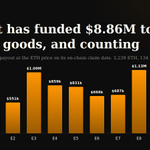
$8.86M is what @OctantApp has funded to impactful projects with no strings attached (valued in USD at each on-chain claim's ETH price).
Soon we'll find out how much the current round will add to that.
About 7 hours left for you to take part.

Bitcoin has the lowest DeFi adoption of any major asset relative to its market cap. But I wouldn't call the rest useless.
For most holders, store of value is the use. Gold in a vault isn't idle.
And a few examples of where it works:
Babylon has around $3.2 billion of BTC staked natively, securing PoS chains.
Lombard's LBTC sits near $1.5 billion live in 70+ protocols.
Stacks ran a 30x capacity upgrade and opened sBTC to 1,800+ institutions through Fireblocks.
Spot ETFs hold more than 1.2 million BTC as a regulated product.
Public companies hold over $80 billion of BTC in treasury, used as reserve and borrowed against.


Only 0.91% of Bitcoin's $1.2T market cap is actively deployed in DeFi protocols
The entire wrapped BTC market across all chains, including wBTC, cbBTC, tBTC, BTCB, adds up to $10.95B
That's it
The other 99%+ sits idle on the Bitcoin network with zero productive use
For context: wBTC alone has been around since 2019
Seven years later, less than 1% of BTC supply has found its way into DeFi
The largest asset in crypto is also one of the least deployed in DeFi
Data: @DefiLlama
