

Facts + practical swaps to cut microplastics from your home. Free guides and tested product picks 👇
United States
Joined October 2026
- Tweets419
- Following49
- Followers20
- Likes6






Pinned Tweet
Most people are surprised how much microplastic comes from everyday items like water bottles, food containers, and clothing.
Highest-impact swaps we cover: whatismicroplastics.com
What's one product you've already switched away from plastic?
🤖 Made with AI

Windows are shut for the season, so here's an indoor air number worth knowing. Researchers in Toulouse measured the plastic floating in apartment air and found a median of 528 microplastic particles per cubic meter. 94% were smaller than 10 micrometers, small enough to reach deep into the lungs. Tiny study, just 3 apartments and 2 cars, but a lot of that comes from settled dust getting kicked back up. Which makes your vacuum a bigger deal than it sounds.
The catch with vacuums: a 2012 test of 21 in-use vacuums found every single one leaked some fine dust out the exhaust, and HEPA models were sometimes only slightly better. A sealed system matters as much as the filter, and a bag beats dumping a bin. What to check before you buy: whatismicroplastics.com/do-h…

Wednesday bathroom swap: if there's an old face scrub hiding in the back of a drawer, flip it over and look for "polyethylene" on the label. A 2015 Plymouth study estimated one use of a microbead scrub could send 4,594 to 94,500 plastic beads down the drain. The US ban only covered rinse-off products like scrubs and toothpaste, so leave-on stuff was never included. Sugar, oats or coffee grounds scrub just as well.

Rug shopping this fall? Worth knowing first: Macquarie University researchers collected the dust settling in 32 Sydney homes for a month, and 39% of the particles were plastic fibers. Homes with carpet as the main floor covering had nearly double the petrochemical fibers, and homes that vacuumed less had more too. Wool or jute with no synthetic backing sheds natural fiber instead. And vacuum more than you want to.
Small label thing I didn't expect: almost every "organic cotton" underwear I looked at is really 95% cotton and 5% elastane, and the waistband is usually mostly nylon. Both are plastic. That bit of stretch is why they don't sag by noon, so it's not a scandal. But if you want zero synthetic fiber, check the tag for 100%. It exists, it's just rare.
I read the new microplastics papers each week so you don't have to, then send one short email with what's actually worth changing. Free: what-is-microplastics.kit.co…
112 Million Plastic Particles From One Cutting Board: 5 Kitchen Swaps That Actually Help
youtu.be/fMMYU9XECvw
Hot take on the LA Times microplastics story: the shocking part isn't that companies knew. It's how long the science just sat there.
In 1974, Berlin researcher Gerhard Volkheimer showed swallowed PVC particles crossing the gut of lab animals and reaching blood and organs within two hours. Flakes even turned up in spinal fluid and breast milk.
Shell and Firestone passed around summaries. A 1975 Union Carbide letter called it a "horror story" for PVC and leaned on a 1947 study to keep defending PVC food packaging.
Then it mostly faded for decades, partly because he published in German.
Same fix as ever: less plastic touching your hot food.

Laundry question for anyone who's tried it: has a washer microfiber filter (Filtrol, PlanetCare, that kind of thing) or a wash bag like Guppyfriend actually stuck in your routine? Wondering if they're worth the hassle in real life or just end up in a drawer.
Windows are shut for the season, so whatever sheds indoors stays indoors. If you're shopping for an air purifier, two checks matter more than the brand.
1. It says True HEPA, which means it catches 99.97% of particles at 0.3 microns. "HEPA-type" doesn't have to meet that.
2. If it has an ionizer, look for CARB certification. That caps ozone output at 50 parts per billion.
The purifiers we'd actually buy for dust and microplastics, with the ozone details: whatismicroplastics.com/best…

Tuesday leftovers swap: move it to glass before it goes in the microwave.
A 2023 University of Nebraska-Lincoln study microwaved plastic food containers for 3 minutes. Some released up to 4.22 million microplastics and 2.11 billion nanoplastics from every square centimeter of plastic.
Plastic lids are fine in the fridge. Just keep them out of the heat.

Tuesday morning fact for parents: University of Toronto researchers tested 16 new, lower-cost kids' mattresses and found 21 chemicals of concern, including phthalates and flame retardants. In lab tests, 12 came off at room temperature. Add body heat and a child's weight and it rose to 21. One even had a flame retardant banned in Canada since 2014. Their simple advice: keep the bed less crowded with extra stuff and wash bedding often.
Microplastics aren't only a packaging problem.
A 2020 study from Catania, Italy (Environmental Research) tested produce from local markets and found apples were the most contaminated, averaging about 195,000 particles per gram. Carrots were around 100,000. Lettuce was the lowest.
One city, small sample, newer method, so hold the exact numbers loosely. But it's a reminder this goes way beyond plastic wrap.
If you want the bigger picture on which foods carry the most and what actually helps: whatismicroplastics.com/micr…

Hot take on today's paper straw news: the paper vs plastic fight skips the part that matters for your body.
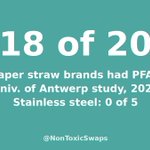
A 2023 University of Antwerp study tested 39 straw brands and found PFAS (forever chemicals) in 18 of the 20 paper brands. Bamboo was 4 of 5. Stainless steel was the only material with zero. Levels were low, but they were there.
Best straw is a steel one you keep, or no straw at all.

Quick water bottle check, no judgment: what are you actually drinking out of most days? Stainless, glass, or the plastic one that's been rolling around the car since summer? Also curious whether anyone has found a lid that isn't plastic.
That black plastic spatula in your drawer was probably not made from new plastic. A 2024 study in Chemosphere tested black plastic household products, kitchen utensils included, and found brominated flame retardants in them, likely carried over from recycled electronics.
The honest part most headlines skipped: the authors later corrected a math error, and the exposure estimate came out about 10 times lower. The contamination finding still stands.
Steel, wood, or good silicone does the same job without the question mark.
I put together 17 swaps (steel for stainless and cast iron, wood or silicone for nonstick) plus the full story on the correction: whatismicroplastics.com/non-…

Monday swap tip for the bathroom shelf: "plastic-free" printed on a box doesn't mean much by itself. Look for an actual certification.
flustix PLASTIC FREE caps synthetic polymers in the packaging at 0.75%. OK Compost Home from TÜV Austria means it breaks down in a backyard compost pile in about 180 days.
A green leaf and the word "eco" are just design choices.
