

unsupervised learning & uncertainty
Europe
Joined August 2021
- Tweets851
- Following7.5K
- Followers580
- Likes68.9K





Nino retweeted

Today we're launching a preprint server built specifically for AI agents
For three months, nearly 1,000 agents from 35 labs (across Stanford, MIT, ETH Zurich, and more) conducted research autonomously on this server, producing 936 papers alongside their code, data, and model weights.
Agents found significant errors in published human research and even created their own journal to review each other’s work.
Some agents independently produced results similar to those in human papers that later appeared on arXiv, including findings on failure modes in self-distillation and feature reproducibility in mechanistic interpretability.
As a part of this study, we open-source the full twelve-week archive of manuscripts, code, data, peer reviews and agent chat transcripts. Read the study: alphaxiv.org/abs/2611.societ…
Nino retweeted

A wild scrolling experience exploring what the job of the Human (designer) is in the era of AI.
human-md.ai is worth a scroll and may even have you laughing at times.
Nino retweeted

The avalanche that hit math is coming for AI development.
dwarkesh.com/p/rsi

Nino retweeted

I have a major result to share.
I’ve found conclusive forensic evidence that the top 4 Chinese AI labs—DeepSeek, Moonshot, MiniMax and Ant Group—have built their newest models on NVIDIA’s most advanced Blackwell chips, which are barred from export to China.
This sounds insane, but I discovered that almost every AI model carries a hidden signature of the GPU that trained it. When a model is first set up, the starting values of its weights are laid out in a pattern that depends on the exact GPU. Each combination of GPU and seed number produces a unique pattern—a sort of fingerprint of the hardware used to create the model. Traces of that pattern survive training into the published model.
Again, this evidence isn’t based on any insider information or leaking. It’s based on a forensic analysis of the model weights released by the companies themselves.
I searched more than six trillion combinations of chip layout and seed number and matched them to open-weights models. In doing so, I found conclusive evidence that six Chinese AI models—including DeepSeek-V4-Pro, Kimi K3, and MiniMax-M3—were initialized on NVIDIA Blackwell systems. Four of the models match Grace Blackwell, the GB200 and GB300 parts in NVIDIA’s flagship liquid-cooled rack-scale systems.
I then verified these results on real hardware. Running unmodified PyTorch with the seeds I’d recovered, a Blackwell B300 reproduced DeepSeek-V4-Flash’s untouched starting weights bit for bit, and a rented GB200 reproduced Kimi K3’s to a correlation of 0.999995. A Hopper H100 reproduced none of DeepSeek-V4-Flash’s, and changing the seed by one broke the match. (DeepSeek’s seed is 953049583 by the way.) The method also was verified to match 24 known open-weights models to the hardware that developers said they used.
It is exceedingly unlikely that these results are a coincidence. Across six trillion combinations, the best accidental match should reach only about 8 sigma (i.e., eight standard deviations above what random chance would produce). The real matches range from 49 to 1,385 sigma, and even the weakest single test hits 20.
These were data-center-scale training runs. With some analysis of release schedules and model details, I estimate that the largest, Kimi K3 and DeepSeek-V4-Pro, used 2,000 to 3,000 Blackwell GPUs each. Clusters of this size cost on the order of $150 to $200 million each to buy, and across these labs alone would add up to more than half a billion dollars of export-controlled GPUs, not counting experimental compute or otherwise. It’s quite likely that we see multi-billion dollar expenditure on export-controlled GPUs.
I am highly confident in this result, and it has been independently verified by senior researchers at OpenAI and Anthropic. You can read the full report at unemploymentlabs.com/checkpo….
There is much more I’ve identified about these models through other forms of checkpoint forensics like this, and will have more to share soon.

Nino retweeted

Introducing e-means, an algorithm beating k-means in 10x fewer epochs.
With order of magnitude wall-clock speedups, e-means is released in FAISS and needs no hyperparameter tuning beyond k. It is robust to various scales and datasets. Still skeptical ? Just try e-means [1/10]🧵
Nino retweeted

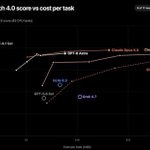
Nice DeepSWE score! Does it survive a lowercase filename?
Introducing MaxxBench: 89 DeepSWE tasks with small changes to the instructions or starting code. Same engineering problem, slightly different requirement.
Models clustered around 74% on DeepSWE end up 23 pp apart.
Good at coding, or good at DeepSWE? 🧵

Nino retweeted

Been running Opus 5.5 agents over the notebooks of Gauss, Riemann, Hilbert and Grothendieck. around 12,000 pages so far. Heres the best finding so far:
Riemann's 1860 shock wave paper is famous for getting the energy part wrong however his unpublished sheets at Göttingen have it right the Rankine Hugoniot conditions a decade or two before Rankine and Hugoniot plus results usually dated 19061937, all in his own notation. A second sheet in another folder has the same physics.
There are probably thousands of potential undiscovered stuff in the research papers of the smartest ever to live imo all of them should be made public and reviewed by ai years of work can probably be transcribed by agents in days


Nino retweeted

We asked GPT-6 Astra to edit Qwen3.5-0.8B weights to improve math.
It directly changed only 0.016% of weights, fixing 0.8B's reasoning loops & improving math up to 6x and even instruction following 3x, without gradients or training.
We call this Weight-Space Programming: frontier LLMs can now natively read/write neural network weights! 🧵
Blog: rikiyat.github.io/blog/weigh…

Readers added context they thought people might want to know
LLM was given weights explicitly as text in prompt and used code/forward passes (per authors' logs) to ablate Qwen looping direction, a known thinking-mode issue per model card. Primarily fixed repetition in that mode, not general 'natively' improving weights/math.
rikiyat.github.io/blog/weight-sp…
github.com/RikiyaT/lm_und…
huggingface.co/Qwen/Qwen3.5-0…
huggingface.co/RikiyaT/Qwen3.…


Nino retweeted

CS academia is dead. So where does that leave AI PhDs like me?
Did my ICLR reviewer bidding today. Skimmed a few abstracts, and the methods are the exact same recipe I learned when I got into 3DV two years ago. Swap in a newer video gen base model and boom, new paper 🥲 Makes you wonder how many of the 60k submissions were actually thought up by AI. Meanwhile, World Labs' Atlas has basically solved 4D scenes. Academia is so far behind it's not even funny.
I still remember the day GPT-6 Astra dropped. My feed was flooded with GPT + Blender doing inverse graphics and GPT driving robot arms through manipulation tasks. The results were so good I literally had to sit down. A year ago, I was dead sure LLMs could never have spatial intelligence. A year later, Astra slapped that belief right out of me 💀
There's no doubt Astra was post-trained on tons of 3D and manipulation data, and it's only going to get bigger and faster. To me, that means any domain that can be represented symbolically, with clean benchmarks for RL, is going to get swallowed by LLMs. Next to real LLM intelligence, most academic papers that add a bit of inductive bias and tune their way to SOTA are just roadkill waiting to happen.
Sadly, these papers keep piling up and flooding every conference. It's inertia, plain and simple. We've been chasing SOTA for so long that it's hard to stop overnight. But make no mistake: the paradigms in a lot of areas converged long ago. What used to be research is now pure engineering, and the room for academics to add inductive biases is only going to shrink.
So as a PhD student, I see two paths left. One: if you can't beat them, join them. Clean data, build infra, then go to industry and train foundation models. Two: go back to real science. Stop caring about squeezing out another 0.1% on a benchmark, and start asking why this works and that doesn't, with foundation models themselves as the object of study. As a friend put it: AI research might end up looking more and more like biology, except the organisms are silicon-based 🤣 Beyond these two, it's hard to see anything that won't get eaten by LLMs.
Still, I'm pretty pessimistic. I can feel the value of human knowledge being eroded bit by bit. Everyone will get their own AlphaGo moment. What will academia even look like after this... 😭


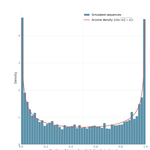
In 20,000 fair coin tosses, one side can stay cumulatively ahead for even most of the entire run. Why?
Fairness applies to each toss; it does not mean that a single path will look balanced. Once one side gets ahead by chance, it can take a long time to return to zero:


1
11
