

Kapitalist absolutist💰 Libertarianer 🗽| Samtykke uden undtagelser🤝 Glad for ærlige og saglige diskussioner. Stor fan af Rand og Rothbard
Denmark
Joined December 2024
- Tweets2.5K
- Following1.2K
- Followers261
- Likes2.6K





Mange tror, at filosofi er ligegyldigt eller kun noget for akademikere. Men vi har alle en filosofi. Spørgsmålet er bare, om du har evalueret din rationelt, eller om du har arvet den fra andre uden at tænke nærmere over det.
Ayn Rand sagde det godt i "Philosophy: Who Needs It":
"You might claim-as most people do—that you have never been influenced by philosophy. I will ask you to check that claim. Have you ever thought or said the following?
“Don't be so sure—nobody can be certain of anything.” You got that notion from David Hume (and many, many others), even though you might never have heard of him.
Or: “This may be good in theory, but it doesn't work in practice.” You got that from Plato.
Or: “That was a rotten thing to do, but it's only human, nobody is perfect in this world.” You got that from Augustine.
Or: “It may be true for you, but it’s not true for me.” You got it from William James.
Or: “I couldn't help it! Nobody can help anything he does.” You got it from Hegel.
Or: “I can't prove it, but I feel that it's true.” You got it from Kant. Or: “It's logical, but logic has nothing to do with reality.” You got it from Kant.
Or: “It's evil, because it’s selfish.” You got it from Kant.
Have you heard the modern activists say: “Act first, think afterward”? They got it from John Dewey.
Some people might answer: “Sure, I've said those things at different times, but I don’t have to believe that stuff all of the time. It may have been true yesterday, but it’s not true today.” They got it from Hegel.
They might say: “Consistency is the hobgoblin of little minds.” They got it from a very little mind, Emerson.
They might say: “But can't one compromise and borrow different ideas from different philosophies according to the expediency of the moment?” They got it from Richard Nixon—who got it from William James."
Så jeg vil anbefale at bruge lidt tid på filosofi. Ikke for at blive akademiker, men for at finde ud af, om de ideer, du lever efter og tror på, faktisk holder.
2
65
Oliver Cramon retweeted

Having a grok bot trained on the fundamentals of Libertarian ethics is very useful when analyzing counter arguments. It cuts right through walls of text.
Response:
This critique attacks argumentation ethics (AE) as an ethical system. It isn't one. AE is a tool for testing whether a normative claim can be justified at all. Hoppe ends his own paper by saying it offers "a completely value-free justification of private property. It remains entirely in the realm of is-statements and never tries to derive an 'ought' from an 'is'" (Economics and Ethics of Private Property, p. 345). Any ethics, Objectivist or Christian, can use that tool, and every ethics has to pass its test.
Every objection here mixes up two orders: what comes first in existence, and what comes first in justification.
1. "Human nature is more fundamental than argument." In existence, sure. Hoppe grants that action comes before argument there (A Theory of Socialism and Capitalism, p. 155 n. 116). But to claim anything about human nature, you have to argue for it. Human nature can't settle a dispute about rights until someone makes the case, and then we're back in argument. The critique also never names a single right that follows from human nature.
2. "Subsistence comes first: food, shelter, community." Your past meals caused you to be here, but they aren't logical preconditions of the argument you're making now. What arguing actually presupposes is that each party controls his own body and the space it stands in, right now. Hoppe already says "only he who survives can sustain an argumentation" (TSC p. 160), and from that he derives property in external goods, not claims on other people. Needing something gives you no title to it. Taking it from someone else to meet the need is aggression.
3. "Arguing has no priority among natural ends, so freedom can be limited to serve values through coercion." This treats a logical constraint as one value competing with others. To argue that coercion is justified, you have to address your opponent as a free judge who can accept or reject your reasons. Arguing for coercion therefore contradicts itself in the act. And "supporting values through coercion" just means initiating force, which is the thing that needs justifying in the first place.
4. "Truths exist before any linguistic community" (citing Søvik 2018). This mixes up a truth with a claim that something is true. A theorem can be necessary and still only ever be proved, disputed or refuted in argument. The critic is doing exactly that right now. And Søvik's paper is a cosmological argument for God about why there can't be nothing at all. It says nothing about AE, language or justification.
5. "The defender must rebuild AE as a natural rights theory and prove Habermas and Apel's philosophy of language." AE was never meant as a natural rights theory, so there's nothing to rebuild. Hoppe takes one step from Habermas and Apel, the idea that truth claims are settled in argument, and breaks with them at the decisive point: argument requires control of the body, which is a scarce (rivalrous) means. "Prove your framework true" is a burden every theory carries, the critic's included.
Two smaller points. The claim that the non-aggression principle is "tautological" only works because the text swaps Rothbard's "invasion" for "violation of rights." Define aggression as initiating conflict over a scarce (rivalrous) means and the circle disappears. And the Hoppe quotes are reworded, apparently translated back from Spanish, and leave out the passages where he grounds property in scarcity and conflict.
In short: AE doesn't say where rights come from. It shows which norms can be defended without contradiction. Every objection here has to be argued, and so it already uses the test it's trying to reject.
Remember: Aggressors are an engineering problem, the ethics tools just help you in identifing them.

The Problem of Argumentation Ethics
1. Formulating Argumentation Ethics
Argumentation ethics is an ethical system that grounds a libertarian theory of justice, one that provides a principled solution to all conflicts over physical resources (scarce goods). It is a justification that follows the maxim that serves as the condition of every workable ethical system: to establish norms that, if complied with, would logically rule out all conflicts from the beginning of humanity. Such norms are known as the right of self-ownership and the right of appropriation of goods external to the body (the latter derived from the implications of the former norm, self-ownership), implying an ethical (and therefore universal) principle: the Non-Aggression Principle, which is stated as follows:
Non-Aggression Principle (NAP): no individual, or group of individuals, has the right to engage in aggression directed against the person or property of another, and in fact is under an obligation not to commit it.
“Aggression” is defined as the initiation of the use or threat of the use of physical violence against the legal person or the property of another. Aggression is, therefore, synonymous with the violation of rights. The reason why this principle is considered tautological with respect to the right of self-ownership and the right of appropriation of goods external to the body (self-ownership) is that, since it implies a prohibition of violations of a person’s property rights, it becomes redundant, given that the very concept of the right already contains the obligation not to violate it.
Paraphrasing Hoppe (1987, p. 67), by “property” is understood not a purely empirical relation, given and extractable from observation, between persons and things; rather, it designates a legal or normative or moral relation (the three terms will be used from now on as synonyms), whose existence or non-existence —regardless of all factual circumstances— depends on whether or not it can be justified or grounded as such. The theory of property, therefore, is not purely empirical, but has a large normative component. It is not concerned with the question “How is it that certain persons do or do not maintain certain relations with certain objects?”, but rather poses the question “How is it that certain relations of certain persons with certain objects can be considered justifiable and others not?”. Naturally, a theory of property, insofar as it is a normative theory, must also include accounts of the fundamental question of the groundability of norms and of the question of the decidability between incompatible and competing normative theories (consistent and strong ones).
Now, the question, according to Hoppe, of whether or not we have rights and, if so, which ones, can only be decided in the course of argumentation (exchange of propositions). Justification (following his lines of reasoning) —proof, conjecture, refutation— is a matter of argumentative justification. Anyone who denied this proposition would be caught in a performative contradiction because their denial would itself constitute an argument. Even an ethical relativist must accept this first proposition, which has been called the a priori of argumentation.
Following the line of reasoning, Hoppe (2010, p. 155) says: “Now, arguing never consists merely of free-floating propositions claiming to be true. Rather, argumentation is also always an activity. But given that truth claims are raised and decided upon in argumentation and that argumentation, aside from whatever is said in its course, is a practical affair, it follows that there must exist intersubjectively meaningful norms, precisely those that make a certain action an argumentation, and that have a special cognitive status in that they are the practical preconditions of objectivity and truth.”
Then, according to Hoppe, the answer to the question of which ends can or cannot be justified is derived from the concept of argumentation (Hoppe, 2010, p. 156).
Following this line of reasoning, the authors proceed with normative arguments about which types of rights are derived from the conditions of possibility of argumentation as a practice, and about the universalization of these rights, because the most transcendental aspect for dealing with the ethical is argumentation as an interpersonal human practice.
2. The Problem
One of the obstacles one encounters in making this ethical theory convincing is the claim that the question of the existence of rights can only be decided in the course of argumentation as an interpersonal practice. This claim, in order to be convincing, would need to pass the filter of comparison with other ethical theories that posit more transcendental conditions. An example of the latter is Aristotelian ethics, which considers human nature to be a more transcendental condition than language itself, since before any attempt at communication we need to have a human nature that makes argumentation possible.
It could be objected that rationality is part of human nature and that argumentation ethics deduces rights from this essential property of the human being; however, argumentation ethics does not use an argumentative method that establishes and deduces rights from a philosophy of human nature, since it focuses on practical argumentation as the most transcendental fact regarding the truth or falsity of any proposition. Therefore, the question remains unresolved of treating human nature in its entirety as a more transcendental fact than argumentation itself for deciding which types of rights we do or do not have.
A second obstacle, related to the first, is that argumentation as a practice depends, in all cases, on the material preconditions that enable the communication of any new human being in this world. What I am referring to are the conditions of subsistence or survival that allow a human being to develop so as to have the possibility of communicating and arguing: eating, drinking, having a home, being in a community where the majority cooperate in order to subsist, et cetera. All of these things must be fulfilled (the extent to which this must occur will depend on the context of each individual) for individuals to be able to actually argue. Then, if we follow the same transcendental method, no matter how much I try right now to object to argumentation ethics by means of an argument, my past means of subsistence are an even more transcendental precondition and therefore a more fundamental source for deciding which types of rights we people have. And if we keep searching for more transcendental preconditions, we arrive at human nature, since one could not argue if one were not human, much less form a community that cooperates to generate means of subsistence.
In response to these problems, it could be objected that, given that the capacity for argumentation is an essential characteristic of human nature —nothing could be said about the latter without the former—, it could also be argued that norms that cannot be effectively defended in the course of argumentation are also incompatible with human nature (Hoppe, 2006, p. 315).
This objection loses its force by failing to prove that the possibility of arguing, or argumentation as a practice, has any priority within a natural law framework over other natural properties of the human being, for it could well be maintained that freedom must serve values defined within a solid conception of humanity, in which case it is evident that nothing prevents limiting it when it does not fulfill its intended instrumental functions: to support values through coercion and to delegitimize anti-values. The possibility of arguing may have certain limited natural ends that would make its indiscriminate use illegitimate when it comes into conflict with the natural ends of the rest of human purposes (or the flourishing of their virtues).
A third problem arises from the fact that this ethical theory depends heavily on the truth that “any truth claim, the claim related to any proposition that it is true, objective or valid (all terms are used synonymously here), is raised and must be resolved in the course of an argumentation. Since it cannot be disputed that this is so (one cannot communicate and argue that one cannot communicate and argue), and since it must be assumed that everyone knows what it means to claim that something is true (one cannot deny this claim without claiming the negation of it as true), this very fact has been aptly called ‘the a priori of communication and argumentation’” (Hoppe, 2006, p. 314). However, there is no reason for this to be so, since strong reasons can be given to believe that theoretical frameworks containing truth claims (such as mathematical propositions or any kind of true proposition) are necessary facts prior to any linguistic community (Søvik, 2018), so that the “a priori of argumentation” would lose all credibility and relevance for grounding an ethical theory.
Attempting to respond to these problems would imply a great challenge for the defender of argumentation ethics, since he would have to restructure his entire theoretical framework in order to adapt it to a consistent theory of natural rights and to prove the priority of the possibility of arguing over the other human virtues. In addition to this, the various philosophies of language would have to be reviewed and contrasted with the postulates that Hoppe maintains, which come from Habermas and Apel, and in the end it would have to be proven that the Hoppean framework is the true one.
References
Hoppe, H.H. (1987). Eigentum, anarchie und staat: Studien zur theorie des kapitalismus. Westdeutscher Verlag.
Hoppe, H.H. (2006). The economics and ethics of private property: Studies in political economy and philosophy (2nd ed.). Ludwig von Mises Institute.
Hoppe, H.H. (2010). A theory of socialism and capitalism: Economics, politics, and ethics [Publicado originalmente por Kluwer Academic Publishers, Boston, 1989]. Ludwig von Mises Institute.
Søvik, A. O. (2018). It is impossible that there could have been nothing: New support for cosmological arguments for the existence of god. Neue Zeitschrift für Systematische Theologie und Religionsphilosophie, 60 (3), 452–463. https : / / doi . org / 10 . 1515 / nzsth-2018-0026
Oliver Cramon retweeted

Statists are fond of claiming that capitalism has “failed,” despite the fact that government is found in every exchange and at every stage of production. The problem isn’t capitalism, but rather the state itself. | Wesley Dorly
mises.org/mises-wire/problem…




Oliver Cramon retweeted

Anyone interested in a comprehensive comparison of the pre- and post-Fed stability of the U.S. economy, informed (unlike the chart below) by up-to-date data, and taking account of other changes since 1914, can find it here: sciencedirect.com/science/ar…


Oliver Cramon retweeted

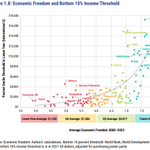
My latest article is an important one:
It's about how economic inequality actually doesn't seem to matter.
Link: cremieux.xyz/p/inequality-do…

Oliver Cramon retweeted
Whatever one thinks of libertarianism, the outmoded chart shown here is no reason to reject it: the pre-1914 statistics it uses are outmoded. Newer ones show very little improvement in the frequency and duration of recessions since the Fed's establishment. 1/3
Oliver Cramon retweeted

Very common myth. If you use a consistently defined & non-imputed measure of industrial production (unlike NBER), then the frequency & severity of recessions has not changed since the 19th century.
Especially obvious if I extend the chart to include 2008 and 2020.


Oliver Cramon retweeted

Så er den korte version af min anmeldelse af @AlexVanopslagh s bog "Den usynlige ånd" færdig.
Den kan læses her (det tager 12 minutter):
liberaletanker.dk/den-usynli…
Oliver Cramon retweeted

Frédéric Bastiat gave economics its most useful diagnostic tool in 1850, and most people in government today have never applied it; in fact, they avoid it like the plague.
The tool is simple: when you evaluate any policy, law, or intervention, you must account not only for what you can see, but for what that intervention could destroy before it could exist.
A shopkeeper's son smashes a window. The glazier gets paid. The crowd watching decides this is good for the economy because money circulates. What they cannot see is the suit the shopkeeper planned to buy, the tailor who goes without a sale, the capital that evaporates into replacement rather than expansion. Destruction consumed resources. Nothing was created. This is the broken window fallacy.
Governments run this logic on a civilizational scale.
The 2009 Cash for Clunkers program destroyed 690,000 working vehicles, most of them affordable transportation for lower-income buyers, in exchange for a brief sales spike at GM and Ford. Congress saw the spike; nobody in the Congressional Budget Office modeled the used-car market that you, specifically, lost access to when supply collapsed and prices jumped. The program cost $3 billion, and you paid for it, then you paid again at the used lot.
Minimum wage laws work exactly this way. The politician sees the worker earning $17 an hour instead of $14. The camera follows that worker. The teenager never got hired because the entry-level position was automated or simply eliminated when the math stopped working for the employer. That teenager's first job, his first reference, his first skill set, disappears into the unseen and nobody holds a press conference about it.
Trade tariffs are perhaps the most dishonest application of the seen-and-unseen problem. The steel mill in Pennsylvania stays open. Those workers are visible, photographed, quoted in dispatches. Invisible are the downstream manufacturers, the auto plants, the appliance makers, the construction firms who now buy steel at artificially inflated prices and either raise their prices or cut their own payrolls. The 2018 Section 232 tariffs saved 8,700 steel jobs by one Federal Reserve estimate, while raising costs across steel-consuming industries that employed 6.5 million workers.
Every resource a government spends was first extracted from somewhere else. Every job a subsidy preserves is set against jobs the private sector never created because capital was redirected by force. The seen is always photogenic. The unseen never gets a ribbon-cutting ceremony, which is precisely why politicians ignore it, and you keep paying the difference.

Jeg har prøvet at lave en mere simpel og forfinet illustrering af Mises' økonomiske beregningsproblem.
Det har jeg også lagt ud på TikTok, så kan jeg se, om man kan trække ungdommen i en mere kapitalistisk retning.
Her er det👇
Link: tiktok.com/@olivercramon/pho…


Oliver Cramon retweeted

I still maintain that taxes are theft, even as head of state.
LONG LIVE FREEDOM, DAMN IT...!!!
Hvis man er nysgerrig på, hvad der menes med, at Argentina er på vej mod en teknisk recession under Milei, så ser billedet nogenlunde sådan her ud.
Tallene er ikke helt robuste og der er vigtige nuanceringer, så det er i hvert fald for tidligt at kalde liberalismen en fejl.

1
132
Det sjoveste angreb jeg hører som libertær, er: "Hvem skal bygge vejene uden staten?"
Markedet har givet os genbrugelige raketter, supercomputere i lommen, selvkørende biler og så meget mere.
Men at lægge asfalt? Det er åbenbart for kompliceret.
Oliver Cramon retweeted
The Austrian Business Cycle Theory explains how the boom, not the bust, is the real distortion, and how the surest way to avoid the next crisis is to stop government from manufacturing the conditions that cause it.
teapaw.org/CreativeDeduct/status/…



Oliver Cramon retweeted

"When you see that in order to produce, you need to obtain permission from men who produce nothing...You may know that your society is doomed.”
― Ayn Rand, Atlas Shrugged

