


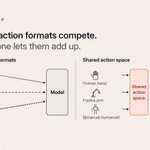




This is the problem we're building P37 Neuro around.
We come at it from the body side. Each robot is described as structured data: its joints, limits, actuators, sensors and kinematics. A high-level policy outputs the task as intent that isn't tied to one body, like reach or grasp. A separate low-level policy turns that intent into motor commands for the specific robot.
The goal is that a new robot body shouldn't automatically need a new model.

Where it stands: the software platform is implemented and tested, including a trainable baseline model built to handle robots with different body structures. The current work is training at scale and testing on robot bodies the model never saw in training. We don't have those results yet, and held-out bodies are the test we'll hold it to.


Ontos retweeted
We've made another significant step forward with P37 Neuro.
The latest version brings task intelligence and fast motor control together, allowing the system to reason about what needs to happen next while a faster, body-specific policy handles the physical movement.
Getting these two levels of intelligence to work together has been a major part of our engineering work at @OntosWorld.
We're getting closer to the kind of robot intelligence we've been building toward: one that can understand a task and translate that understanding into physical action across different machines.
Ontos retweeted

Machines get paid once the work is proven.
@sedaprotocol handles verification for @OntosWorld , whose stack settles payments on @peaq.
Live on testnet today.
Verified work is the plumbing.

Ontos retweeted
I want developers to be able to take what they've built for one robot and bring as much of it as possible to another.
We've spent a considerable part of our work on P37 defining how different robots connect to the same intelligence system.
That means accounting for their actual hardware, from joint mappings to sensor inputs and control limits.
The architecture is in place already. What matters now is testing how easily developers can bring in new machines without having to modify the core system.

ALT Robotics

P37 Neuro is designed to make robot software easier to use across different machines.
A robotic arm and a humanoid may have entirely different joints, sensors, and control systems, even when performing similar tasks.
We've developed a Robot Integration Kit that maps these hardware differences into a common software interface.
Developers can reuse more of their existing software when connecting new robots, while keeping each machine's physical limits and safety requirements intact.
The integration system is implemented. We're continuing to validate it across different robot configurations and physical hardware.

Ontos retweeted
A robot learns to grasp an object. Move the same policy to a different arm and it may fail. The task is unchanged, but the geometry, joints and motor limits are different.
Cross-embodiment learning addresses this problem by allowing learned skills to transfer across different robot bodies.
With P37 Neuro, we've built a system that represents each robot's physical structure and separates task reasoning from body-specific control.
This allows us to train and evaluate shared policies across different robot designs, reducing the need for separate models for every machine.
Our current work focuses on measuring how well these policies generalize to robot bodies excluded from training.
Ontos retweeted
Robot-2-Robot Markets are just one example of the global markets SEDA's infrastructure is now serving.
We're evolving from an oracle to necessary infrastructure for the merger of global markets onchain.
study: @OntosWorld + @peaq

“10 years from now, there could be well over 1 billion humanoid robots” — Elon Musk
SEDA= Verification layer for robotic tasks
@peaq= Blockchain for machines
Ontos= Machine understanding of physical environments
Ontos retweeted
Cross Embodiment training sets are coming to P37 Neuro today.
I won’t be active here for the whole day but will put you all up to speed.

Introducing P37 Neuro, our open-source robot brain at @OntosWorld.
For a while, we’ve been working on a question:
Can we build a robot brain that keeps working when the body or task changes?
P37 Neuro is part of our answer.
The system is designed to understand the body it controls, interpret the state of the robot and its environment, follow a task or demonstration, and turn that information into physical actions.
A new robot or task shouldn’t always require a completely new model.
P37 has an embodiment layer that represents the robot itself, high- and low-level policies for planning and control, and memory that carries context across actions and failures.
It also supports reinforcement learning, simulation in MuJoCo and Isaac Lab, and a C++ runtime that connects the learned policy to the physical machine.
Around the model, we’ve built the infrastructure for training, evaluation, safety, model releases, fleet feedback, and rollback.
The current software path covers P37-E0 through E6.
We’ve begun testing the ideas behind the system.
A shared model has been trained across different synthetic robot morphologies and evaluated on bodies it had never encountered during training.
We’ve also tested demonstration conditioning on unseen tasks, with no fine-tuning during evaluation.
For the memory tests, we gave the model information before a simulated failure, then compared its performance when that memory was preserved and when it was removed.

Ontos retweeted
Our product briefing page remains available for enterprises and developers exploring and building inference solutions for robotics and hardware applications.
You can also explore our open-source products and developer resources on our website, designed to support innovation and accelerate real-world AI deployment.

A robot navigating a crowded warehouse needs to account for more than the obstacles it can currently see. People move, pathways become blocked, and objects change position.
World models give robots a way to represent these environments and estimate how they might evolve over time.
Using observations from sensors and knowledge of physical dynamics, a world model can predict possible future states under different actions. A robot can use these predictions to evaluate a route, anticipate an interaction, or adjust its plan when conditions change.
For manipulation tasks, this could mean estimating how an object will move when pushed, whether a grasp will remain stable, or where an object might land.
These predictions are imperfect, particularly in unfamiliar environments. Robots need to continually update their understanding using real-world feedback.
Building reliable world models is an active area of robotics research, with implications for navigation, manipulation, and longer autonomous tasks.


A simple product scan can be the start of a verifiable record.
We built Ontos Verify to help developers connect physical-world activity with onchain verification.
A machine reads a barcode, QR code or NFC tag. The software collects the required evidence, and verification checks it against defined conditions, with the result linked to an onchain record.
Built for applications where machines need to prove what happened in the physical world.
