

Orby is fundamentally transforming the way enterprise teams perform, giving you the power to delegate tedious tasks to automation.
San Francisco Bay Area
Joined July 2022
- Tweets40
- Following59
- Followers372
- Likes42



Orby AI - A Uniphore Company retweeted

Uniphore has acquired Orby AI and intends to acquire Autonom8, two AI-native companies adding unmatched expertise and proven innovation to push the boundaries of Business AI. bit.ly/45CvRPp
#BusinessAI #AIAgents #LargeActionModels #EnterpriseAI #FutureOfAI

Orby AI - A Uniphore Company retweeted

🚀We’ve just dropped the ET30 2025 — our 7th annual list of the top private companies in enterprise tech.
This year, it’s all about AI-native products, agentic systems, and a resurgence in early-stage dealmaking. Proudly created in partnership with @EricNewcomer.
60 trailblazing startups. One epic list. 🔥 #ET30
Check out the full report → enterprisetech30.com/

Orby AI - A Uniphore Company retweeted

How AI Agents Are Starting To Automate the Enterprise | By @ricmac feat. @OrbyAI
thenewstack.io/how-ai-agents…

Orby AI - A Uniphore Company retweeted
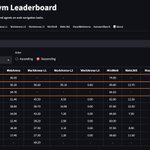
🚨 Big news! ActIO / UGround is officially #1 on the ScreenSpot GUI Grounding Benchmark, outperforming Google DeepMind, Anthropic, Salesforce, and OpenAI with an industry-leading 89.4% accuracy. 💪 #AI #GenAI #AIResearch #LAM #GUI #AIAgent

ALT Table showing ActIO / UGround achieving #1 performance on the GUI Grounding Benchmark (ScreenSpot), outperforming Google DeepMind, Anthropic, and OpenAI. The table ranks models by accuracy, with details for Rank, Release Date, Model, Developer, Developer Logo, and Accuracy. Top-ranked model ActIO / UGround by Orby/OSU scored 89.4%, followed by Aguvis (Salesforce) at 88.4%, and Project Mariner/Gemini (Google DeepMind) at 84.0%. Other developers include Anthropic, Shanghai AI Lab, Microsoft, and OpenAI, with accuracy ranging down to 16.2%.
Orby AI - A Uniphore Company retweeted

🚀 UGround accepted to #ICLR2025 [scores=10/8/8/5]! 🎉
We’re also thrilled to share some exciting updates:
✨ UGround is SOTA—again!
Using the exact same training data, our latest model achieved 89.4% accuracy on ScreenSpot, outperforming models from Google, Anthropic, Apple, and others.
Even more surprising? Without any desktop data, UGround also excels on ScreenSpot-Pro, a new challenging desktop benchmark. Incredible cross-platform generalization! 💪
We’ve also released models in 2B, 7B, and 72B, aiming to provide a strong foundation for further research.
📢 Try our secret sauce!
The highly effective training datasets we synthesized for UGround are now available for research use.
Additionally, we’ve provided a comprehensive evaluation suite packed with meaningful resources to help researchers test GUI Agents and grounding models with ease.
Since UGround's first release in August 2024, we’ve been blown away by the community’s enthusiasm. Our modular agent design, SeeAct-V, is now widely used—what an honor to contribute to the evolution of GUI Agents and see so many brilliant works emerge.
💡 Shoutouts:
- Deep gratitude to my amazing advisors, @ysu_nlp and @hhsun1 , for their unwavering guidance, and to my amazing collaborators, @demisama_ ,@boyuan__zheng , and @YihengShu .
- Huge thanks to @OrbyAI for their incredible support with infra, compute, and analysis. Special appreciation to Yanan Xie, Gang Li, Cheng Chang, and Yining Mao for their critical contributions.
Finally, thanks to the brilliant researchers from various groups for their insightful discussions and generous help! Let’s keep pushing the boundaries of GUI Agents together! 🚀

Orby AI - A Uniphore Company retweeted

In @OrbyAI's latest collaboration with the OSU NLP (@osunlp), 𝐖𝐞𝐛𝐃𝐫𝐞𝐚𝐦𝐞𝐫, we tackle this problem by leveraging #FoundationModels as world models for inference-time search. Specifically, we find that via clever prompting and task formulation, we can turn frontier models
3/n
Orby AI - A Uniphore Company retweeted

❓Wondering how to scale inference-time compute with advanced planning for language agents?
🙋♂️Short answer: Using your LLM as a world model
💡More detailed answer: Using GPT-4o to predict the outcome of actions on a website can deliver strong performance with improved safety and efficiency. (1/7)

Orby AI - A Uniphore Company retweeted

Congratulations to the finalists of the Databricks Generative AI Startup Challenge: @ChipStackAI, @orbyai, @vevo_ai and Flagler Health.
These startups are doing groundbreaking work to solve real-world customer problems. dbricks.co/4fN1JTI

Orby AI - A Uniphore Company retweeted

People into agents, let me pitch something to you:
🌟 An agent that works across every platform (web, desktop & mobile)
🌟 Visual perception only, no messy & often incomplete HTML or a11y tree
🌟 SOTA performance across 6 agent benchmarks
Sounds too good to be true? Continue ⬇️
🖥️ Human-like embodiment for digital agents
Most humans perceive the digital world visually and act via keyboards, mice, or touchscreens. In principle, the embodiment of a digital agent should already be complete if it can
1) visually perceive the GUI renderings, and
2) have effectors equivalent to a keyboard for typing and equivalent to a mouse or touchscreen for pixel-level operations like clicking and hovering.
However, existing agents, even those using multimodal LLMs, still require text-based representations (HTML/accessibility trees/etc.), which are noisy, often incomplete, and costly to obtain and encode, adding to latency and compromising user experience. Occam's razor tells us to seek a minimalist approach: visual observation only + pixel-level operations directly on the screen.
📌 Visual grounding was the blocker
In our SeeAct agent ('GPT-4V is a Generalist Web Agent, if Grounded' at ICML'24), which helped popularize multimodal agents, we have identified visual grounding as the key challenge. Multimodal LLMs like GPT-4o can often visually perceive a complex screenshot correctly and generate plausible textual plans (e.g., 'go back to the homepage') about what to do, but how to turn the textual plans into precise coordinates on the screen that an agent should act on (e.g., pixels corresponding to that house icon at the top left of the screen)? A few recent works have attempted this visual grounding problem, but the performance was far from practical use, which was blocking the development of digital agents with human-like embodiment.
📢 Introducing UGround, a universal grounding model for GUI agents
We need a universal visual grounding model that can:
- Generalize across platforms: different websites, desktop (Windows, Linux, macOS), mobile (Android, iOS), etc.
- Plug and play in different planning models (e.g., multimodal LLMs)
- Support diverse input image resolutions (up to 1-2k pixels, portrait & landscape) and referring expressions (visual, positional & functional)
We show that a simple recipe, which includes web-based synthetic data and a slight adaptation of the LLaVA architecture, is surprisingly effective for training such universal grounding models. Using our data synthesis pipeline, we construct a large grounding dataset with 10M (screenshot, referring expression, element coordinates) triplets and train UGround with a 7B LLaVA-like architecture.
💥SOTA in most comprehensive agent eval to date
While most existing agent work evaluates on 1-2 benchmarks, to show the universality of UGround, we evaluate on 6 agent benchmarks covering all major platforms and 3 different settings:
- GUI visual grounding (ScreenSpot)
- Offline agents (Multimodal-Mind2Web, AndroidControl & OmniAct)
- Online agents (Mind2Web-Live & AndroidWorld)
Using UGround, agents with human-like embodiment (visual perception only + pixel-level operations) achieve SOTA performance across the board, often outperforming prior SOTA by a large margin, despite prior work using additional text-based observations! These results make a strong case for human-like embodiment for GUI agents.
Another surprising finding: even though the training data is predominantly web-based (because the web has the richest metadata for synthesis), the model generalizes fairly strongly to desktop and mobile settings. This shows the shared design principles underlying different GUIs do exist and UGround can capture that.
Final remarks
We started working on this not too long after SeeAct. It actually didn't take long to get to SOTA performance on visual grounding (ScreenSpot), but what we really care about is to make the model useful in real agents, not just on grounding benchmarks. That took another few months of hard work. I'm glad that the final solution is still quite simple, elegant, and works like a charm.
This work is led by the amazing @BoyuGouNLP from @osunlp (can you believe this is just his 1st year in PhD?). @OrbyAI (Yanan, Cheng, Will, Peng, etc.) has been an invaluable collaborator on this: compute, eng support, research brainstorming, and incredible patience in tolerating my nitpicking that keeps delaying the release 😜

Orby AI - A Uniphore Company retweeted

Exclusive: NEA and Pear VC just led a $4.5 million seed investment in Orby, the AI that has thoughts about your job performance trib.al/kADFlbT
