

Founder & CIO @SargassoCap [email protected] {Prev: biotech, Chief of Staff to US Presidential Candidate, & @Yale alumnus}
Greenwich, CT
Joined March 2024
- Tweets569
- Following1.5K
- Followers2.3K
- Likes2.1K


Pinned Tweet
SpaceX printed $14.6 billion in Q3 revenue and $7.5 billion of it came from AI, yet most people still value it as a rocket company. The Super Intelligence segment is 1.7 gigawatts of compute plus Grok and Cursor, and it posted $431 million of profit even after a $1.2 billion one-time charge for the Cursor deal.
Elon on the earnings call, on where AI/SI actually gets stuck.
"People are starting to realize [that] the constraint on deployment of super intelligence is more in power and cooling and infrastructure than it is in chips."
"When we talk to the turbine suppliers, they tell us that the blades and vanes are 12 to 18 months behind the rest of the turbine ... So that means that we can bring power online 12 to 18 months faster than anyone else. That's the kind of advantage that's difficult to replicate."
SpaceX is casting those parts in house with the capability it built for rockets.


Elon named the shutoff. H100 spot rental is down about 57% from 2H23. Operators still depreciate servers over five to six years. The loan fails on the refinance date, not on demand. Recoverable value sits in energized megawatts. The GPUs mark like inventory.
Pretty much.
As of the past few weeks, debt markets have almost entirely shut off access to money for any company that doesn’t have substantial revenue independent of AI data centers.
SpaceX closed $40B of debt for GPUs, but we’re investment grade and have Starlink & launch revenue.
That means the 200+ neoclouds are going to see guppy-level death and consolidation. Some will make it through, but not many.


Private credit is underwriting the AI buildout against chips that age out fast. Someone ends up holding that risk when the cycle turns.

The Next Fannie Mae Is Made Of GPUs zerohedge.com/ai/next-fannie…

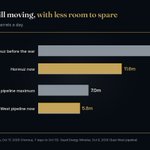
Most tankers crossing Hormuz now switch their trackers off. The oil is still getting out, about 11.6m barrels a day per Kpler, roughly two thirds of the 17m that flowed before the war.
The backup is a single Saudi pipeline across the desert to Yanbu on the Red Sea, pumping 5.8m b/d of its 7m maximum.
Today the Houthis claimed a strike on the Aramco facility at Yanbu, where that pipeline ends. So far the oil is still flowing, and Brent closed Friday at $116.72, up 6% on the week.
If that pipe holds, Saudi Arabia keeps cushioning the shock for everyone. If it breaks, there is no backup to the backup.


On SpaceX's Q3 call, @elonmusk's team said power, cooling and infrastructure now limit AI more than chips do, and SpaceX casts its own turbine blades because outside supply runs 12 to 18 months late.
The BLS data shows the same thing one layer down. Assembly costs, not the chips themselves, are the real bottleneck right now. +130% on loaded boards vs +1.8% on microprocessors tells you where the margin pressure (and opportunity) actually sits.
Is board assembly next on the list to bring in house?

Patrick F. Feeley retweeted
SpaceX printed $14.6 billion in Q3 revenue and $7.5 billion of it came from AI, yet most people still value it as a rocket company. The Super Intelligence segment is 1.7 gigawatts of compute plus Grok and Cursor, and it posted $431 million of profit even after a $1.2 billion one-time charge for the Cursor deal.
Elon on the earnings call, on where AI/SI actually gets stuck.
"People are starting to realize [that] the constraint on deployment of super intelligence is more in power and cooling and infrastructure than it is in chips."
"When we talk to the turbine suppliers, they tell us that the blades and vanes are 12 to 18 months behind the rest of the turbine ... So that means that we can bring power online 12 to 18 months faster than anyone else. That's the kind of advantage that's difficult to replicate."
SpaceX is casting those parts in house with the capability it built for rockets.
SpaceX is the most vertically integrated company out there, and I do not think it is even really close.
.@PFFeeley on SpaceX's Q3. Of $14.6 billion in revenue, $7.5 billion came from AI. On the call, SpaceX said power, cooling and infrastructure now limit super intelligence more than chips do. Turbine blades run 12 to 18 months behind, so it casts them in house.
Amazon CEO @ajassy tells @bhorowitz and @eriktorenberg that AWS capacity for 2026 is sold out, 2027 is largely sold out, and a good chunk of 2028 is gone. Jassy doesn't see the shortage of data centers, power and memory ending in 2027.
"There's only so much data center and power today. There's only so much memory, and I don't think that shortage ends in 2027. One of the reasons I think we can invest a lot more, and it wouldn't be a bad use of capital, is that 2026 is obviously sold out at this point. 2027 is largely sold out. We always leave a certain amount for on demand in our inference service Bedrock or EC2, but all the big chunks are largely sold out. A good chunk of 2028 is sold out.
There's so much demand. If you think about the AI business and what we call the core business, which is non-AI, they're both growing at really rapid rates right now. And if you only have a certain amount of memory, you have to decide how much of it you want to allocate to HBM for the AI accelerators versus DRAM for your core. So these are real tradeoffs you have to make.”
Amazon CEO @ajassy tells @bhorowitz and @eriktorenberg that AWS's AI business hit a $25 billion run rate in three years, several hundred times faster than AWS itself. Amazon is spending $220 billion on capex this year and still leaving demand on the table.
"We built a whole bunch of AI services that actually was a pretty good business for us on the AWS side, but nothing like what we're seeing right now. In the early days of AWS, we felt like we were growing really fast and we felt good about it. And we were about a $60 million annual run rate business after three years. In the first three years of this generative AI wave, our AI business in AWS is over $25 billion in run rate. So it's several hundred times faster. We just haven't seen anything like it.
And then the question becomes, how much capex do you want to invest to go after the opportunity? We've said this year in 2026, we expect to spend about $220 billion of capex. By the way, I remember being at a leadership team breakfast 15 years ago when we couldn't believe a telco company spent $50 billion in capex. We were like, how are they spending that much on capex? So these are kind of mind-blowing numbers.
And even spending $220 billion in capex this year, we're leaving a meaningful amount of demand on the table.”
.@8vc founder @JTLonsdale says AI is not a new god, it is the second industrial revolution. The last time productivity grew this fast, from 1870 to 1900, median income more than doubled in less than a generation.
"I was on the Zoom with Dario, who runs Anthropic, today. ... It's one of the top three labs. He's raising at $350 billion. And he's very, very worried.
I agree with him about some of the things he's worried about. What's not real, at least to me, is I don't think this is an existential thing that changes our entire civilization, where a lot of people think you've created a god, or that we will create a god in the next several years. A lot of people, especially in Silicon Valley, don't really have the same religious tradition that we have here more often in Texas. And so a lot of them, this has become their religion.
I think the right way to look at it as investors and as citizens is this is a very important industrial revolution. Productivity is definitely going to go up a lot. The last time productivity grew this fast was probably the second industrial revolution, which is 1870 to 1900. If you take a typical person in America, median income more than doubled in less than one generation. It was very, very good for America.
It was a lot of change. A lot of jobs that existed in the 1860s and 70s did not exist by 1900. We have our last names as Coopers or Smiths, but you don't have the jobs. That's going to be similar now. There's about $5 trillion today in wages in the services industries, and in $2 trillion worth of wages, already 40% of our entire service industry, we've seen examples of being able to double the productivity. In some cases triple or quadruple. We've already bought companies two years ago that we've already tripled their cash flow.
Productivity is 100% real. It's going to change a lot of things in a lot of positive ways, hopefully. ... I don't buy the whole existential thing."
More output from fewer people in the sector closest to AI. The St. Louis Fed says early sign, and I agree the direction is clear.
